MCQ
When a body moves with some friction on a surface
  • A
    It loses kinetic energy but momentum is constant
  • B
    It loses kinetic energy but gains potential energy
  • Kinetic energy and momentum both decrease
  • D
    Mechanical energy is conserved

Answer

Correct option: C.
Kinetic energy and momentum both decrease
c
(c) Friction is a non-conservative external force to the system, it decreases momentum and kinetic energy both.

Need a full question paper?

Generate a complete, print-ready paper with questions like this in minutes — across 16+ boards, with answer keys.

Start Generating Free

Similar questions

The $K.E.$ and $P.E.$ of a particle executing $SHM$ with amplitude $A$ will be equal when its displacement is
An air bubble of $1\, cm$ radius is rising at a steady rate of $2.00\, mm/sec$ through a liquid of density $1.5\, gm$ per $cm^3$. Neglect density of air. If $g$ is $1000\, cm/sec^2$, then the coefficient of viscosity of the liquid is
By sucking through a straw, a student can reduce the pressure in his lungs to $750\, mm\, of\, Hg$ (density $= 13.6\, gm/cm^3$). Using the straw, he can drink water from a glass upto a maximum depth of ....... $cm$
Where should be the centre of gravity of a body ?
Radius of the curved road on national highway is $R$. Width of the road is $b$. The outer edge of the road is raised by $h$ with respect to inner edge so that a car with velocity $v$ can pass safe over it. The value of $h$ is
A particle is projected from the ground at an angle of $\theta $ with the horizontal with an initial speed of $u$. Time after which velocity vector of the projectile is perpendicular to the initial velocity is
person trying to lose weight by burning fat lifts a mass of $10\ kg$ upto a height of $1\ m$ $1000$ times. Assume that the potential energy lost each time he lowers the mass is dissipated. How much fat will he use up considering the work done only when the weight is lifted up? Fat supplies $3.8 \times 10^7\ J$ of energy per kg which is converted to mechanical energy with a $20\%$ efficiency rate. Take $g=9.8$ $ms^{-2}$ 
Speed $v$ of a particle moving along a straight line, when it is at a distance $x$ from a fixed point on the line is given by $v^2 = 108 - 9x^2$ (all quantities in $S.I.$ unit). Then
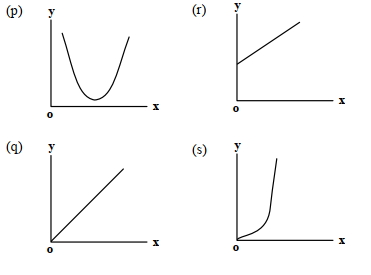
Column $I$ gives a list of possible set of parameters measured in some experiments. The variations of the parameters in the form of graphs are shown in Column $II$. Match the set of parameters given in Column $I$ with the graph given in Column $II$. Indicate your answer by darkening the appropriate bubbles of the $4 \times 4$ matrix given in the $ORS$.
Column $I$ Column $II$
$(A)$ Potential energy of a simple pendulum (y axis) as a function of displacement ( $\mathrm{x}$ axis) $Image$
$(B)$ Displacement (y axis) as a function of time (x axis) for a one dimensional motion at zero or constant acceleration when the body is moving along the positive $\mathrm{x}$-direction $Image$
$(C)$ Range of a projectile (y axis) as a function of its velocity ( $\mathrm{x}$ axis) when projected at a fixed angle $Image$
$(D)$ The square of the time period (y axis) of a simple pendulum as a function of its length ( $\mathrm{x}$ axis) $Image$

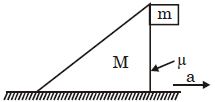
As shown in the figure, block m and wedge $M$ move together with a horizontal acceleration of $20\, m/s^2$. Given $m = 1\, kg$, $\mu = 0.6$ (between $m$ and $M$) and $g = 10\, m/s^2$. Choose the $CORRECT$ alternative :-