Question
When a car is at rest, its driver sees rain drops falling on it vertically. When driving the car with speed $v,$ he sees that rain drops are coming at an angle $60^{\circ}$ from the horizontal. On further increasing the speed of the car to $(1+\beta) v ,$ this angle changes to $45^{\circ} .$ The value of $\beta$ is close to$......$
Answer

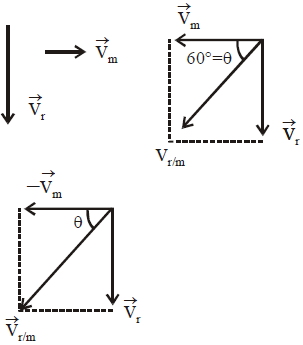
Rain is falling vertically downwards.

$\vec{v}_{r / m}=\vec{v}_{r}-\vec{v}_{m}$

$\tan 60^{\circ}=\frac{ V _{ r }}{ v _{ m }}=\sqrt{3}$

$v _{ r }= v _{ m } \sqrt{3}= v \sqrt{3}$

Now, $v _{ m }=(1+ B ) v$

and $\theta=45^{\circ}$

$\tan 45=\frac{ v _{ r }}{ v _{ m }}=1$

$v _{ r }= v _{ m }$

$v \sqrt{3}=(1+\beta) v$

$\sqrt{3}=1+\beta$

$\Rightarrow \beta=\sqrt{3}-1=0.73$

Need a full question paper?

Generate a complete, print-ready paper with questions like this in minutes — across 16+ boards, with answer keys.

Start Generating Free

Similar questions

A vehicle of mass $m$ is moving on a rough horizontal road with momentum $P$. If the coefficient of friction between the tyres and the road be $\mu$, then the stopping distance is
Which of the following gases when passed through warm dilute solution of ${H_2}S{O_4}$ in presence of $HgS{O_4}$ gives acetaldehyde
A particle of mass $m$ undergoes oscillations about $x=0$ in a potential given by $V(x)-\frac{1}{2} k x^2-V_0 \cos \left(\frac{x}{a}\right)$, where $V_0, k, a$ are constants. If the amplitude of oscillation is much smaller than $a$, the time period is given by
A linear aperture whose width is $0.02\,\, cm$ is placed immediately in front of a lens of focal length $60\,\, cm.$ The aperture is illuminated normally by a parallel beam of wavelength $5 \times 10^{-5}\,\, cm.$ The distance of the first dark band of the diffraction pattern from the centre of the screen is .....$cm$
Which of the following statement is true about magnetic moments of atoms of different elements
The magnetic moment $\left( \mu  \right)$ of a revolving electron around the nucleus varies with principal quantum number $n$ as
If a semiconductor photodiode can detect a photon with a maximum wavelength of $400\, nm ,$ then its band gap energy is

Planck's constant $h=6.63 \times 10^{-34}\, J . s$

Speed of ligh $c =3 \times 10^{8}\, m / s$

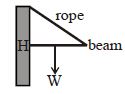
A uniform beam of weight $W$ is attached to a vertical wall by a hinge $H$ . The beam is held horizontal by a rope as shown below. Which one of the following best shows the direction of the reaction force $R$ at the hinge ?
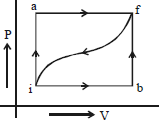
When a system is taken from a state $i$ to $f$ along the path $iaf$ (as shown in the figure). $Q = 50\, cal$ and $W = 20\, cal$ ; along path $ibf,$ $Q = 36\, cal.$

$(i)$ What is $W$ along path $ibf$ ?

$(ii)$ If $W = 13$ cal for path $fi$, what is $Q$ for the path $fi$ ?

$(iii)$ Take $E_{int,i} = 10\,\, cal$ then what is $E_{int,f}$ ?

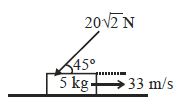
A block of mass $5\, kg$ is kept on a rough horizontal floor. It is given a velocity $33\, m/s$ towards right. A force of $20\sqrt {2\,} \,N$ continuously acts on the block as shown in the figure. If the coefficient of friction between block and floor is $0.5$ the velocity of block after $3\, seconds$ is ........ $m/s$  ($g = 10\, m/s^2$)