MCQ
When a ceiling fan is switched on, it makes $10 \,rotations$ in the first
$3 \,\sec.$ How many rotations will it make in the next $3 \,\sec$ (Assume uniform angular acceleration)
  • A
    $10$
  • B
    $20$
  • $30$
  • D
    $40$

Answer

Correct option: C.
$30$
c
In first three seconds, angle rotated $\theta=2 \pi \times 10 \mathrm{rad}$

Using, $\theta=\omega_{0} t+\frac{1}{2} \alpha t^{2}$

$\therefore 2 \pi \times 10=0+\frac{1}{2} \alpha \times 3^{2}=\frac{9}{2} \alpha \ldots(i)$

For the rotation of fan in next three second, the total time of revolutions

$=$$3+3=6 s$

Let total number of revolutions $=N$

Then angle of revolutions, $\theta^{\prime}=2 \pi \mathrm{N}$ rad

$\therefore 2 \pi N=0+\frac{1}{2} \alpha \times 6^{2}=18 \alpha$     $...(ii)$

Dividing $(ii)$ by $(i),$ we get

$N=40$

No. of revolutions in last three seconds

$=40-10=30$ revolutions

Need a full question paper?

Generate a complete, print-ready paper with questions like this in minutes — across 16+ boards, with answer keys.

Start Generating Free

Similar questions

The radius of a metal sphere at room temperature T is R, and the coefficient of linear expansion of the metal is $\alpha.$ The The sphere is heated a little by a temperature $\Delta\text{T}$ so that its new temperature is $\text{T}+\Delta\text{T}.$ The increase in the volume of the sphere is approximately:
Assume that the acceleration due to gravity on the surface of the moon is $0.2$ times the acceleration due to gravity on the surface of the earth. If ${R_e}$ is the maximum range of a projectile on the earth’s surface, what is the maximum range on the surface of the moon for the same velocity of projection
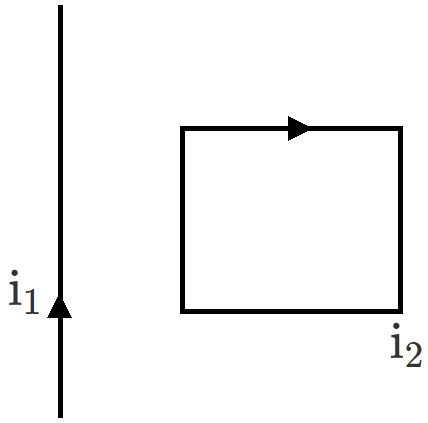
Consider the situation shown in figure. The straight wire is fixed but the loop can move under magnetic force. The loop will:

  1. Remain stationary.
  2. Move towards the wire.
  3. Move away from the wire.
  4. Rotate about the wire.
A car of mass $m$ when passes over top of convex bridge of radius of curvature $r,$ with a velocity $v,$ then the normal force exerted by the bridge on the car is 
A particle is thrown vertically upwards with a velocity of $4\,ms^{-1}$. The ratio of its accelerations after $1\,s$ and $2\,s$ of its motion is
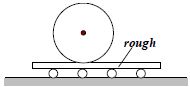
The plank in the figure moves a distance $100\ mm$ to the right while the centre of mass of the sphere of radius $150\, mm$ moves a distance $75\,mm$ to the left. The angular displacement of the sphere (in radian) is (there is no slipping anywhere) :-
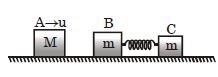
A block  $'A'$  of mass $M$ moving with speed $u$ collides elastically with block $B$ of mass $m$ which is connected to block $C$ of mass $m$ with a spring. When the compression in spring is maximum the velocity of block $C$ with respect to block $A$ is (neglect friction)
A wheel of radius 20cm is pushed to move it on a rough horizontal surface. It is found to move through a distance of 60cm on they road during the time it completes one revolution about the centre. Assume that the linear and the angular accelerations are uniform. The frictional force acting on the wheel by the surface is:
$Assertion$ : The earth without atmosphere would be inhospitably cold.
$Reason$ : All heat would escape in the absence of atmosphere.
A hollow sphere made of metal is filled with water and hung by a long thread. A tiny hole has been made in the bottom through which water slowly seeps out. Now if the sphere is made to oscillate, then its time period :