Question
When a charged particle moves in a magnetic field normally; what quantity changes the particle’s speed, particle’s energy, path of motion of the particle?

Answer

Path of motion changes.

Need a full question paper?

Generate a complete, print-ready paper with questions like this in minutes — across 16+ boards, with answer keys.
Start Generating Free

Similar questions

What are the factors which are considered for an electromagnet? Give an example.
When we place a gas cylinder on a van and the van moves, does the kinetic energy of the molecules increase? Does the temperature increase?
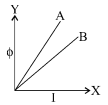
Graph between magnetic flux $\phi$ and electric current $I$ for two inductors $A$ and $B$ is given in the figure. The magnitude of self-inductance will be more for whom?
Image
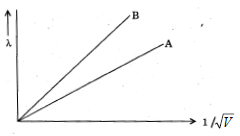
Two lines, A and B, in the plot given below show. the variation of de Broglie wavelength, $\lambda$ versus $1/\sqrt{\text{V}},$ where V is the accelerating potential difference, for two particles carrying the same charge. Which one of two represents a particle of smaller mass?

Write the value of electric flux due to a point charge located outside the surface of a sphere.
Which mirror does the driver use to see the traffic behind in motor vehicles and why?
The frequency of oscillation of the electric field vector of a certain electromagnetic wave is 5 × 10¹⁴Hz. What is the frequency of oscillation of the corresponding magnetic field vector and to which part of the electromagnetic spectrum does it belong?
In a semiconductor the concentration of electrons is 8 × 1013 cm–3 and that of holes is 5 × 1012 cm–3. Is it a p-type or n-type semiconductor?
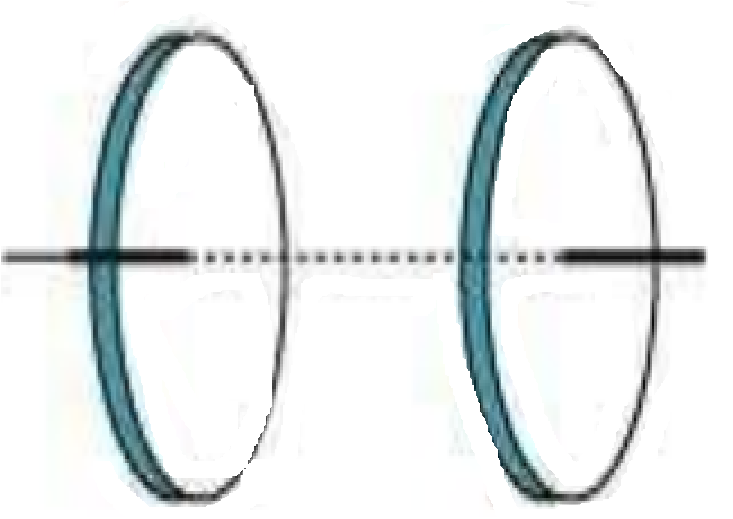
shows a capacitor made of two circular plates each of radius 12 cm, and separated by 5.0 cm. The capacitor is being charged by an external source (not shown in the figure). The charging current is constant and equal to 0.15A.
  1. Calculate the capacitance and the rate of charge of potential difference between the plates.
  2. Obtain the displacement current across the plates.
  3. Is Kirchhoff’s first rule (junction rule) valid at each plate of the capacitor? Explain.
​​​​​​​
Define the term conductivity of a conductor. On what factors does it depend?