Question
When a compass needle be placed at magnetic north pole, how would it behave? If a dip needle be placed at the place, how would it behave?

Answer

Compass needle stays in horizontal north-south direction. At poles horizontal component H = 0; therefore there will be no effect of earth’s field on magnetic north pole and it can stay in any direction; on the other hand a dip needle points along the resultant magnetic field and at poles the resultant field is vertical; hence the needle becomes vertical.

Need a full question paper?

Generate a complete, print-ready paper with questions like this in minutes — across 16+ boards, with answer keys.
Start Generating Free

Similar questions

Write the definition of wavefront. Using Huygens' principle, draw the shape of a plane wave incident on a convex lens and the refracted wave body.
###
(a) When a wave propagates from a rarer medium to a denser medium, then which characteristic of that wave does not change and why?
(b) The refractive indices of two mediums are $\mu_1$ and $\mu_2$, what will be the ratio of velocities in the wave in them?
An electron microscope uses electrons accelerated by a voltage of 50 kV. Determine the de-Broglie wavelength associated with the electrons. Taking other factors, such as numerical aperture etc. to be same, how does the resolving power of an electron microscope compare with that of an optical microscope which uses yellow light?
In a single slit diffraction experiment, a slit of width d is illuminated by red light of wavelength 650 nm. For what value of d will
i. the first minimum fall is at an angle of diffraction of 30°and
ii. the first maximum fall is at an angle of diffraction of 30°?
Consider a uniform electric field E = 3 × 10³ î N/C.
  1. What is the flux of this field through a square of 10 cm on a side whose plane is parallel to the yz plane?
  2. What is the flux through the same square if the normal to its plane makes a 60° angle with the x-axis?
Draw diagrams to depict the behaviour of magnetic field lines near a ‘bar’ of: (i) Copper (ii) Aluminium (iii) Mercury, cooled to a very low temperature (4.2K)
A hot gas emits radiation of wavelengths 46.0nm, 82.8nm and 103.5nm only. Assume that the atoms have only two excited states and the difference between consecutive energy levels decreases as energy is increased. Taking the energy of the highest energy state to be zero, find the energies of the ground state and the first excited state.
The voltage and current in a series AC circuit are given by, $\text{V}=\text{V}_0\cos\omega\text{t}$ and $\text{i}=\text{i}_0\sin\omega\text{t}.$ What is the power dissipated in the circuit?
  1. Show, with the help of a diagram, how unpolarised sunlight gets polarised due to scattering.
  2. Two polaroids P1 and P2 are placed with their pass axes perpendicular to each other. Unpolarised light of intensity Io is incident on P1. A third polaroid P3 is kept in between Pand P2 such that its pass axis makes an angle of $45^{\circ}$ with that of P1. Determine the intensity of light transmitted through P1, P2 and P3.
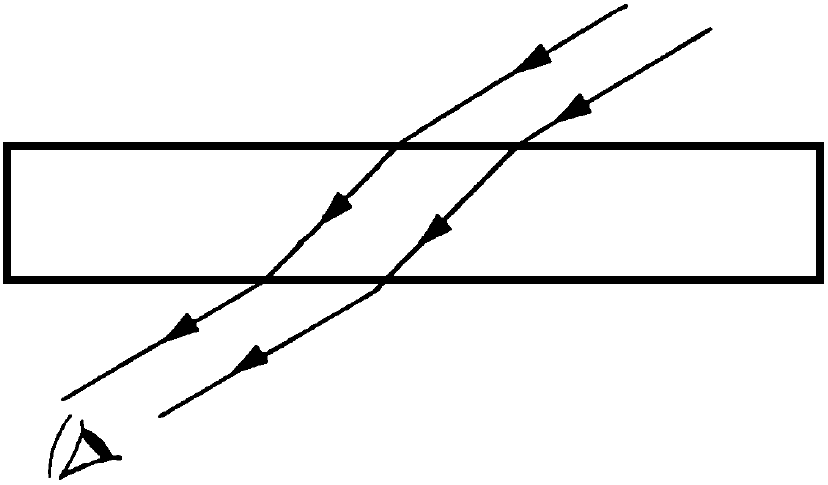
A narrow beam of light passes through a slab obliquely and is then received by an eye. The index of refraction of the material in the slab fluctuates slowly with time. How will it appear to the eye? The twinkling of stars has a similar explanation.