MCQ
When a conservative force does positive work on a body, then the
  • Potential energy of body decreases
  • B
    Potential energy of body increases
  • C
    Total mechanical energy of body increases
  • D
    Total mechanical energy of body decreases

Answer

Correct option: A.
Potential energy of body decreases
a
(a)

$F=\frac{-d U}{d x}$

$\int d U=-\int F d r$

$\Rightarrow U$ will decrease

Need a full question paper?

Generate a complete, print-ready paper with questions like this in minutes — across 16+ boards, with answer keys.
Start Generating Free

Similar questions

A proton has a mass $1.67 \times 10^{-27} \,kg$ and charge $+1.6 \times 10^{-19} \,C$. If the proton is accelerated through a potential difference of million volts, then the kinetic energy is ......... $J$
Sand is being dropped on a conveyer belt at the rate of $M \ kg/s.$ The force necessary to keep the belt moving with a constant velocity of $v\ m/s$ will be
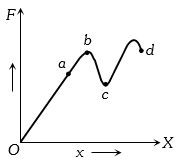
The graph is drawn between the applied force $F$ and the strain $(x)$ for a thin uniform wire. The wire behaves as a liquid in the part
A bomb of mass $12\,\,kg$  at rest explodes into two fragments of masses in the ratio $1 : 3.$  The $K.E.$  of the smaller fragment is $216\,\,J.$  The momentulm of heavier fragment is (in $kg-m/sec$ )
After $280$ days, the activity of a radioactive sample is $6000\, dps$. The activity reduces to $3000\, dps$ after another $140\, days$. The initial activity of the sample in dps is
The terminal velocity of a copper ball of radius $2.0 \;mm$ falling through a tank of oll at $20\,^{\circ} C$ is $6.5 \;cm s ^{-1} .$ Compute the viscosity of the oil at $20\,^{\circ} C .$ Density of oil is $1.5 \times 10^{3} \;kg m ^{-3},$ density of copper is $8.9 \times 10^{3} \;kg m ^{-3}$
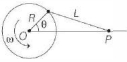
One end of a rod of length $L=1 \,m$ is fixed to a point on the circumference of a wheel of radius $R=1 / \sqrt{3} \,m$. The other end is sliding freely along a straight channel passing through the centre $O$ of the wheel as shown in the figure below. The wheel is rotating with a constant angular velocity $\omega$ about $O$. The speed of the sliding end $P$, when $\theta=60^{\circ}$ is
The mass and diameter of a planet are twice those of earth. The period of oscillation of pendulum on this planet will be (If it is a second's pendulum on earth)
$A$ cylinder is pure rolling up an incline plane. It stops momentarily and then rolls back. The force of friction
Light ray is incident on a prism of angle $A= 60^o$ and refractive index $\mu =\sqrt 2 $ The angle of incidence at which the emergent ray grazes the surface is given by .