Question
When a current in a circular loop is equivalently replaced by a magnetic dipole:
  1. The pole strength m of each pole is fixed.
  2. The distance d between the poles is fixed.
  3. The product md is fixed.
  4. None of the above.

Answer

  1. The product md is fixed.
Explanation:
When we replace a circular current-carrying loop with a magnetic dipole to resemble field lines of the circular loop, the pole strength m and the distance between the poles are not fixed.
But the magnetic dipole moment of both systems is always fixed. It is the product of the magnetic moment and the distance between the poles. In other words, md is fixed.
A current loop of area A and current I can be replaced with a magnetic dipole of dipole moment md.
i.e. md = IA

Need a full question paper?

Generate a complete, print-ready paper with questions like this in minutes — across 16+ boards, with answer keys.

Start Generating Free

Similar questions

In Boolean algebra A.B=Y implies the:
If a linear isotropic dielectric is placed in an electric field of strength E, then the polarization P is:
Joining of light nuclei of elements to form a heavy nucleus with the release of energy is called:
In electrolysis, if the duration of the passage of current is doubled, the mass liberated i(a) Doubled(b) Halved(c) Increased four times(d) Remains the same
       
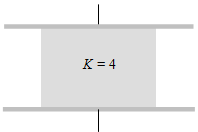
Consider a parallel plate capacitor of $10 \mu F\ ($micro$-$farad$)$ with air filled in the gap between the plates. Now one half of the space between the plates is filled with a dielectric of dielectric constant $4,$ as shown in the figure. The capacity of the capacitor changes to
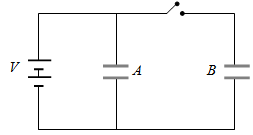
Figure given below shows two identical parallel plate capacitors connected to a battery with switch $S$ closed. The switch is now opened and the free space between the plate of capacitors is filled with a dielectric of dielectric constant $3$. What will be the ratio of total electrostatic energy stored in both capacitors before and after the introduction of the dielectric
.
The polarisation is measured in:
Magnetic lines of force:
An object may have:
  1. Varying speed without having varying velocity.
  2. Varying velocity without having varying speed.
  3. Nonzero acceleration without having varying velocity.
  4. Nonzero acceleration without having varying speed.
If potential  V = 100 ± 0.5 Volt and current I = 10  ± 0.2 amp are given to us.  Then what will be the value of resistance(a) 10 ± 0.7 ohm (b) 5 ± 2 ohm(c) 0.1 ± 0.2 ohm(d) None of these