Question

When a current passes through the junction of two different  metals, evolution or absorption of heat at the junction is known as

(a) Joule  effect

(b) Seebeck effect

(c) Peltier effect

(d) Thomson effect

Answer

(c) Peltier effect

Need a full question paper?

Generate a complete, print-ready paper with questions like this in minutes — across 16+ boards, with answer keys.

Start Generating Free

Similar questions

The largest distance between the interatomic planes of a crystal is 10-7cm. The upper limit for the wavelength of X-rays which can be usefully studied with this crystal is

(a) 1 Å

(b) 2 Å

(c) 10 Å

(d) 20 Å

When an atomic gas or vapour is excited at low pressure, by passing an electric current through it then?
According to Bohr's Model, which is not possible energy value of emitted photon by hydrogen atom :
For nuclei with A > 100:
  1. The binding energy of the nucleus decreases on an average as A increases.
  2. The binding energy per nucleon decreases on an average as A increases.
  3. If the nucleus breaks into two roughly equal parts, energy is released.
  4. If two nuclei fuse to form a bigger nucleus, energy is released.
Which of the following is not correct about relative magnetic permeability $(\mu,)$

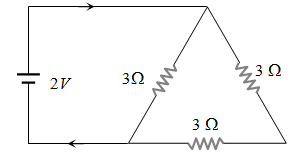
The current in the following circuit is

(a)  

(b)

(c)  

(d) 1A

In a common base amplifier circuit, calculate the change in base current if that in the emitter current is 2 mA and a = 0.98

(a) 0.04 mA

(b) 1.96 mA

(c) 0.98 mA

(d) 2 mA

The maximum electric field that a dielectric medium can withstand without break-down is called its:

What type of modulation is employed in India for radio transmission

(a) Amplitude modulation

(b) Frequency modulation

(c) Pulse modulation

(d) None of these

In nuclear fission, the fission reactions proceeds with a projectile. Which of the following suits the best

(a) Slow proton

(b) Fast neutron

(c) Slow neutron

(d) None of these