Question
When a ferromagnetic material goes through a hysteresis loop, its thermal energy is increased. Where does this energy come from?

Answer

When a ferromagnetic material is taken through the cycle of magnetisation, magnet dipoles of the material orient and reorient with time. This molecular motion within the material results in the production of heat, which increses thermal energy of material.

Need a full question paper?

Generate a complete, print-ready paper with questions like this in minutes — across 16+ boards, with answer keys.
Start Generating Free

Similar questions

By analogy to Gauss's law of electrostatics, we can write Gauss's law of magnetism as $\oint\vec{\text{B}}.\text{d}\vec{\text{v}}=\mu_0\text{m}_{\text{inside}}$ where $\oint\vec{\text{B}}.\text{d}\vec{\text{s}}$ is the magnetic flux and $\text{m}_{\text{inside}}$ is the net pole strength inside the closed surface. We do not have an isolated magnetic pole in nature. At least none has been found to exist till date. The smallest unit of the source of magnetic field is a magnetic dipole where the net magnetic pole is zero. Hence, the net magnetic pole enclosed by any closed surface is always zero. Correspondingly, the flux of the magnetic field through any closed surface is zero.
  1. Consider the two idealised systems
  1. a parallel plate capacitor with large plates and small separation and
  2. a long solenoid of length L >> R, radius of cross-section.
(In) (i) $\vec{\text{E}}$ is ideally treated as a constant between plates and zero outside. In (ii) Magnetic field is constant inside the solenoid and zero outside. These idealised assumptions, however, contradict fundamental laws as below
  1. Case (i) contradicts Gauss's law for electrostatic fields.
  2. Case (ii) contradicts Gauss's law for magnetic fields.
  3. Case (i) agrees with $\oint\vec{\text{E}}.\text{d}\vec{\text{l}}=0$
  4. Case (ii) contradicts $\oint\vec{\text{H}}.\text{d}\vec{\text{l}}=\text{l}_{\text{en}}.$
  1. The angle between the true geographic north and the north shown by a compass needle is called as:
  1. $\text{Zero}$
  2. $\frac{\mu_0}{4\pi}$
  3. $4\pi\mu_0$
  4. $\frac{4\mu_0}{\pi}$
  1. A closed surface S encloses a magnetic dipole of magnetic moment 2ml. The magnetic flux emerging from the surface is:
  1. $\mu_0\text{m}$
  2. $\text{Zero}$
  3. $2\mu_0\text{m}$
  4. $\frac{2\text{m}}{\mu _0}$
  1. Which of the following is not a consequence of Gauss's law?
  1. The magnetic poles always exist as unlike pairs of equal strength.
  2. If several magnetic lines of force enter in a closed surface, then an equal number of lines of force must leave that surface.
  3. There are abundant sources or sinks of the magnetic field inside a closed surface.
  4. Isolated magnetic poles do not exist.
  1. The surface integral of a magnetic field over a surface:
  1. Is proportional to mass enclosed.
  2. Is proportional to charge enclosed.
  3. S zero.
  4. Equal to its magnetic flux through that surface.
TV signals broadcast by Delhi studio cannot be directly received at Patna which is about 1000km away. But the same signal goes some 36000km away to a satellite, gets reflected and is then received at Patna. Explain.
A container contains water upto a height of 20cm and there is a point source at the centre of the bottom of the container. A rubber ring of radius r floats centrally on the water. The ceiling of the room is 2.0m above the water surface.
  1. Find the radius of the shadow of the ring formed on the ceiling if r = 15cm.
  2. Find the maximum value of r for which the shadow of the ring is formed on the ceiling. Refractive index of water $\frac{4}{3}.$
The absolute temperature of air in a region linearly increases from $T_1$ to $T_2$ in a space of width d. Find the time taken by a sound wave to go through the region in terms of $T_1, T_2,$ d and the speed v of sound at 273K. Evaluate this time for $T_1 = 280K, T_2 = 310K, d = 33m$ and $v = 330m/s.$
Photoelectric effect is the phenomenon of emission of electrons from a metal surface, when radiations of suitable frequency fall on them. The emitted electrons are called photoelectrons and the current so produced is called photoelectric current.
  1. With the increase of intensity of incident radiations on photoelectrons emitted by a photo tube, the number of photoelectrons emitted per unit time is:
  1. Increases.
  2. Decreases.
  3. Remains same.
  4. None of these.
  1. It is observed that photoelectron emission stops at a certain time t after the light source is switched on. The stopping potential (V) can be represented as:
  1. $2(KE_{max}/e)$
  2. $(KE_{max}/e)$
  3. $(KE_{max}/3e)$
  4. $(KE_{max}/2e)$
  1. A point source of light of power $3.2 \times 10^{-3} W$ emits monoenergetic photons of energy 5.0eV and work function 3.0eV. The efficiency of photoelectron emission is 1 for every $10^6$ ncident photons. Assume that photoelectrons are instantaneously swept away after emission. The maximum kinetic energy of photon is:
  1. 4eV
  2. 5eV
  3. 2eV
  4. Zero
  1. Which of the following device is the application of Photoelectric effect?
  1. Light emitting diode.
  2. Diode.
  3. Photocell.
  4. Transistor.
  1. If the frequency of incident light falling on a photosensitive metal is doubled, the kinetic energy of the emitted photoelectron is:
  1. Unchanged.
  2. Halved.
  3. Doubled.
  4. More than twice its initial value.
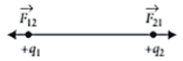
Coulomb's law states that the electrostatic force of attraction or repulsion acting between two stationary point charges is given by
Image

where $F$ denotes the force between two charges $q _1$ and $q _2$ separated by a distance $r$ in free space, $\varepsilon_0$ is a constant known as the permittivity of free space. Free space is a vacuum and may be taken to be air practically. If free space is replaced by a medium, then $\varepsilon_0$ is replaced by $\left(\varepsilon_0 k\right)$ or $\left(\varepsilon_0 \varepsilon_r\right)$ where $k$ is known as dielectric constant or relative permittivity.
$(i)$ In coulomb's law, $F =k \frac{q_1 q_2}{r^2}$, then on which of the following factors does the proportionality constant $k$ depends?
$(a)$ Nature of the medium between the two charges
$(b)$ Distance between the two charges
$(c)$ Electrostatic force acting between the two charges
$(d)$ Magnitude of the two charges
$(ii)$ Dimensional formula for the permittivity constant $\varepsilon_0$ of free space is
$(a) \left[ M ^{-1} L^3 T^2 A^2\right]$
$(b) \left[ ML ^{-3} T^4 A^2\right]$
$(c) \left[ M ^{-1} L^{-3} T^4 A^2\right]$
$(d) \left[ ML ^{-3} T^4 A^{-2}\right]$
$(iii)$ The force of repulsion between two charges of $1 C$ each, kept $1m$ apart in vaccum is
$(a) \frac{1}{9 \times 10^9} N$
$(b) \frac{1}{9 \times 10^{12}} N$
$(c) 9 \times 10^7 N$
$(d) 9 \times 10^9 N$
$(iv)$ Two identical charges repel each other with a force equal to $10$ mgwt when they are $0.6 m$ apart in air.
$(g =10 m s ^{-2} ).$ The value of each charge is
$(a) 2 mC$
$(b) 2 \times 10^{-7} mC$
$(c) 2 \mu C$
$(d) 2 nC$
OR
Coulomb's law for the force between electric charges most closely resembles with
$(a)$ law of conservation of energy
$(b)$ Newton's $2^{nd}$ law of motion
$(c)$ law of conservation of charge .
$(d)$ Newton's law of gravitation
When white radiation is passed through a sample of hydrogen gas at room temperature, absorption lines are observed in Lyman series only. Explain.
A ladder is resting with one end on a vertical wall and the other end on a horizontal floor. Is it more likely to slip when a man stands near the bottom or near the top?
Derive the formula for the magnetic field produced at a point on the axis of a current carrying circular loop.
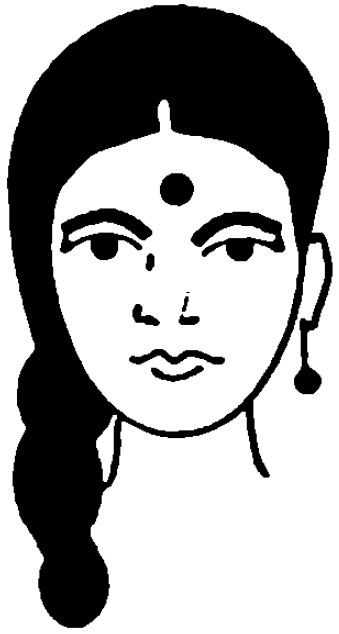
The ear-ring of a lady shown in has a 3cm long light suspension wire.
  1. Find the time period of small oscillations if the lady is standing on the ground.
  2. The lady now sits in a merry-go-round moving at 4m/s in a circle of radius 2m. Find the time period of small oscillations of the ear-ring.