Question
When a ferromagnetic material goes through a hysteresis loop, the magnetic susceptibility:
  1. Has a fixed value.
  2. May be zero.
  3. May be infinity.
  4. May be negative.

Answer

  1. May be zero.
  2. May be infinity.
  3. May be negative.

Explanation:

When a ferromagnetic material goes through a Hysteresis loop, the Magnetic susceptibility may be zero, may be infinity or may be negative.

Need a full question paper?

Generate a complete, print-ready paper with questions like this in minutes — across 16+ boards, with answer keys.

Start Generating Free

Similar questions

Bohr’s atom model is the modification of Rutherford’s atom model by the application of:
As compared to 12C atom, 14C atom has:
A long, straight wire carries a current i. The magnetizing field intensity H is measured at a point P close to the wire. A long, cylindrical iron rod is brought close to the wire so that the point P is at the centre the rod. The value of H at P will:
  1. Increase many times.
  2. Decrease many times
  3. Remain almost constant.
  4. Become zero.

The electric field due to a dipole at a distance r  on its axis is

(a) Directly proportional to  

(b) Inversely proportional to  

(c) Directly proportional to  

(d) Inversely proportional to  

An EM wave of intensity I falls on a surface kept in vacuum and exerts radiation pressure p on it. Which of the following are true?
Which of the following is the radio isotope in this pair?$30\text{​P}\\ \ 15$,$32\text{​P}\\ \ 15$
The work done by the external forces on a system equals the change in:
  1. Total energy.
  2. Kinetic energy.
  3. Potential energy.
  4. None of these.

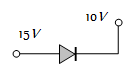
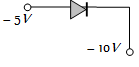
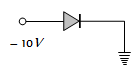
Which one is reverse-biased

(a)

(b)

(c)

(d)

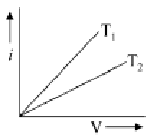
In the given figure, V-i graph of a conductor at two different temperatures is shown. If resistances corresponding to these temperatures are $R_1$ and $R _2$ respectively, then which of the following statement is correct ?
Image
Which of the following sets cannot enter into the list of fundamental quantities in any system of units?
  1. Length, mass and velocity.
  2. Length, time and velocity.
  3. Mass, time and velocity.
  4. Length, time and mass.