Question
When a ferromagnetic material goes through a hysteresis loop, the magnetic susceptibility:
  1. Has a fixed value.
  2. May be zero.
  3. May be infinity.
  4. May be negative.

Answer

  1. May be zero.
  2. May be infinity.
  3. May be negative.

Explanation:

When a ferromagnetic material goes through a Hysteresis loop, the Magnetic susceptibility may be zero, may be infinity or may be negative.

Need a full question paper?

Generate a complete, print-ready paper with questions like this in minutes — across 16+ boards, with answer keys.
Start Generating Free

Similar questions

A diatomic gas, having $C_{p}=\frac{7}{2} R$ and $C _{ v }=\frac{5}{2} R ,$ is heated at constant pressure. The ratio $dU : dQ : dW :$
Alarge tank is filled with water to a height $H$.A small hole is made at the base of the tank. It takes $T_1$ time to decrease the height of water to $H/ \eta , (\eta > 1)$ and it takes $T_2$ time to take out the rest of water. If $T_1 = T_2$ , then the value of $\eta$ is :
The temperature at which the vapour pressure of a liquid becomes equals to the external (atmospheric) pressure is its
The upper end of a wire of diameter $12\,mm$ and length $1\,m$ is clamped and its other end is twisted through an angle of $30^{\circ}$. The angle of shear is$........^{\circ}$
$N$ moles of an ideal diatomic gas are in a cylinder at temperature $T$. suppose on supplying heat to the gas, its temperature remain constant but $n$ moles get dissociated into atoms. Heat supplied to the gas is
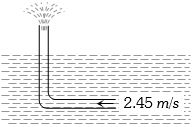
An $ L-$ shaped tube with a small orifice is held in a water stream as shown in fig. The upper end of the tube is $ 10.6 cm$  above the surface of water. ....... $cm$ will be the height of the jet of water coming from the orifice ? Velocity of water stream is $2.45 m/s$ 
A monkey of mass $20\,kg$ is holding a vertical rope. The rope will not break when a mass of $25\, kg$ is suspended from it but will break if the mass exceeds $25 \,kg$. What is the maximum acceleration with which the monkey can climb up along the rope ............ $m/{s^2}$ $(g = 10\,m/{s^2})$
Which one of the following statements is true for the speed $v$ and the acceleration $a$ of a particle executing simple harmonic motion
When a wire is compressed, the potential energy of its molecules:
A liquid drop of radius R is broken up into N small droplets. The work done is proportional to( take $N^{\frac{1}{3}}>>1$ ).