MCQ
When a forward bias is applied to a $p-n$ junction, it
  • A
    Raises the potential barrier
  • B
    Reduce the majority carrier current to zero
  • Lower the potential barrier
  • D
    None of the above

Answer

Correct option: C.
Lower the potential barrier
c
When forward bias is applied to a $p-n$ junction, it lower the values of potential barrier. In the case of forward bias, the potential barrier is opposed by the applied voltage. Hence, the potential barrier across the junction gets reduced.

Need a full question paper?

Generate a complete, print-ready paper with questions like this in minutes — across 16+ boards, with answer keys.

Start Generating Free

Similar questions

Assertion : An induced current has a direction such that the magnetic field due to the current opposes the change in the magnetic flux that induces the current.

Reason : Above statement is in accordance with conservation of energy
The critical angle between an equilateral prism and air is $45^o $. If the incident ray is perpendicular to the refracting surface, then
Two planets $A$ and $B$ having masses $m_1$ and $m_2$ move around the sun in circular orbits of $r_1$ and $r_2$ radii respectively. If angular momentum of $\mathrm{A}$ is $\mathrm{L}$ and that of $B$ is $3L$, the ratio of time period $\left(\frac{T_A}{T_B}\right)$ is:
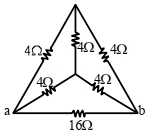
The equivalent resistance of the circuit shown below between points $a$ and $b$ is $..........\Omega$
The half life period of a radioactive substance is $5\, min$. The amount of substance decayed in $20\, min$ will be..........$\%$
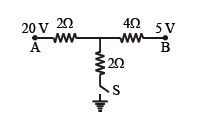
As the switch $S$ is closed in the circuit shown in figure, current passing through it is ................ $\mathrm{A}$
Find the approx. number of molecules contained in a vessel of volume $7$ litres at $0^oC$ at $1.3 \times 10^5$ pascal
The displacement of a particle is represented by the equation $y = sin^3\,\,\,\omega t$ . The motion is
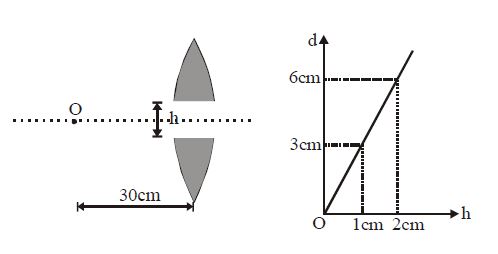
Figures shows a convex lens cut symmetrically into two equal halves and separated laterally by a distance $h.$ A point object placed at a distance $30\, cm,$ from the lens halves, forms two real images separated by a distance $d$. A plot of $d$ versus $h$ is shown in figure. The focal length of the lens is ......$cm$
An aircraft with a wing-span of $40\, m$ flies with a speed of $1080\, km\, h^{-1}$ in the eastward direction at a constant altitude in the northern hemisphere, where the vertical component of earth's magnetic field is $1.75 \times 10^{-5} T$. Then the emf that develops between the tips of the wings is.......$V$