MCQ
When a forward bias is applied to a $p-n$ junction, it
  • A
    Raises the potential barrier
  • B
    Reduce the majority carrier current to zero
  • Lower the potential barrier
  • D
    None of the above

Answer

Correct option: C.
Lower the potential barrier
c
When forward bias is applied to a $p-n$ junction, it lower the values of potential barrier. In the case of forward bias, the potential barrier is opposed by the applied voltage. Hence, the potential barrier across the junction gets reduced.

Need a full question paper?

Generate a complete, print-ready paper with questions like this in minutes — across 16+ boards, with answer keys.

Start Generating Free

Similar questions

Match the List I with the List II from the combination shown. In the left side (List I) there are four different conditions and in the right side (List II), there are ratios of heat produced in each resistance for each condition :
List I List II
(I) Two wires of same resistance are connected in series and same current is passed through them (A) 1 : 2
(II) Two wires of resistance R and 2R ohm are connected in series and same P.D. is applied across them (B) 4 : 1
(III) Two wires of same resistance are connected in parallel and same current is flowing through them (C) 1 : 1
(IV) Two wires of resistances in the ratio 1 : 2 are connected in parallel and same P.D. is applied across them (D) 2 : 1
A current is flowing through a thin cylindrical shell of radius $R$. If energy density in the medium, due to magnetic field, at a distance $r$ from axis of the shell is equal to $U$ then which of the following graphs is correct
When photons of energy $hf$ fall on an aluminium plate (of work function $ E_0$), photoelectrons of maximum kinetic energy $K$ are ejected. If the frequency of radiation is doubled, the maximum kinetic energy of the ejected photoelectrons will be 
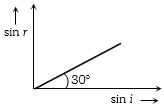
When light is incident on a medium at angle i and refracted into a second medium at an angle $ r$, the graph of $sin\, i $ vs $sin\,r $ is as shown in the graph. From this, one can conclude that
The angle of incidence for a ray of light at a refracting surface of a prism is $45^o  $. The angle of prism is $60^o $ . If the ray suffers minimum deviation through the prism, the angle of minimum deviation and refractive index of the material of the prism respectively, are 
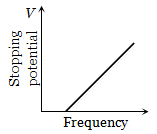
In the graph given below. If the slope is $4.12 \times 10^{-15}$ V-sec, then value of ‘h’ should be
Work done by magnetic field of $1\,tesla$ on a particle of chargs $1\,C$ moving with speed $5\,m/s$ in one second........$J$
A parallel beam of fast moving electrons is incident normally on a narrow slit. A fluorescent screen is placed at a large distance from the slit. if the speed of the electrons is increased , which of the following statements is correct?
When an object possess electric charge then the object is said to be:
A double charged lithium atom is equivalent to hydrogen whose atomic number is 3. The wavelength of required radiation for emitting electron from first to third Bohr orbit in $Li^{++}$ will be (Ionisation energy of hydrogen atom is 13.6eV)