Question
When a gun is fired at a distance, why is it that the flash is seen almost instantaneously while the sound is heard a little later?

Answer

The reason is that the speed of light in air is $3 \times 10^8 ms^{-1}$ which is much larger as compared to the speed of sound in air $3 \times$ $10^2 ms^{-1}$. Hence light takes almost negligible time in comparison to sound in reaching us from the gun.

Need a full question paper?

Generate a complete, print-ready paper with questions like this in minutes — across 16+ boards, with answer keys.
Start Generating Free

Similar questions

(i) (a) Name the kind of reactions taking place :
(i) In the star
(ii) In muclear reactor
(iii) In our body.
(b) When an alpha particle gains two clectrons it becomes neutral and becomes an atom of an element which is rare gas. What is the name of this rare gas?
(ii) State three precautions in the handling of radioactive substances.
(iii) (a) Define radionctivity.
(b) What happens inside the mucleus that causes the emission of a beta particle?
(c) Express the above change in the form of an equation.
Why does weather become pleasant when it starts freezing in cold countries?
Name the type of single pulley that can act as a force multiplier. Draw a labelled diagram of the pulley mentioned by you.
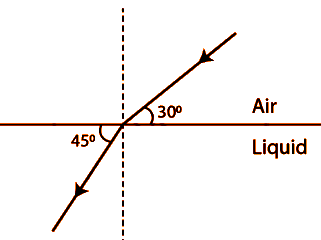
The diagram alongside shows the refraction of a ray of light from air to a liquid.

  1. Write the values of (i) angle of incidence, (ii) angle of refraction.
  2. Use Snell’s law to find the refractive index of liquid with respect to air.

Define the term radioactivity. Of the three normally occurring radioactive radiations:
(a) Which has a positive charge?
(b) Which is most penetrating?
(c) Which has no electric charge?
Comment on the statement ‘loudness of sound is a subjective quantity, while intensity is an objective quantity.
State Faraday’s law of electromagnetic induction.
A lever of length 9 cm has its load arm 5 cm long and the effort arm is 9 cm long.
Draw diagram of the lever showing the position of fulcrum F and directions of both the load L and effort E.
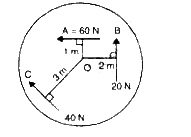
Three forces A, B and C are acting on a rigid body which can turn about O in fig.9. If all the three forces are applied simultaneously, in which direction will the body move? Explain.
State the principle of reversibility of light.