Question
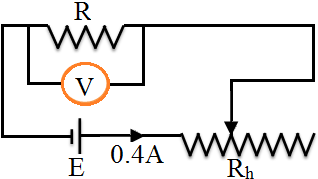
When a high resistance voltmeter is connected directly across a resister its reading is 2V. An electric cell is sending the current of 0.4 A, (measured by an ammeter) in the electric circuit
in which a rheostat is also connected to vary the current.
  1. Draw an equivalent labelled circuit for the given data.
  2. Find the resistance of the resister.
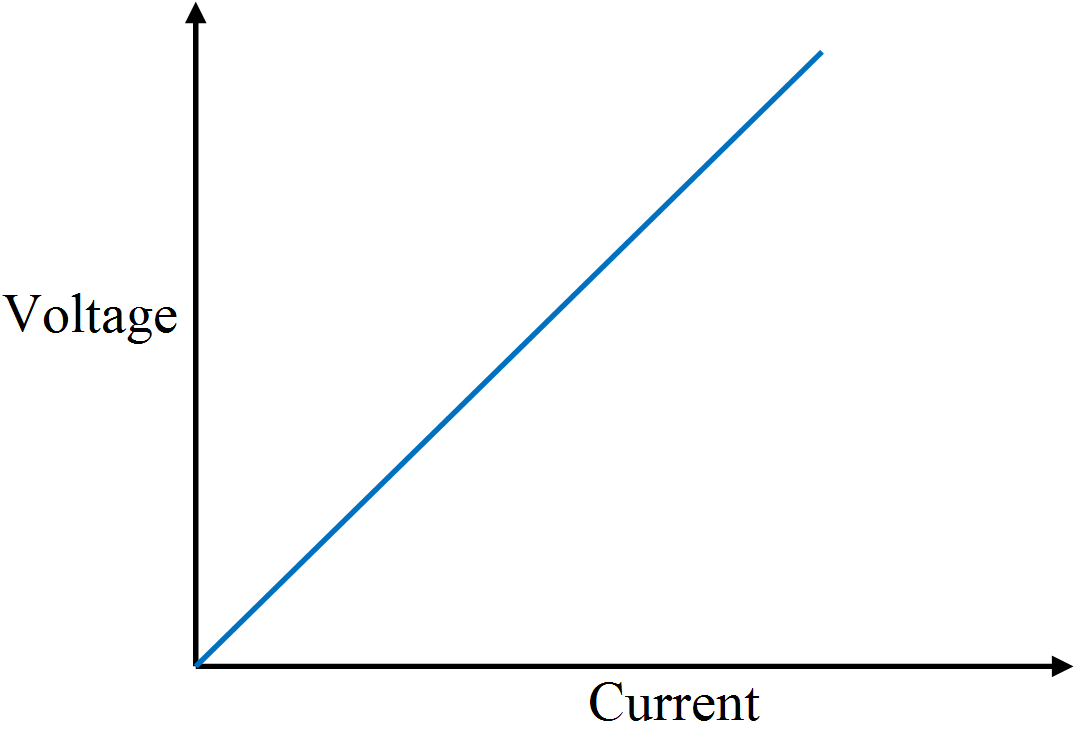
  3. Name and state the law applicable in the given case. A graph is drawn between a set of values of potential difference (v) across the resister and current (I) flowing through it.
Show nature of graph thus obtained.

Answer

  1. .​
  2. Voltmeter reading shows, V = 2 V
Since, $\text{R} =\frac {\text{V}}{\text{I}} = \frac{2}{0.4}=5\Omega$
  1. The law applicable here is the Ohm’s law.
Ohm’s law states that the current flowing through a conductor is directly proportional to the potential difference across the conductor. The proportionality constant is the

resistance of the conductor, it is a constant for a known temperature range.


The graph obtained is a straight line with positive slope.

Need a full question paper?

Generate a complete, print-ready paper with questions like this in minutes — across 16+ boards, with answer keys.

Start Generating Free

Similar questions

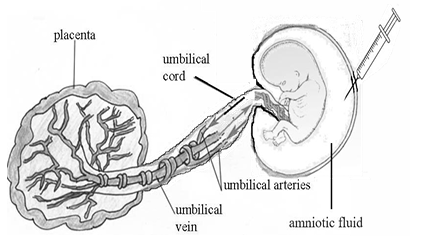
The image below shows a developing fetus in the mother's womb. The developing fetus is connected to the placenta by means of umbilical cord. The Umbilical vein and artery run inside the umbilical cord.
Image

(i) Name two substance that moves through the blood vessels. (1)
(ii) If the placenta has less villi how will it affect the baby's growth? (1)
(iii) Name the region where the embryo develops inside the female body. Explain how this region is adapted for nourishing the baby. (1)
(iv) Some of the fetal cells fall off into the amniotic fluid and can be collected by careful procedure. The cells were screened and found to contain XY chromosome. (2)
(a) What is the sex of the foetus?
(b) How is this prenatal sex determination misused?
State five uses of metals and five of non-metals.
What is the role of the Peripheral Nervous System (PNS)?
The image of a candle flame placed at a distance of 30cm from a spherical lens is formed on a screen placed on the other side of the lens at a distance of 60cm from the optical centre of the lens. Identify the type of lens and calculate its focal length. If the height of the flame is 3cm, find the height of its image.
Name two bacterial diseases which are sexually transmitted. Name their causal organisms, symptoms and preventive measures.
  1. What is scattering of light? Explain how the colour of the scattered light depends on the size of the scattering particles.
  2. Explain the reddish appearance of the Sun at sunrise or sunset. Why does it not appear red at noon?
Draw a labelled diagram of the human male reproductive system. With the help of this diagram, describe the working of human male reproductive system?
Consider the following chemical reactions which take place in different organisms/ tissues under various conditions:
  1. Glucose → Respiration → Respiration Ethanol + Carbon-dioxide + Energy.
  2. Glucose → Respiration → Respiration Carbon-dioxide + Water + Energy.
  3. Glucose → Respiration → Respiration Lactic acid + Energy.
  1. Name one organism which respires according to equation (i) above.
  2. Name one organism which respires according to equation (ii) above.
  3. When and where does respiration represented by equation (iii) above take place?
  4. Which equation/ equations represent aerobic respiration?
  5. Which equation/ equations represent anaerobic respiration?
  6. Which of the above reactions produces the maximum amount of energy?
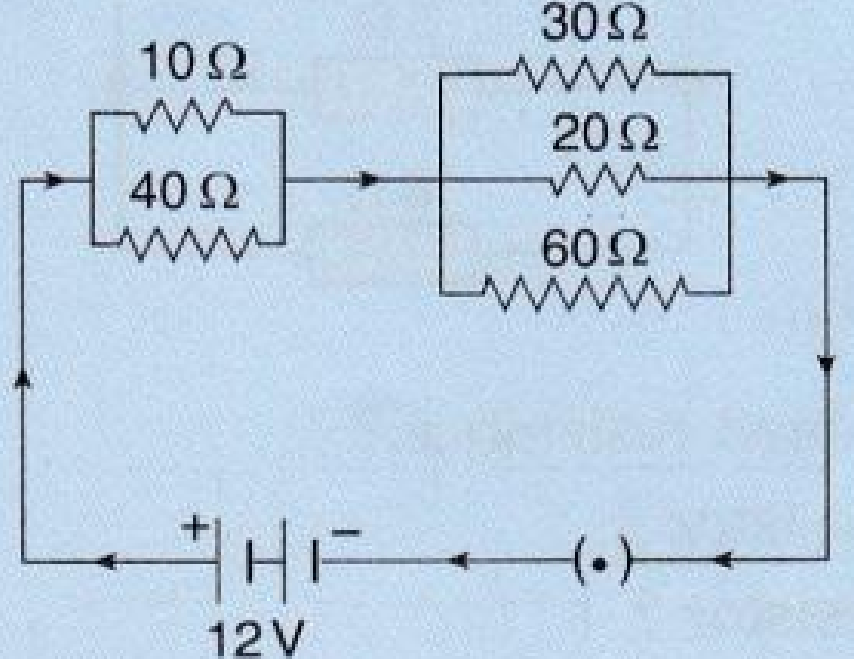
In the circuit diagram given below five resistances of $10 Ω, 40 Ω, 30 Ω, 20 Ω\ \text{and}\ 60 Ω$ are connected as shown to a 12V battery.
Calculate:
  1. Total resistance in the circuit.
  2. Total current flowing in the circuit.
  1. Draw a ray diagram to explain the term angle of deviation.
  2. Why do the component colours of incident white light split into a spectrum while passing through a glass prism, explain.
  3. Draw a labelled ray diagram to show the formation of a rainbow.