MCQ
When a longitudinal wave propagates through a medium, the particles of the medium execute simple harmonic oscillations about their mean positions. These oscillations of a particle are characterised by an invariant
  • A
    Kinetic energy
  • B
    Potential energy
  • Sum of kinetic energy and potential energy
  • D
    Difference between kinetic energy and potential energy

Answer

Correct option: C.
Sum of kinetic energy and potential energy
c
(c)Total energy is conserved.

Need a full question paper?

Generate a complete, print-ready paper with questions like this in minutes — across 16+ boards, with answer keys.

Start Generating Free

Similar questions

A transverse wave of frequency $500 \,Hz$ and speed $100 \,m / s$ is travelling in the positive $x$-direction on a long string. At time $t=0 \,s$, the displacements at $x=0.0 \,m$ and at $x=0.25 \,m$ are $0.0 \,m$ and $0.02 \,m$, respectively. The displacement at $x=0.2 \,m$ at $t=5 \times 10^{-4} s$ is ............ $m$
The gases carbon monoxide $(CO)$ and nitrogen $(N_2)$ at the same temperature have kinetic energies $E_1$ and $E_2Z,$ respectively. Then,
A metallic rod of length $I$ and cross-sectional area $A$ is made of a material of Young's modulus $Y$. If the rod is elongated by an amount $y$, then the work done is proportional to ......
The energy of a given sample of an ideal gas depends only on its:
Two identical blocks $A$ and $B$ each of mass $m$ resting on the smooth horizontal floor are connected by a light spring of natural length $L$ and spring constant $K$. A third block $C$ of mass $m$ moving with a speed $v$ along the line joining $A$ and $B$ collides with $A$.The maximum compression in the spring is
An object thrown vertically upwards with a velocity of $25\ m/ s$ takes $4\ sec$ to reach the thrower. What is displacement of the object?
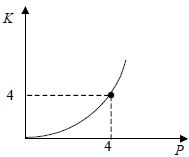
A graph between kinetic energy and momentum of a particle is plotted as shown in the figure. The mass of the moving particle is ........ $kg$.
A body of mass $5 \,kg$ falls from a height of $30$ metre. If its all mechanical energy is changed into heat, then heat produced will be........ $cal$
A Camot cycle consists of
A particle of mass $'{m}'$ is moving in time $'t'$ on a trajectory given by

$\overrightarrow{{r}}=10 \alpha {t}^{2}\, \hat{{i}}+5 \beta({t}-5)\, \hat{{j}}$

Where $\alpha$ and $\beta$ are dimensional constants. The angular momentum of the particle becomes the same as it was for ${t}=0$ at time ${t}=$ .....$seconds.$