Question
When a magnetic field is applied in a direction perpendicular to the direction of cathode rays, then their(a) Energy decreases(b) Energy increases(c) Momentum increases(d) Momentum and energy remain unchanged


Answer

(d) Momentum and energy remain unchanged

Need a full question paper?

Generate a complete, print-ready paper with questions like this in minutes — across 16+ boards, with answer keys.
Start Generating Free

Similar questions

According to modern astronomers into how many constellations, the whole sky is divided
Calculate the de$-$Brogile wavelength of an electron travelling at $1\%$ of the speed of light:
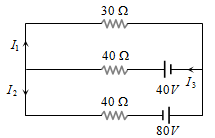
In the given circuit the current $I_1$ is
A motor car is going due north at a speed of 50km/h. It makes a 90° left turn without changing the speed. The change in the velocity of the car is about:
  1. 50km/h towards west.
  2. 70km/h towards south-west.
  3. 70km/h towards north-west.
  4. zero.
The engine of a train sounds a whistle at frequency v. The frequency heard by a passenger is:
  1. $>\text{v}$
  2. $<\text{v}$
  3. $=\frac{1}{\text{v}}$
  4. $=\text{v}$
Two parallel plates have equal and opposite charge. When the space between them is evacuated, the electric field between the plates is $2 \times 10^5 V / m$. When the space is filled with dielectric, the electric field becomes $1 \times 10^5 V / m$. The dielectric constant of the dielectric material
A current $i$ passes through a wire of length $l$, radius of cross$-$section $r$ and resistivity $\rho$. The rate of heat generation is
Banding of a stick when placed in water is because:
The vertical component of earth's magnetic field is zero at or The earth's magnetic field always has a vertical component except at the(a) Magnetic poles(b) Geographical poles(c) Every place(d) Magnetic equator
       
Assertion :   When two coils are wound on each other, the mutual induction between the coils is maximum.
Reason     : Mutual induction does not depend on the orientation of the coils.(a) If both assertion and reason are true and the reason is the correct explanation of the assertion.(b) If both assertion and reason are true but reason is not the correct explanation of the assertion.(c) If assertion is true but reason is false.(d) If the assertion and reason both are false.