Question
When a more reactive element displaces a less reactive element from its compound, it is called a displacement reaction. The reaction is of two types. Single displacement reaction and double displacement reaction.
Iron being more reactive than copper displaces copper from an aqueous solution of copper sulphate. This is an example of a single displacement reaction.
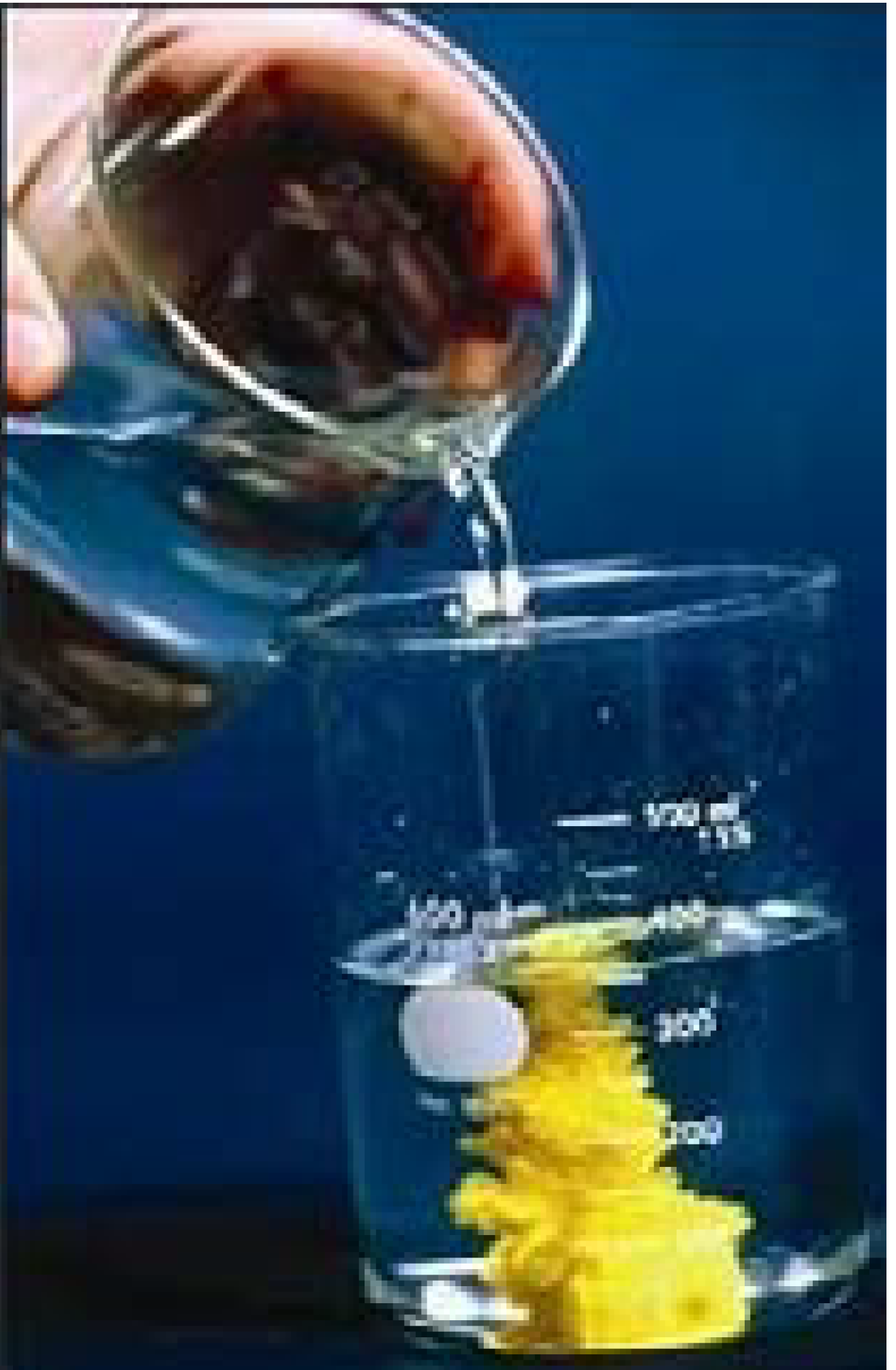
On adding silver nitrate solution to sodium bromide, a yellow ppt of silver bromide and solution of sodium nitrate is formed. This is an example of a double displacement reaction.
i. When dil. sulphuric acid is added to pieces of iron sulphide, hydrogen sulphide gas is produced and soluble ferrous sulphate is formed. Which chemical reaction is involved in this process?
ii. Mention reaction which is used for the preparation of oxygen gas in the laboratory.
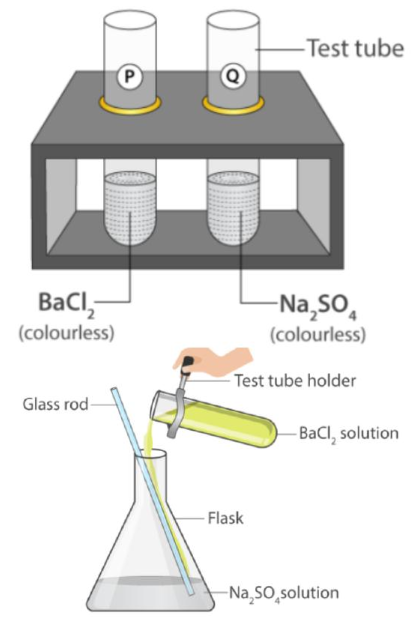
iii. What are the products formed in the double displacement reaction discussed below?
Image
OR
Which elements displace aluminum from its salt?
Answer

i. Double displacement reaction
ii. $2 \mathrm{KClO}_{3} \xrightarrow[\text { Catalyst }]{\text { Heat }} 2 \mathrm{KCl}(\mathrm{s})+3 \mathrm{O}_{2}(\mathrm{~g})$
It is a decomposition reaction and endothermic in nature.
iii. Barium Sulphate, Sodium Chloride
OR
Ca elements displace aluminium from its salt.

Need a full question paper?

Generate a complete, print-ready paper with questions like this in minutes — across 16+ boards, with answer keys.

Start Generating Free

Similar questions

Cellular respiration is a chemical process by which cells convert glucose to energy.
The equation given below shows the reaction for cellular respiration.
$\underset{\text { (glucose) }}{ C _6 H _{12} O _6}+\underset{\text { (oxygen) }}{6 O _2} \longrightarrow \underset {\text { (carbon dioxide) }} {6 CO _2}+\underset{\text { (water) }}{6 H _2 O }+$ Energy
3. In the above reaction, which substance is oxidised?
4. Carbon dioxide and water are the two new substances formed during cellular respiration. What are they known as?
  A. Reactants
  B. Mixtures
  C. Catalysts
  D. Products
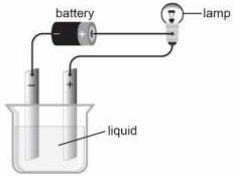
Mike placed an electric circuit separately in a dilute acid and a dilute base.

Image
Mike observed whether the lamp in the circuit glowed or not for each liquid.
8. Which property of acids and bases was Mike trying to test through his experiment?
9. Will the lamp glow if the circuit is placed in distilled water? 
Explain your answer.
10. Acid + Metal →Salt + X
What is X in the equation?

Read the following and answer any three questions from (i) to (iv).

Bleaching powder is also known as chloride of lime. It is a solid and yellowish white in colour. Bleaching powder can be easily identified by the strong smell of chlorine. When calcium hydroxide (slaked lime) reacts with chlorine, it gives calcium oxychloride (bleaching powder) and water is formed. Aqueous solution of bleaching powder is basic in nature. The material to be bleached is first passed through solution of Na OH to remove greasy matter. Then it is passed through aqueous solution of bleaching powder and very dil. HCl solution. HCl reacts with bleaching powder to liberate nascent oxygen which bleaches material.

  1. Write two uses of Bleaching powder?

  2. Bleaching powder is also known as?

  3. A) Why does Bleaching powder gives smell of chlorine?
    B) What happens when calcium hydroxide reacts with chlorine?

                          OR
    What happens when HCl reacts with bleaching powder?
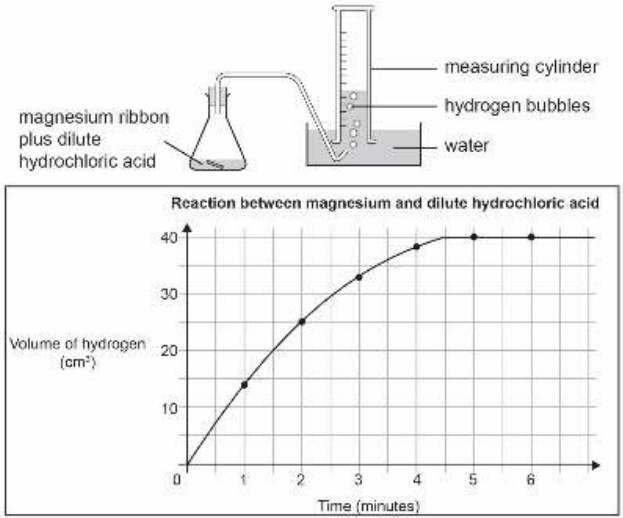
A piece of magnesium ribbon is added to a lask containing dilute hydrochloric acid.
Hydrogen gas is formed which is collected in the measuring cylinder.
The amount of hydrogen formed with time is plotted on a graph.
The line on the graph indicates the rate of chemical reaction occurring in the lask.

Image
5. At what time is the reaction rate the fastest in the lask?
A. At 1 minute
B. At 3 minutes
C. At 4 minutes
D. At 6 minutes
6. The reaction is repeated with magnesium powder in place of magnesium ribbon under the same conditions. Will the reaction rate increase or decrease?
Explain your answer with reference to the volume of hydrogen formed in the lask at 2 minutes.
7. Which of these could increase the rate of reaction in the lask?
Circle ‘Yes’ or ‘No’ for each row.

Will this increase the rate of reaction?

Yes or No

Adding more acid to the flask

Yes/No

Heating the acid in the flask

Yes/No

Using a higher concentration of acid

Yes/No

8. Magnesium reacts with hydrochloric acid to form magnesium chloride and hydrogen gas.
Write a balanced chemical equation to show the reaction.
9. Which of these is an example of decomposition reaction?
A. Melting of glaciers
B. Rusting of old bridges
C. Rotting of fruits and vegetables
D. Absorption of carbon dioxide by oceans
10. Methane gas released from waste water treatment plants can be used as a source of fuel. Which chemical equation represents combustion of methane to produce heat energy?
A. $CH _4+ CO _2 \rightarrow 2 O _2+2 H _2 O$
B. $CH _4+2 O _2 \rightarrow CO _2+2 H _2 O$
C. $2 O _2+2 H _2 O \rightarrow CO _2+ CH _4$
D. $CO _2+2 O _2 \rightarrow CH _4+2 H _2 O$

Carbon is a versatile element that forms the basis of all living organisms and many of the things we use. A large variety of compounds is formed because of its tetravalency. Compounds of carbon are formed with oxygen, hydrogen, nitrogen, sulphur, chlorine and many other elements.
Answer the following questions:
a. What are hydrocarbons?
b. List two properties by virtue of which carbon can form a large number of compounds.
c. Write the formula of the functional group present in (1) aldehydes, and (2) ketones. Write chemical equation for the reaction that occurs between ethanoic acid and ethanol in the presence of a catalyst.
OR
What are structural isomers? Write the structures of two isomers of butane $\left(\mathrm{C}_{4} \mathrm{H}_{10}\right)$.
Corrosion is the phenomenon of deterioration of surface of metal in presence of air and moisture. It is a natural process and in the presence of a moist atmosphere, chemically active metals get corroded. This is oxidation reaction. Rusting is the process where iron corrodes due to exposure to the atmosphere. The main circumstance of corrosion occurs with iron because it is a structural material in construction, bridges, buildings, rail transport, ships, etc. Aluminium is also an important structural metal, but even aluminium undergoes oxidation reactions. However, aluminium doesn't corrode or oxidize as rapidly as its reactivity suggests. An alloy of aluminium or any other metal like magnesium can make aluminium stronger and harder.
Copper $( Cu )$ corrodes and forms a basic green carbonate and lead corrodes to form a white lead oxide or carbonate.
(i) What is rusting?
(ii) Which two metals do not corrode easily?
(iii) List two properties of alloys.
or
(iv) What is the effect of corrosion on electrical conductivity?
A series of organic compounds having the same functional group, with similar or almost identical chemical characteristics in which all the members can be represented by the same general formula and the two consecutive members of the series differ by $-\mathrm{CH}_{2}$, group or 14 mass unit in their molecular formulae is called a homologous series. For example, all the members of the alcohol family can be represented by the general formula, $\mathrm{C}_{n} \mathrm{H}_{2 n+1} \mathrm{OH}$ where, $n$ may have the values $1,2,3, \ldots$ etc. The various members of a particular homologous series are called homologues. The physical properties such as density, melting point, boiling point, solubility, etc. of the members of a homologous series show almost regular variation in ascending or descending the series.
i. Write two characteristics of homologous series.
ii. What are the fourth and fifth members of the alcohol homologous series? Write their name with the formula.
iii. Draw structure of Butanol.
OR
What is heteroatom?