MCQ
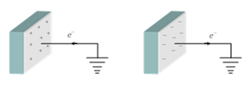
When a negatively charged conductor is connected to earth
  • A
    Electrons flow from the earth to the conducto
  • B
    Protons flow from the conductor to the earth
  • C
    No charge flow occurs
  • D
    Electrons flow from the conductor to the earth

Answer

(d) Electrons flow from the conductor to the earth
Explanation: After earthing a positively charged conductor electrons flow from earth to conductor and if a negatively charged conductor is earthed then electrons flows from conductor to earth.
Image

Need a full question paper?

Generate a complete, print-ready paper with questions like this in minutes — across 16+ boards, with answer keys.
Start Generating Free

Similar questions

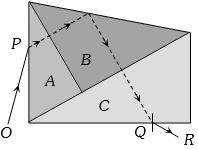
Three glass prisms $A, B$ and $C $ of same refractive index are placed in contact with each other as shown in figure, with no air gap between the prisms. Monochromatic ray of light $OP$ passes through the prism assembly and emerges as $QR.$ The conditions of minimum deviation is satisfied in the prisms
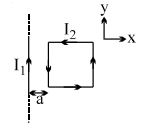
A square loop of side $\lambda $ is placed in the neighbourhood of an infinitely long straight wire carrying a current $I_1.$ The loop carries a current $I_2$ as shown in figure
Electric current has both magnitude and direction. It is a
Sodium light of wavelengths $650\, nm$ and $655\, nm$ is used to study diffraction at a single slit of aperture $0.5\, mm$. The distance between the slit and the screen is $2.0 \,m$. The separation between the positions of the first maxima of diffraction pattern obtained in the two cases is $\times 10^{-5} \,m$
 If $N$ is the number of turns in a coil, the value of self inductance varies as
A magnet oscillating in a horizontal plane has a time period of 2 second at a place where the angle of dip is $30^{\circ}$ and 3 seconds at another place where the angle of dip is $60^{\circ}$. The ratio of resultant magnetic fields at the two places is
An electron moving to the east in a horizontal plane is deflected towards south by a magnetic field. The direction of this magnetic field is:
If mean wavelength of light radiated by $100 W$ lamp is $5000 Å$, then number of photons radiated per second are
In a hydrogen like atom, when an electron jumps from the $M -$ shell to the $L-$ shell the wavelength of emitted radiation is $\lambda $. If an electron jumps from $N-$ shell to the $L-$ shell the wavelength of emitted radiation will be
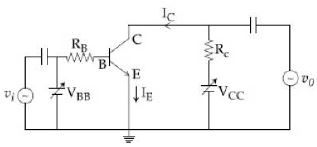
In the figure, given that $V_{BB}$ supply can vary from $0$ to $5.0 \,V,\,\,V_{CC} = 5\,V,$ $\beta _{dc} = 200,\,\,R_B = 100,\,k\Omega ,$ $R_C = 1\,k\Omega  $ an $V_{BE} = 1.0\,V,$ The minimum base current and the input voltage at which the transistor will go to saturation, will be respectively