Question
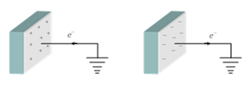
When a negatively charged conductor is connected to earth

Answer

(d) Electrons flow from the conductor to the earth
Explanation: After earthing a positively charged conductor electrons flow from earth to conductor and if a negatively charged conductor is earthed then electrons flows from conductor to earth.
Image

Need a full question paper?

Generate a complete, print-ready paper with questions like this in minutes — across 16+ boards, with answer keys.
Start Generating Free

Similar questions

A solid floats in a liquid in a partially dipped position.
  1. The solid exerts a force equal to its weight on the liquid.
  2. The liquid exerts a force of buoyancy on the solid which is equal to the weight of the solid.
  3. The weight of the displaced liquid equals the weight of the solid.
  4. The weight of the dipped part of the solid is equal to the weight of the displaced liquid.
One requires $11\ eV$ of energy to dissociate a carbon monoxide molecule into carbon and oxygen atoms. The minimum frequency of the appropriate electromagnetic radiation to achieve the dissociation lies in:
Out of the following sources which gives best monochromatic light ?
An $\alpha-$particle is bombarded on $^{14}N.$ As a result $,a ^{17}O$ nucleus is formed and a particle is emitted. This particle is $a:$
The slits in a Young's double slit experiment have equal widths and the source is placed symmetrically relative to the slits. The intensity at the central fringes is $\mathrm{I}_0.$ If one of the slits is closed, the intensity at this point will be
Two heater wires of equal length are first connected in series and then in parallel. The ratio of heat produced in the two cases is(a) 2 : 1 (b) 1 : 2 (c) 4 : 1 (d) 1 : 4
       
A bar magnet is oscillating in the Earth’s magnetic field with a period $T.$ What happens to its period and motion if its mass is quadrupled
The phenomena of total internal reflection is seen when angle of incidence is(a) 90°     (b) Greater than critical angle(c) Equal to critical angle(d) 0°       
   
   
Rutherford’s a-particle experiment showed that the atoms have:
The half life $(T)$ and the disintegration constant $(\lambda)$ of a radioactive substance are related as