MCQ
When a $p-n$ diode is reverse biased, then
  • A
    no current flows
  • the depletion region is increased
  • C
    the depletion region is reduced
  • D
    the height of the potential barrier is reduced

Answer

Correct option: B.
the depletion region is increased
b
When $p-n$ junction is reverse biased, the depletion region is increased i.e., the potential barrier increased

Need a full question paper?

Generate a complete, print-ready paper with questions like this in minutes — across 16+ boards, with answer keys.
Start Generating Free

Similar questions

Magnetic materials used for making permanent magnets $(P)$ and magnets in a transformer $(T)$ have different properties of the following, which property best matches for the type of magnet required $?$
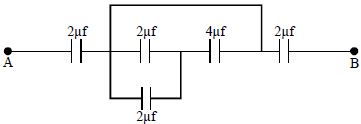
Find the equivalent capacitance between $A$ and $B$.......$\mu f$
The focal length of the objective of a compound microscope is:
Let $\overrightarrow{\text{A}}$ be a unit vector along the axis of rotation of a purely rotating body and $\overrightarrow{\text{B}}$ be a unit vector along the velocity of a particle P of the body away from the axis. The value of $\overrightarrow{\text{A}}.\overrightarrow{\text{B}}$ is:
The rate of change of current needed to induce an emf of $8V$ in $0.1H$ coil is.
Which one of the following properties is not found in cathode rays?
If only $2\,%$ of the main current is to be passed through a galvanometer of resistance $G$, then the resistance of shunt will be
A capacitor of capacitance 6μF is charged upto 100 volt. The energy stored in the capacitor is
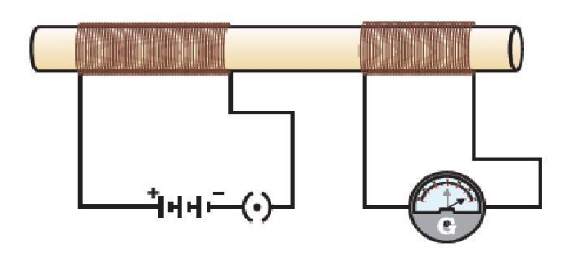
In the arrangement shown in given Figure, there are two coils wound on a non$-$conducting cylindrical rod. Initially the key is not inserted. Then the key is inserted and later removed. Then,
When a coil is connected across a $20 \mathrm{~V}$ dc supply, it draws a current of $5 \mathrm{~A}$. When it is connected across $20 \mathrm{~V}, 50 \mathrm{~Hz}$ ac supply, it draws a current of $4 \mathrm{~A}$. The self inductance of the coil is .............. $\mathrm{mH}$. (Take $\pi=3$ )