Question

When a plane polarised light is passed through an analyser and analyser is rotated through 90°, the intensity of the emerging light

(a) Varies between a maximum and minimum

(b) Becomes zero

(c) Does not vary

(d) Varies between a maximum and zero

Answer

(d) Varies between a maximum and zero

Need a full question paper?

Generate a complete, print-ready paper with questions like this in minutes — across 16+ boards, with answer keys.

Start Generating Free

Similar questions

The primary winding of transformer has 500 turns whereas its secondary has 5000 turns. The primary is connected to an ac supply of 20 V, 50 Hz. The secondary will have an output of

(a) 200 V, 50 Hz

(b) 2 V, 50 Hz

(c) 200 V, 500 Hz

(d) 2 V, 5 Hz

The bending of light as it passes from one medium into another is commonly known as:

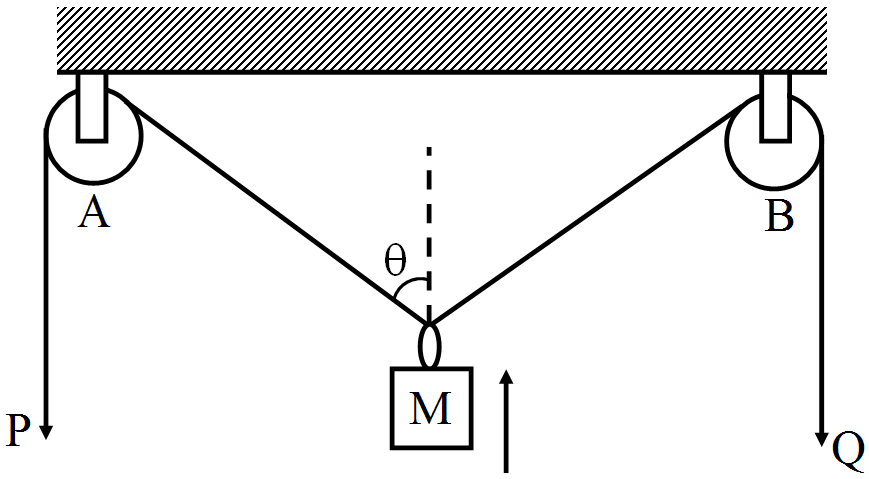
In the arrangement shown in figure, the ends P and Q of an inextensible string move downwards with uniform speed u. Pulleys A and B are fixed. The mass M moves upwards with a speed:

  1. $2\text{u}\cos\theta$

  2. $\frac{\text{u}}{\cos\theta}$

  3. $\frac{\text{2u}}{\cos\theta}$

  4. $\text{u}\cos\theta$

In the circuit of a triode valve, there is no change in the plate current, when the plate potential is increased from 200 volt to 220 volt and the grid potential is decreased from – 0.5 volt to –1.3 volt. The amplification factor of this valve is

(a) 15

(b) 20

(c) 25 

(d) 35

Two point charges 10C and -10C are placed at a certain distance. What is the electric potential of their midpoint?
 Maxwell in his famous equations of electromagnetism introduced the concept of:

Which of the following is not a correct statement

(a) Resistivity of electrolytes decreases on increasing temperature

(b) Resistance of mercury falls on decreasing its temperature

(c) When joined in series a 40 W bulb glows more than a 60 W bulb

(d) Resistance of 40 W bulb is less than the resistance of 60 W bulb

Two wires of the same material are given. The first wire is twice as long as the second and has twice the diameter of the second. The resistance of the first will be

(a) Twice of the second

(b) Half of the second

(c) Equal to the second

(d) Four times of the second

ABC is an equilateral triangle. Charges + q are placed at each corner. The electric intensity at O will be

(a)  

(b)

(c) Zero

(d)

The equivalent resistance between the points P and Q of the circuit given is

(a)  

(b)  

(c) 4 R      

(d) 2 R