MCQ
When a polaroid sheet is rotated between two crossed polaroids then the transmitted light intensity will be maximum for a rotation of :
  • A
    $60^{\circ}$
  • B
    $30^{\circ}$
  • C
    $90^{\circ}$
  • D
    $45^{\circ}$

Answer

Let $I_0$ be intensity of unpolarised light incident on first polaroid.
$I_1=$ Intensity of light transmitted from $1^{\text {st }}$ polaroid $=\frac{ I _0}{2}$
$\theta$ be the angle between $1^{\text {st }}$ and $2^{\text {nd }}$ polaroid
$\phi$ be the angle between $2^{\text {nd }}$ and $3^{\text {rd }}$ polaroid
$\theta+\phi=90^0($ as $1^{\text {st }}$ and $3^{\text {rd }}$ polaroid are crossed$)$
$\phi=90^0-\theta$
$I_2=$ Intensity from $2^{\text {nd }}$ polaroid
$I_2=I_1 \cos ^2 \theta=\frac{I_0}{2} \cos ^2 \theta$
$I_3=$ Intensity from $3^{\text {rd }}$ polaroid
$I_3=I_2 \cos ^2 \phi$
$I_3=I_1 \cos ^2 \theta \cos ^2 \phi$
$I_3=\frac{I_0}{2} \cos ^2 \theta \cos ^2 \phi$
$\phi=90-\theta$
$I_3=\frac{I_0}{2} \cos ^2 \theta \sin ^2 \theta$
$I_3=\frac{I_0}{2}\left[\frac{2 \sin \theta \cos \theta}{2}\right]^2$
$I_3=\frac{I_0}{8} \sin ^2 2 \theta$
$I _3$ will be maximum when $\sin 2 \theta=1$
$2 \theta=90^{\circ}$
$\theta=45^{\circ}$

Need a full question paper?

Generate a complete, print-ready paper with questions like this in minutes — across 16+ boards, with answer keys.

Start Generating Free

Similar questions

The resultant of two forces, one double the other in magnitude, is perpendicular to the smaller of the two forces. The angle between the two forces is ........ $^o$
The specific heats at constant pressure is greater than that of the same gas at constant volume because
A second harmonic has to be generated in a string of length $l$ stretched between two rigid supports. The point where the string has to be plucked and touched are
A uniform cylinder of length $L$ and mass $M$ having crosssectional area $A$ is suspended, with its length vertical, from a fixed point by a massless spring such that it is half submerged in a liquid of density $\sigma$ at equilibrium position. The extension $x_0$ of the spring when it is in equilibrium is
Consider the following statements ( $X$ and $Y$ stand for two different elements):

$(I)$ ${ }_{32}^{65} X$ and ${ }_{33}^{65} Y$ are isotopes.

$(II)$ ${ }_{42}^{86} X$ and ${ }_{42}^{85} Y$ are isotopes.

$(III)$ ${ }_{85}^{174} X$ and ${ }_{88}^{177} Y$ have the same number of neutrons.

$(IV)$ ${ }_{92}^{235} X$ and ${ }_{94}^{235} Y$ are isobars.

Which of the above statements are correct?
If the temperature of sink is at absolute zero, then the efficiency of Carnot engine will be ........ $\%$
A body starts from rest and travels a distance $S$ with uniform acceleration, then moves uniformly a distance $2S$ and finally comes to rest after moving further $3S$ under uniform retardation. The ratio of the average velocity to maximum velocity is
For which combination of working temperatures the efficiency of Carnot’s engine is highest
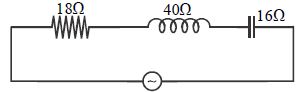
The impedance of the given circuit is......$\Omega $
In an hour-glass approximately $100$ grains of sand fall per second (starting from rest); and it takes $2 \, s$ for each sand particle to reach the bottom of the hour-glass. If the average mass of each sand particle is $0.2 \,g$, then the average force exerted by the falling sand on the bottom of the hour-glass is close to .......... $N$