Question

When a positive q charge is taken from lower potential to a higher potential point, then its potential energy will

(a) Decrease

(b) Increases

(c) Remain unchanged

(d) Become zero

Answer

(b) Increases

Need a full question paper?

Generate a complete, print-ready paper with questions like this in minutes — across 16+ boards, with answer keys.

Start Generating Free

Similar questions

The electric intensity due to an infinite cylinder of radius R and  having charge q per unit length at a distance r(r > R) from its axis is

(a) Directly proportional to  

(b) Directly proportional to  

(c) Inversely proportional to r

(d) Inversely proportional to  

The net resistance of an ammeter should be small to ensure that:
  1. It does not get overheated.
  2. It does not draw excessive current.
  3. It can measure large currents.
  4. It does not appreciably change the current to be measured.

In Milikan’s experiment, an oil drop having charge q gets stationary on applying a potential difference V in between two plates separated by a distance ‘d’. The weight of the drop is

(a) qVd

(b) q  

(c)  

(d) q 

Assertion :   Charge is quantized

Reason    : Charge, which is less than 1 C is not possible

(a) If both assertion and reason are true and the reason is the correct explanation of the assertion.

(b) If both assertion and reason are true but reason is not the correct explanation of the assertion.

(c) If assertion is true but reason is false.

(d) If the assertion and reason both are false.

Water enters through end A with a speed v1 and leaves through end B with a speed v2 of a cylindrical tube AB. The tube is always completely filled with water. In case I the tube is horizontal, in case II it is vertical with the end A upward and in case III it is vertical with the end B upward. We have v1 = v2 for
  1. Case I.
  2. Case II.
  3. Case III.
  4. Each case.
In a circuit L, C and R are connected in series with an alternating voltage source of frequency f. The current leads the voltage by 45°. The value of C is.
A proton beam is going from north to south and an electron beam is going from south to north. Neglecting the earth's magnetic field, the electron beam will be deflected
The part of the spectrum of the electromagnetic radiation used to cook food is then:
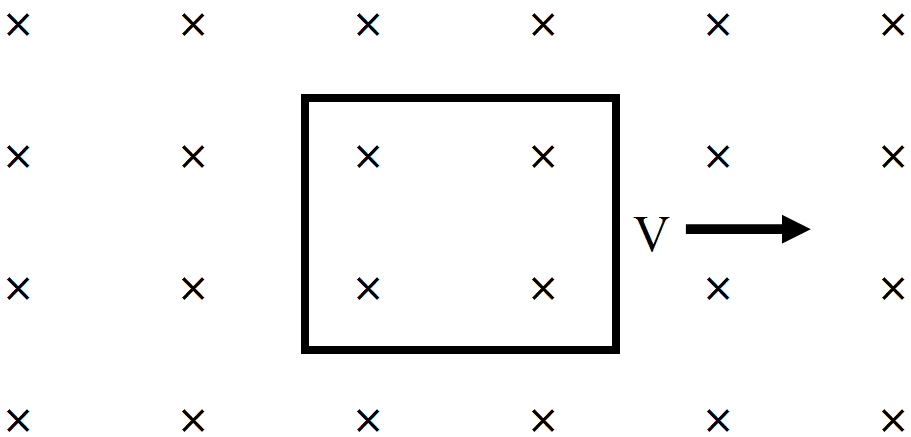
A conducting square loop of side l and resistance R moves in its plane with a uniform velocity u perpendicular to one of its sides. A uniform and constant magnetic field B exists along the perpendicular to the plane of the loop as shown in figure. The current induced in the loop is:
  1. $\frac{\text{Blv}}{\text{R}}$ clockwise.
  2. $\frac{\text{Blv}}{\text{R}}$ anticlockwise.
  3. $\frac{2\text{Blv}}{\text{R}}$ anticlockwise.
  4. $\text{Zero.}$

A particle is moving in a uniform magnetic field, then

(a) Its momentum changes but total energy remains the same

(b) Both momentum and total energy remain the same

(c) Both will change

(d) Total energy changes but momentum remains the same