Question
When a potential difference is applied across, the current passing through
| (a) An insulator at 0 K is zero |
| (b) A semiconductor at 0 K is zero |
|
(c) A P-N diode at 300 K is finite, if it is reverse biased |
| (d) a, b, c |
When a potential difference is applied across, the current passing through
| (a) An insulator at 0 K is zero |
| (b) A semiconductor at 0 K is zero |
|
(c) A P-N diode at 300 K is finite, if it is reverse biased |
| (d) a, b, c |
(d) a, b, c
Generate a complete, print-ready paper with questions like this in minutes — across 16+ boards, with answer keys.
The atomic weight of silver and copper are 108 and 64. A silver voltameter and a copper voltameter are connected in series and when current is passed 10.8 gm of silver is deposited. The mass of copper deposited will be
|
(a) 6.4 gm |
(b) 12.8 gm |
(c) 3.2 gm |
(d) 10.8 gm |
Two charges of equal magnitudes and at a distance r exert a force F on each other. If the charges are halved and distance between them is doubled, then the new force acting on each charge is
|
(a) F / 8 |
(b) F / 4 |
(c) 4 F |
(d) F / 16 |
The figure represents the observed intensity of X-rays emitted by an X-ray tube as a function of wavelength. The sharp peaks A and B denote
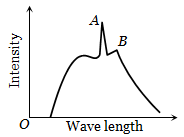
|
(a) Band spectrum |
(b) Continuous spectrum |
|
(c) Characteristic radiations |
(d) White radiations |
A nucleus  emits one α and one β particles. The resulting nucleus is
|
(a) |
(b) |
(c) |
(d) |
A capacitor is fully charged with a battery. Then the battery is removed and coil is connected with the capacitor in parallel, current varies as
|
(a) Increases monotonically |
(b) Decreases monotonically |
|
(c) Zero |
(d) Oscillates indefinitely |
A proton of mass m and charge +e is moving in a circular orbit in a magnetic field with energy 1 MeV. What should be the energy of α - particle (mass = 4m and charge = + 2e), so that it can revolve in the path of same radius
|
(a) 1 MeV |
(b) 4 MeV |
(c) 2 MeV |
(d) 0.5 MeV |


