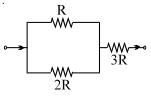
When a potential difference $V$ is applied across a wire of resistance $R$, it dissipates energy at a rate $W$. If the wire is cut into two halves and these halves are connected mutually parallel across the same supply, the same supply, the energy dissipation rate will become:
JEE MAIN 2024, Diffcult
Download our app for free and get started
$ \frac{\mathrm{v}^2}{\mathrm{R}}=\mathrm{W}$ $....(i)$
$\frac{\mathrm{v}^2}{\frac{1}{2}\left(\frac{\mathrm{R}}{2}\right)}=\mathrm{W}^{\prime}$ $...(ii)$
From $(i)$&$(ii)$, we get
$W^{\prime}=4 W$

Download our appand get started for free
Experience the future of education. Simply download our apps or reach out to us for more information. Let's shape the future of learning together!No signup needed.*
Similar Questions
- 1In an electric heater $4\, amp$ current passes for $1$ minute at potential difference of $250\, volt$, the power of heater and energy consumed will be respectivelyView Solution
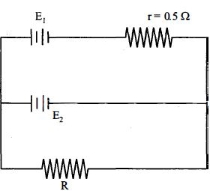
- 2A $dc$ source of $emf \,E_1 = 100\,V$ and internal resistance $r = 0.5\,\Omega ,$ a storage battery of emf $E_2 = 90\,V$ and an external resistance $R$ are connected as shown in figure. For what value of $R$ no current will pass through the battery ? ................ $\Omega$View Solution
- 3By using only two resistance coils-singly, in series, or in parallel one should be able to obtain resistances of $3$, $4$, $12$ and $16\, ohms$. The separate resistances of the coil areView Solution
- 4Two uniform wires $A$ and $B$ are of the same metal and have equal masses. The radius of wire $A$ is twice that of wire $B$. The total resistance of A and $B$ when connected in parallel isView Solution
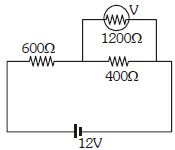
- 5Find the error in reading of voltmeter ................ $\%$View Solution
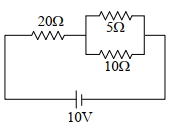
- 6The ratio of heat dissipated per second through the resistance $5 \Omega$ and $10 \Omega$ in the circuit given below is: :View Solution
- 7In the diagram shown, the reading of voltmeter is $20\, V$ and that of ammeter is $4\, A$. The value of $R$ should be (Consider given ammeter and voltmeter are not ideal)View Solution
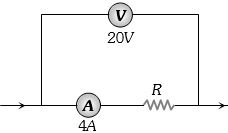
- 8A resistance of $2 \Omega$ is comnected across one gap of a metre-bridge (the length of the wire is $100 \mathrm{~cm}$ ) and an unknown resistance, greater than $2 \Omega$, is connected across the other gap. When these resistance are interchanged, the balance point shifts by $20 \mathrm{~cm}$. Neglecting any corrections, the unknown resistance isView Solution
- 9A wire $100\,cm$ long and $2.0\,mm$ diameter has a resistance of $0.7\, ohm$, the electrical resistivity of the material is ...........$ \times {10^{ - 6}}\,ohm \times m$View Solution
- 10The ratio of powers dissipatted respectively in $R$ and $3R$, as shown is:View Solution