MCQ
When a proton is accelerated with $1$ volt potential difference, then its kinetic energy is
  • A
    $\frac{1}{1840} eV$
  • B
    $1840\ eV$
  • $1\ eV$
  • D
    $1840 c^2\ eV$

Answer

Correct option: C.
$1\ eV$
$1\ eV$

Need a full question paper?

Generate a complete, print-ready paper with questions like this in minutes — across 16+ boards, with answer keys.
Start Generating Free

Similar questions

In a cyclotron, a charged particle.
The dominant mechanisms for motion of charge carriers in forward and reverse biased silicon P-N junctions are (a) Drift in forward bias, diffusion in reverse bias(b) Diffusion in forward bias, drift in reverse bias(c) Diffusion in both forward and reverse bias(d) Drift in both forward and reverse bias


When a current $I$ is passed through a wire of constant resistance, it produces a potential difference $V$ across its ends. The graph drawn between $\log I$ and $\log V$ will be
In a single slit diffraction experiment first minimum for red light (660 nm) coincides with first maximum of some other wavelength l'. The value of l' is (a) 4400 Å(b) 6600 Å(c) 2000 Å(d) 3500 Å
       
Which series of hydrogen atom's spectrum does not lie in infrared region ?
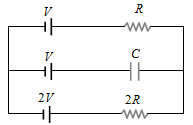
In the given circuit, with steady current, the potential drop across the capacitor must be
The minimum distance between an object and its real image formed by a convex lens is(a) 1.5 f (b) 2 f (c) 2.5 f(d) 4 f
       
A parallel plate capacitor is charged and the charging battery is then disconnected. If the plates of the capacitor are moved further apart by means of insulating handles, then(a) The charge on the capacitor increases(b) The voltage across the plates decreases(c) The capacitance increases(d) The electrostatic energy stored in the capacitor increases


Two coherent sources have intensity in the ratio of $\frac{100}{1}$ . Ratio of $($intensity$)$ max$($intensity$)$ min is
A condenser of capacitance 10 μF has been charged to 100 volts. It is now connected to another uncharged condenser in parallel. The common potential becomes 40 volts. The capacitance of another condenser is(a) 15 μF (b) 5 μF(c) 10 μF(d) 16.6 μF