Question
When a rectangular loop PQRS of sides' a' and' b' carrying current I is placed in uniform magnetic field B, such that area vector ii makes an angle 8 with direction of magnetic field, then forces on the arms QR and SP of loop are equal, opposite and collinear, thereby perfectly cancel each other, whereas forces on the arms PQ and RS of loop are equal and opposite but not collinear, so they give rise to torque on the loop.
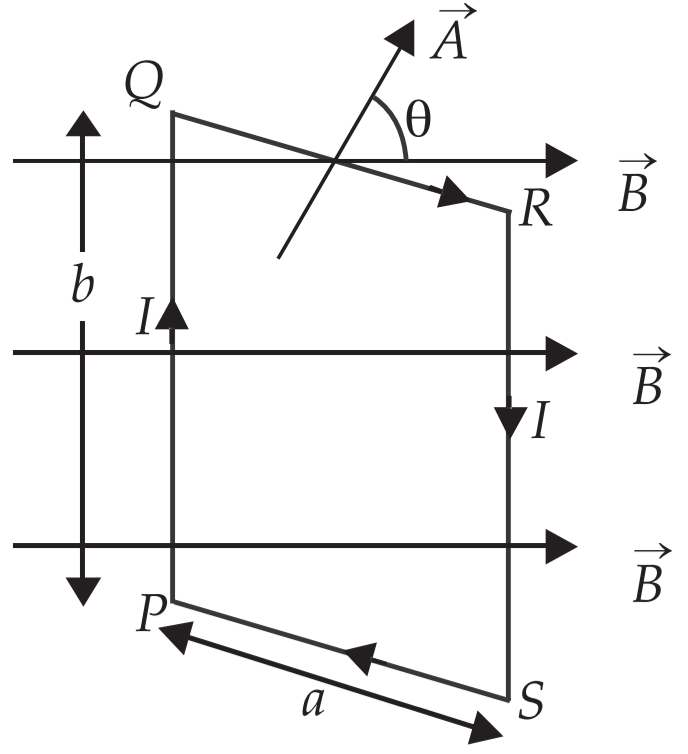
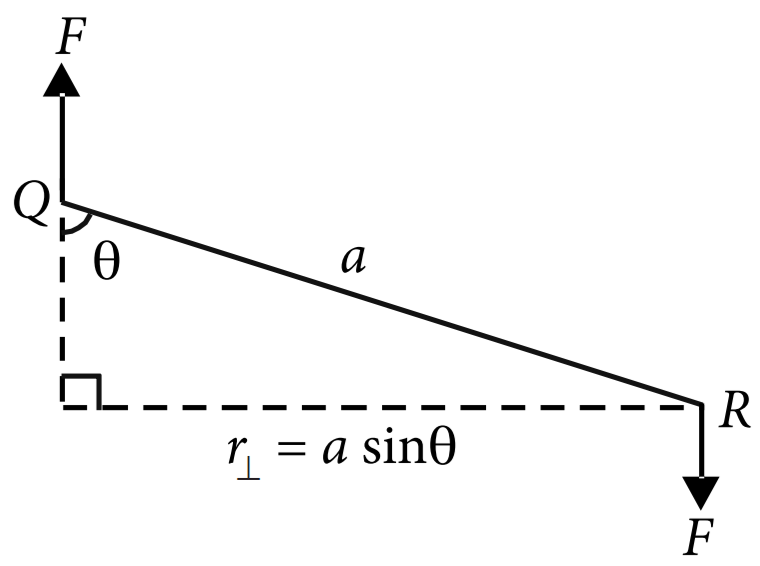
Force on side PQ or RS of loop is F = JbB sin 90º = lb B and perpendicular distance between two non-collinear forces is $\text{r}_\bot=\text{a}\sin\theta$

So, torque on the loop. $\tau=\text{IAB}\sin\theta$

In vector form torque, $\vec{\tau}=\vec{\text{M}}\times\vec{\text{B}}$

Where $\vec{\text{M}}=\text{NI}\vec{\text{A}}$ is called magnetic dipole moment of current loop and is directed in direction of area vector $\vec{\text{A}}$ i.e., normal to the plane ofloop.

  1. A circular loop of area 1cm2, carrying a current of 10A is placed in a magnetic field of 0.1T perpendicular to the plane of the loop. The torque on the loop due to the magnetic field is:
  1. Zero
  2. 10-4Nm
  3. 10-2Nm
  4. 1Nm
  1. Relation between magnetic moment and angular velocity is:
  1. $\text{m}\propto\omega$

  2. $\text{m}\propto\omega^2$

  3. $\text{m}\propto\sqrt{\omega}$

  4. None of these.
  1. A current loop in a magnetic field:
  1. Can be in equilibrium in two orientations, both the equilibrium states are unstable.
  2. Can be in equilibrium in two orientations, one stable while the other is unstable.
  3. Experiences a torque whether the field is uniform or non uniform in all orientations.
  4. Can be in equilibrium in one orientation.
  1. The magnetic moment of a current I carrying circular coil of radius rand number of turns N varies as:
  1. $\frac{1}{\text{r}^2}$
  2. $\frac{1}{\text{r}}$

  3. $\text{r}$

  4. $\text{r}^2$
  1. A rectangular coil carrying current is placed in a non-uniform magnetic field. On that coil the total:
  1. Force is non-zero.
  2. Force is zero.
  3. Torque is zero.
  4. ZNone of these.  

Answer

  1. (a) Zero

Explanation:

Torque on a current carrying loop in magnetic field, $\tau=\text{IBA}\sin\theta$

Here, $\text{I}=10\text{A},\text{B}=0.1\text{T},\text{A}=1\text{cm}^2=10^{-4}\text{m}^2,\theta=0^0$

$\therefore\tau=10\times0.1\times10^{-4}\sin0^0=0$

  1.  (a) $\text{m}\propto\omega$

Explanation:

Magnetic moment, $\text{M}=\text{IA}=\text{I}(\pi\text{r}^2)=\frac{\text{q}}{T}\times\pi\text{r}^2$

As, $\omega=\frac{2\pi}{\text{T}}\ \therefore\text{ M}=\frac{\text{q}\omega\text{r}^2}{2}\ \text{ or }\text{ M}\propto\omega$

  1. (b) Can be in equilibrium in two orientations, one stable while the other is unstable.

Explanation:

When a current loop is placed in a magnetic field it experiences a torque. It is given by,

$\vec{\tau}=\vec{\text{M}}\times\vec{\text{B}}$

Where M is the magnetic moment of the loop and B is the magnetic field.

or $\tau=\text{MB}\sin\theta$ where $\theta$ is angle between M and B When $\vec{\text{M}}$ and $\vec{\text{B}}$ are parallel (i.e. $\theta$ = 00) the equilibrium is stable and when they are antiparallel (i.e. $\theta$) the equilibrium is unstable.

  1. (d) $\text{r}^2$

 Explanation:

Magnetic moment, $\text{M}=\text{NIA}=\text{NI}\pi\text{r}^2\text{ i.e., }\text{M}\propto\text{r}^2$

  1. (a) Force is non-zero.

Need a full question paper?

Generate a complete, print-ready paper with questions like this in minutes — across 16+ boards, with answer keys.

Start Generating Free

Similar questions

Derive the formula for the magnetic field produced at a point on the axis of a current carrying circular loop.
Deduce the expression for the torque $\overrightarrow{\tau}$  acting on a planar loop of area $\overrightarrow{\text{A}}$ and carrying current I placed in a uniform magnetic field $\overrightarrow{\text{B}}.$ 
If the loop is free to rotate, what would be its orientation in stable equilibrium?
Two point charges $5 \mu C$ and $-5 \mu C$ are kept at a distance of 1 cm from each other. Calculate the intensity of the electric field at a distance of 0.30 cm from mid-point (i) in the axial position, (ii) in neutral position.
Why don't we have interference when two candles are placed close to each other and the intensity is seen at a distant screen? What happens if the candles are replaced by laser sources?
Two long bar magnets are placed with their axes coinciding in such a way that the north pole of the first magnet is 2·0cm from the south pole of the second. If both the magnets have a pole strength of 10A-m, find the force exerted by one magnet on the other.
This energy possessed by a system of charges by virtue of their positions. When two like charges lie infinite distance apart, their potential energy is zero because no work has to be done in moving one charge at infinite distance from the other.
In carrying a charge q from point A to point B, work done W = q(VA - VB). This work may appear as change in $\frac{\text{KE}}{\text{PE}}$ of the charge. The potential energy of two charges q1 and q2 at a distance r in air is $\frac{\text{q}_1\text{q}_2}{1\pi\in_0\text{r}}.$ It is measured in joule. It may be positive, negative or zero depending on the signs of q1 and q2.
  1. Calculate work done in separating two electrons form a distance of 1m to 2m in air, where e is electric charge and k is electrostatic force constant.
  1. ke2
  2. $\frac{\text{e}^2}{2}$
  3. $-\frac{\text{ke}^2}{2}$
  4. Zero
  1. Four equal charges q each are placed at four corners of a square of side a each. Work done in carrying a charge -q from its centre to infinity is:
  1. $\text{Zero}$
  2. $\frac{\sqrt{2}\text{q}^2}{\pi\in_0\text{a}}$
  3. $\frac{\sqrt{2}\text{q}}{\pi\in_0\text{a}}$
  4. $\frac{\text{q}^2}{\pi\in_0\text{a}}$
  1. Two points A and Bare located in diametrically opposite directions of a point charge of $+2\mu\text{C}$ at distances 2m and 1m respectively from it. The potential difference between A and B is:
  1. 3 × 103V
  2. 6 × 10⁴V
  3. -9 × 10³V
  4. -3 × 103V
  1. Two point charges A = + 3nC and B = + 1nC are placed 5cm apart in air. The work done to move charge B towards A by 1cm is:
  1. 2.0 × 10-7J
  2. 1.35 × 10⁻⁷J
  3. 2.7 × 10-7J
  4. 12.1 × 10-7J
  1. A charge Q is placed at the origin. The electric potential due to this charge at a given point in space is V. The work done by an external force in bringing another charge q from infinity up to the point is:
  1. $\frac{\text{V}}{\text{q}}$
  2. Vq
  3. V + q
  4. V
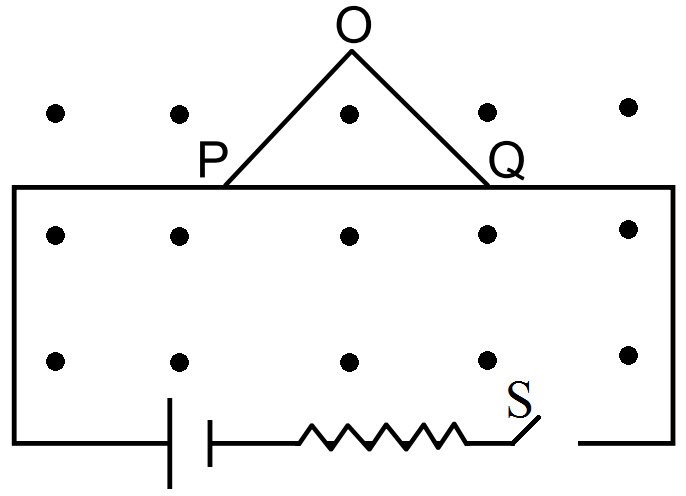
Shows a rod PQ of length 20.0cm and mass 200g suspended through a fixed point O by two threads of lengths 20.0cm each. A magnetic field of strength 0.500T exists in the vicinity of the wire PQ, as shown in the figure. The wires connecting PQ with the battery are loose and exert no force on PQ.
  1. Find the tension in the threads when the switch S is open.
  2. A current of 2.0A is established when the switch S is closed. Find the tension in the threads now.

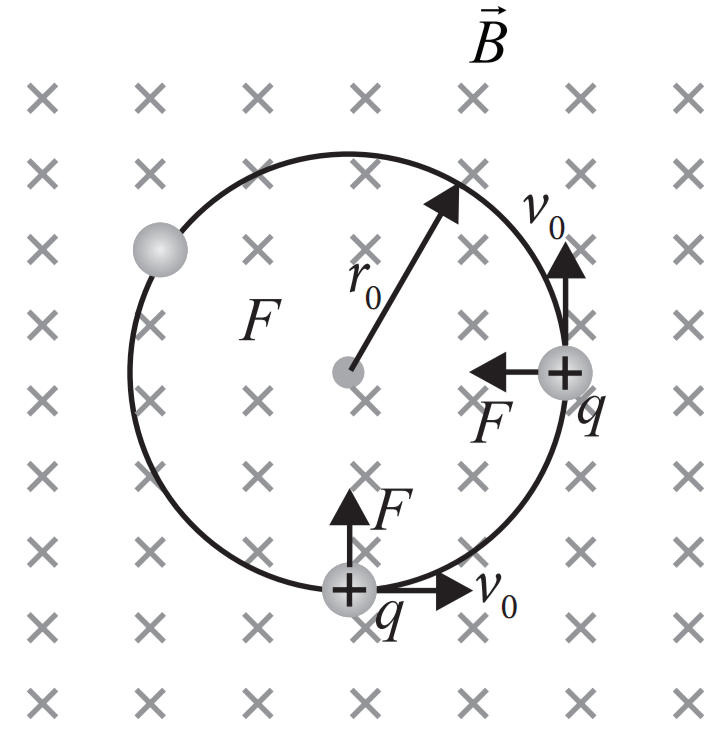
An electron with speed v0 << c moves in a circle of radius r0 in a uniform magnetic field. This electron is able to traverse a circular path as magnetic field is perpendicular to the velocity of the electron. A force acts on the particle perpendicular to both $\vec{\text{v}}_0$ and $\vec{\text{B}},$ This force continuously deflects the particle sideways without changing its speed and the particle will move along a circle perpendicular to the field. The time required for one revolution of the electron is T0.

  1. If the speed of the electron is now doubled to 2v0. The radius of the circle will change to:
  1. 4r0
  2. 2r0
  3. r0
  4. $\frac{\text{r}_0}{2}$

  1. If v0 = 2v0 then the time required for one revolution of the electron will change to:
  1. 4T0
  2. 2T0
  3. T0
  4. $\frac{\text{T}_0}{2}$

  1. A charged particles is projected in a magnetic field $\vec{\text{B}}=(2\hat{\text{i}}+4\hat{\text{j}})\times10^2\text{ T}.$ The acceleration of the particle is found to be $\vec{\text{a}}=(\text{x}\hat{\text{i}}+2\hat{\text{j}})\text{m s}^{-2}$ Find the value of x.
  1. 4ms-2
  2. -4ms-2
  3. -2ms-2
  4. 2ms-2
  1. If the given electron has a velocity not perpendicular to B, then trajectory of the electron is:
  1. Straight line.
  2. Circular.
  3. Helical.
  4. Zig-zag.
  1. If this electron of charge (e) is moving parallel to uniform magnetic field with constant velocity v, the force acting on the electron is:
  1. Bev
  2. $\frac{\text{Be}}{\text{v}}$

  3. $\frac{\text{B}}{\text{ev}}$

  4. Zero
TV signals broadcast by Delhi studio cannot be directly received at Patna which is about 1000km away. But the same signal goes some 36000km away to a satellite, gets reflected and is then received at Patna. Explain.
Draw a block diagram of a generalized communication system. Write the functions of each of the following:
(a) Transmitter, (b) Channel, (c) Receiver.