Question
When a rectangular loop PQRS of sides' a' and' b' carrying current I is placed in uniform magnetic field B, such that area vector ii makes an angle 8 with direction of magnetic field, then forces on the arms QR and SP of loop are equal, opposite and collinear, thereby perfectly cancel each other, whereas forces on the arms PQ and RS of loop are equal and opposite but not collinear, so they give rise to torque on the loop.
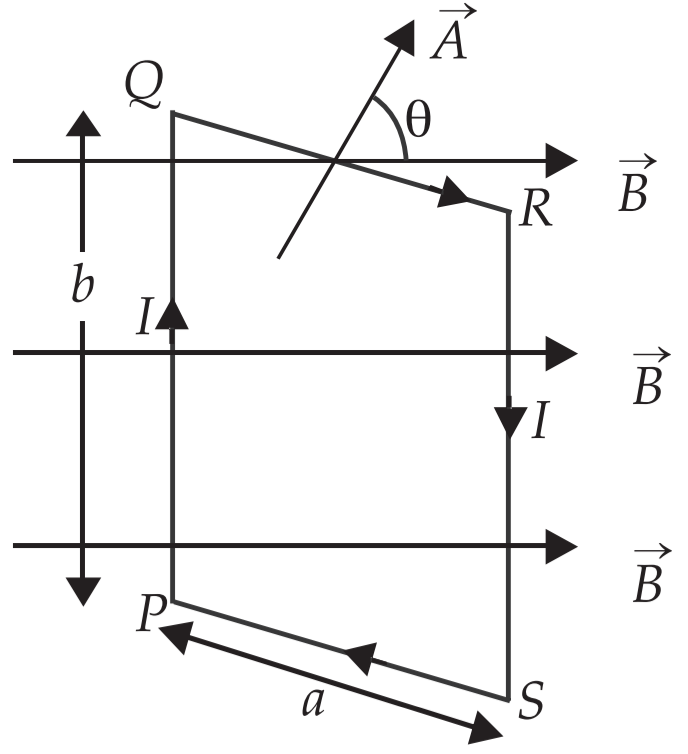
Force on side PQ or RS of loop is F = JbB sin 90º = lb B and perpendicular distance between two non-collinear forces is $\text{r}_\bot=\text{a}\sin\theta$
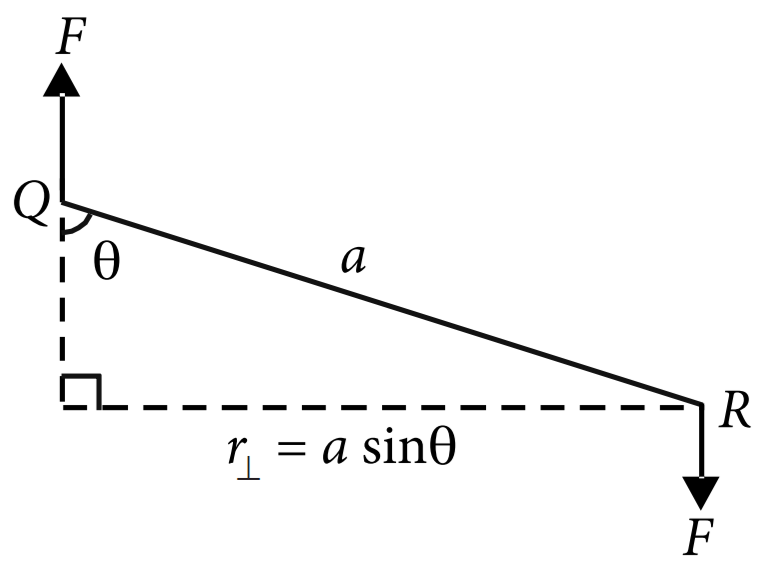
So, torque on the loop. $\tau=\text{IAB}\sin\theta$ In vector form torque, $\vec{\tau}=\vec{\text{M}}\times\vec{\text{B}}$ Where $\vec{\text{M}}=\text{NI}\vec{\text{A}}$ is called magnetic dipole moment of current loop and is directed in direction of area vector $\vec{\text{A}}$ i.e., normal to the plane ofloop.
  1. A circular loop of area $1cm^2,$ carrying a current of 10A is placed in a magnetic field of 0.1T perpendicular to the plane of the loop. The torque on the loop due to the magnetic field is:
  1. Zero
  2. $10^{-4}Nm$
  3. $10^{-2}Nm$
  4. 1Nm
  1. Relation between magnetic moment and angular velocity is:
  1. $\text{m}\propto\omega$
  2. $\text{m}\propto\omega^2$
  3. $\text{m}\propto\sqrt{\omega}$
  4. None of these.
  1. A current loop in a magnetic field:
  1. Can be in equilibrium in two orientations, both the equilibrium states are unstable.
  2. Can be in equilibrium in two orientations, one stable while the other is unstable.
  3. Experiences a torque whether the field is uniform or non uniform in all orientations.
  4. Can be in equilibrium in one orientation.
  1. The magnetic moment of a current I carrying circular coil of radius rand number of turns N varies as:
  1. $\frac{1}{\text{r}^2}$
  2. $\frac{1}{\text{r}}$
  3. $\text{r}$
  4. $\text{r}^2$
  1. A rectangular coil carrying current is placed in a non-uniform magnetic field. On that coil the total:
  1. Force is non-zero.
  2. Force is zero.
  3. Torque is zero.
  4. ZNone of these.

Answer

  1. (a) Zero
Explanation:

Torque on a current carrying loop in magnetic field, $\tau=\text{IBA}\sin\theta$

Here, $\text{I}=10\text{A},\text{B}=0.1\text{T},\text{A}=1\text{cm}^2=10^{-4}\text{m}^2,\theta=0^0$

$\therefore\tau=10\times0.1\times10^{-4}\sin0^0=0$
  1. (a) $\text{m}\propto\omega$
Explanation:

Magnetic moment, $\text{M}=\text{IA}=\text{I}(\pi\text{r}^2)=\frac{\text{q}}{T}\times\pi\text{r}^2$

As, $\omega=\frac{2\pi}{\text{T}}\ \therefore\text{ M}=\frac{\text{q}\omega\text{r}^2}{2}\ \text{ or }\text{ M}\propto\omega$
  1. (b) Can be in equilibrium in two orientations, one stable while the other is unstable.
Explanation:

When a current loop is placed in a magnetic field it experiences a torque. It is given by,

$\vec{\tau}=\vec{\text{M}}\times\vec{\text{B}}$

Where M is the magnetic moment of the loop and B is the magnetic field.

or $\tau=\text{MB}\sin\theta$ where $\theta$ is angle between M and B When $\vec{\text{M}}$ and $\vec{\text{B}}$ are parallel $(i.e. \theta = 0^{0)}$ the equilibrium is stable and when they are antiparallel (i.e. $\theta$) the equilibrium is unstable.
  1. (d) $\text{r}^2$
Explanation:

Magnetic moment, $\text{M}=\text{NIA}=\text{NI}\pi\text{r}^2\text{ i.e., }\text{M}\propto\text{r}^2$
  1. (a) Force is non-zero.

Need a full question paper?

Generate a complete, print-ready paper with questions like this in minutes — across 16+ boards, with answer keys.

Start Generating Free

Similar questions

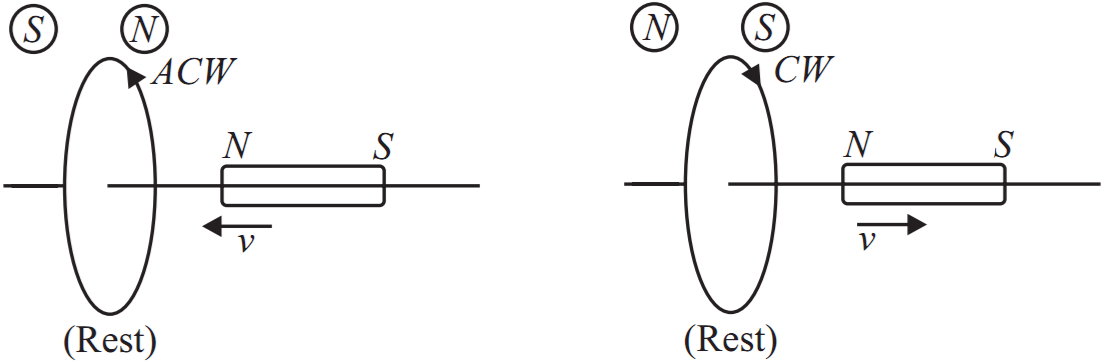
Lenz's law states that the direction of induced current in a circuit is such that it opposes the change which produces it. Tims, if the magnetic flux linked with a closed circuit increases, the induced current flows in such a direction that a magnetic flux is created in the opposite direction of the original magnetic flux. If the magnetic flux linked with the closed circuit decreases, the induced current flows in such a direction so as to create a magnetic flux in the direction of the original flux.
  1. Which of the following statements is correct?
  1. The induced e.m.f is not in the direction opposing the change in magnetic flux so as to oppose the cause which produces it.
  2. The relative motion between the coil and magnet produces change in magnetic flux.
  3. Emf is induced only if the magnet is moved towards coil.
  4. Emf is induced only if the coil is moved towards magnet.
  1. The polarity of induced emf is given by:
  1. Ampere's circuital law.
  2. Biot-Savart law.
  3. Lenz's law.
  4. Fleming's right hand rule.
  1. Lenz's law is a consequence of the law of conservation of:
  1. Charge.
  2. Mass.
  3. Momentum.
  4. Energy.
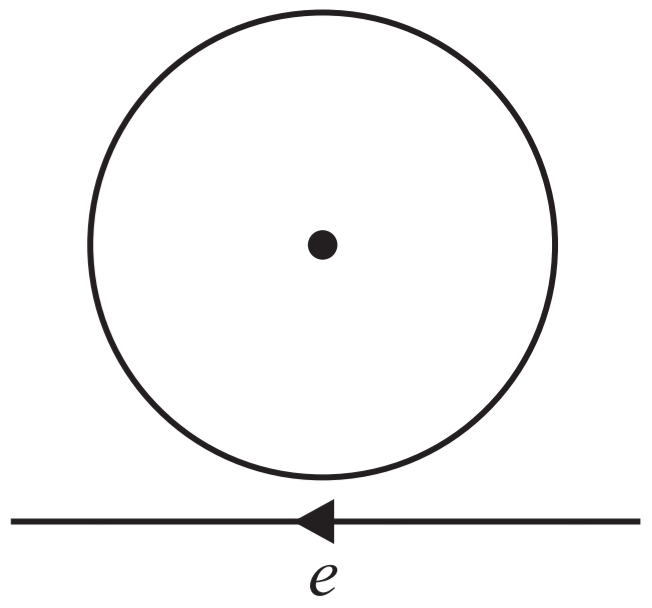
  1. Near a circular loop of conducting wire as shown in the figure, an electron moves along a straight line. The direction of the induced current if any in the loop is:
  1. Variable.
  2. Clockwise.
  3. Anticlockwise.
  4. Zero.
  1. Two identical circular coils A and Bare kept in a horizontal tube side by side without touching each other. If the current in the coil A increases with time, in response, the coil B:
  1. Is attracted by A.
  2. Remains stationary.
  3. Is repelled.
  4. Rotates.
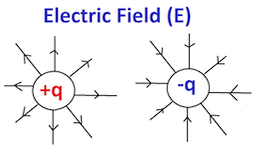
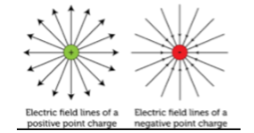
Electric field intensity at any point is the strength of the electric field at that point. It is also defined as the force experienced by unit positive charge placed at that point. Electric Field Intensity is a vector quantity. It is denoted by E. When placed within the electric field, the test charge will experience an electric force - either attractive or repulsive.
Image
(i) The Electric field at a point is
(a) discontinuous only if there is a negative charge at that point
(b) always continuous
(c) continuous if there is charge at that point
(d) continuous if there is no charge at that point

(ii) A charge is distributed uniformly over a ring of radius a. Obtain an expression for the electric intensity E at a point on the axis of the ring. Hence the points at large distances from the ring, it behaves like a point charge is:
(a) $E =\frac{1}{4 \pi \varepsilon_0} \cdot \frac{q}{x}$
(b) $E =\frac{1}{2 \pi \varepsilon_0} \cdot \frac{Q}{x^2}$
(c) $E =\frac{1}{4 \pi \varepsilon_0} \cdot \frac{q}{x^4}$
(d) $E =\frac{1}{4 \pi \varepsilon_0} \cdot \frac{Q}{x^2}$

(iii) Force acting on an electron in a uniform electric field of $5 \times 10^4 N / C$ is:
(a) $8 \times 10^{-15} N$
(b) $-7 \times 10^{-15} N$
(c) $-8 \times 10^{-15} N$
(d) $7 \times 10^{-15} N$

(iv) At a particular point, the electric field depends upon:
(a) source charge Q only
(b) both Q and q
(c) test charge $q_0$ only
(d) neither Q nor q

OR

Four charges of the same magnitude and same sign are placed at the corners of a square, of each side 0.1 m. then electric field intensity at the centre of the square is:
(a) $0.01 N / C$
(b) $0.25 N / C$
(c) zero
(d) $0.1 N / C$

A charge is a property associated with the matter due to which it experiences and produces an electric and magnetic field. Charges are scalar in nature and they add up like real numbers. Also, the total charge of an isolated system is always conserved. When the objects rub against each other charges acquired by them must be equal and opposite.
Image
(i) The cause of charging is:
(a) the actual transfer of atoms
(b) the actual transfer of protons
(c) the actual transfer of electrons
(d) the actual transfer of neutrons

(ii) Pick the correct statement.
i. The glass rod gives protons to silk when they are rubbed against each other.
ii. The glass rod gives electrons to silk when they are rubbed against each other.
iii. The glass rod gains protons from silk when they are rubbed against each other.
iv. The glass rod gains electrons when they are rubbed against each other.
(a) Option (i) (b) Option (iv) (c) Option (iii) (d) Option (ii)

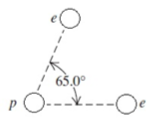
(iii) If two electrons are each $1.5 \times 10^{-10} m$ from a proton, as shown in Figure, magnitude of the net electric force they will exert on the proton is
Image

(a) $1.97 \times 10^{-8} N$
(b) $3.83 \times 10^{-8} N$
(c) $4.63 \times 10^{-8} N$
(d) $2.73 \times 10^{-8} N$

(iv) A charge is a property associated with the matter due to which it produces and experiences:
(a) electric effects only
(b) magnetic effects only
(c) both electric and magnetic effects
(d) non magnetic effects only

OR

The cause of quantization of electric charges is:
(a) transfer of an integral number of electrons
(b) transfer of an integral number of neutrons
(c) transfer of an integral number of protons
(d) transfer of an integral number of Atom
Why is it found experimentally difficult to detect neutrinos in nuclear $\beta$-decay?
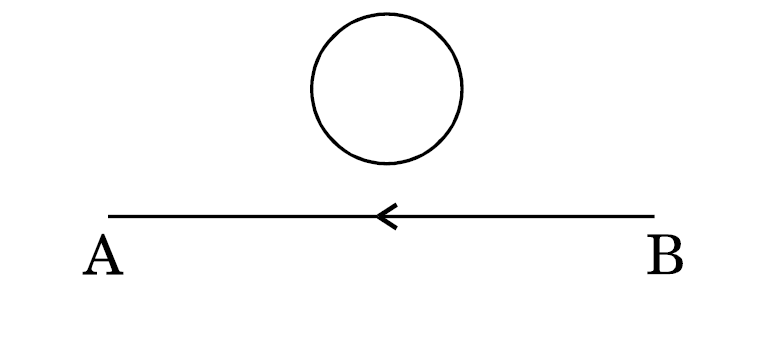
The electric current flowing in a wire in the direction from B to A is decreasing. Find out the direction of the induced current in the metallic loop kept above the wire as shown.
A slide projector has to project a 35mm slide (35mm × 23mm) on a 2m × 2m screen at a distance of 10m from the lens. What should be the focal length of the lens in the projector?
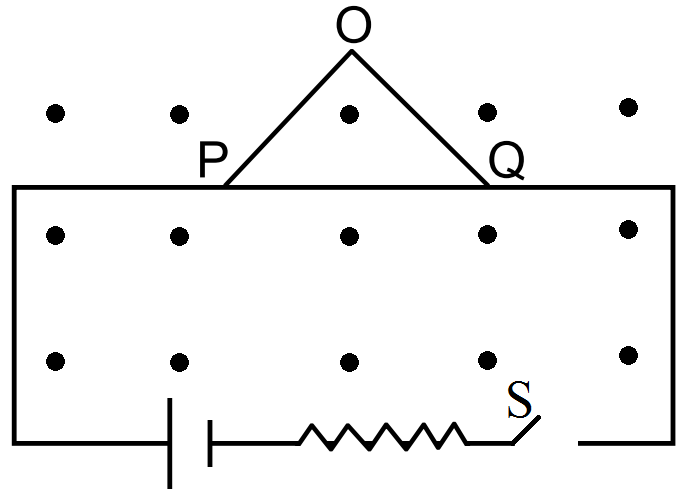
Shows a rod PQ of length 20.0cm and mass 200g suspended through a fixed point O by two threads of lengths 20.0cm each. A magnetic field of strength 0.500T exists in the vicinity of the wire PQ, as shown in the figure. The wires connecting PQ with the battery are loose and exert no force on PQ.
  1. Find the tension in the threads when the switch S is open.
  2. A current of 2.0A is established when the switch S is closed. Find the tension in the threads now.
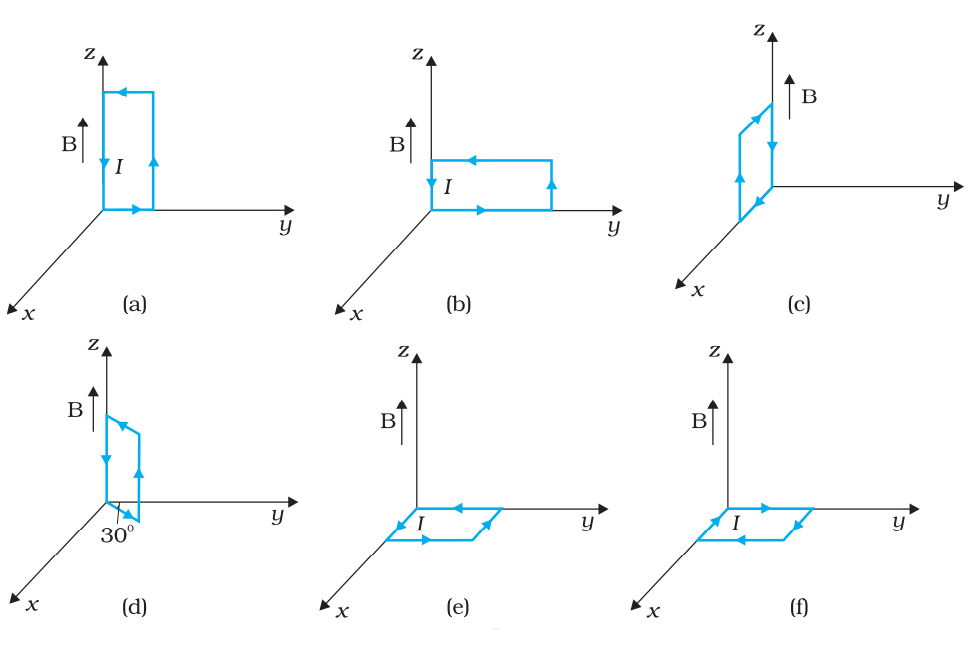
A uniform magnetic field of 3000 G is established along the positive z-direction. A rectangular loop of sides 10 cm and 5 cm carries a current of 12 A. What is the torque on the loop in the different cases shown in Fig.? What is the force on each case? Which case corresponds to stable equilibrium?
Mr. Verma (50kg) and Mr. Mathur (60kg) are sitting at the two extremes of a 4m long boat (40kg) standing still in water. To discuss a mechanics problem, they come to the middle of the boat. Neglecting friction with water, how far does the boat move on the water during the process?
Niels Bohr introduced the atomic Hydrogen model in 1913. He described it as a positively charged nucleus, comprised of protons and neutrons, surrounded by a negatively charged electron cloud. In the model, electrons orbit the nucleus in atomic shells. The atom is held together by electrostatic forces between the positive nucleus and negative surroundings.

Bohr correctly proposed that the energy and radii of the orbits of electrons in atoms are quantized, with energy for transitions between orbits given by
$\triangle\text{E}=\text{h}\upsilon=\text{E}_\text{i}-\text{E}_\text{f}$ where $\triangle\text{E}$ is the change in energy between the initial and final orbits and $\text{h}\upsilon$ is the energy of an absorbed or emitted photon.
  1. In the Bohr model of the hydrogen atom, discrete radii and energy states result when an electron circles the atom in an integer number of
  1. De Broglie wavelengths
  2. Wave frequencies
  3. Quantum numbers
  4. Diffraction patterns.
  1. The angular speed of the electron in the $n^{th}$ orbit of Bohr's hydrogen atom is.
  1. Directly proportional to n
  2. Inversely proportional to $\sqrt{\text{n}}$
  3. Inversely proportional to $n^2$
  4. Inversely proportional to $n^3$
  1. When electron jumps from n = 4 level to n = 1 level, the angular momentum of electron changes by.
  1. $\frac{\text{h}}{2\pi}$
  2. $\frac{\text{h}}{\pi}$
  3. $\frac{\text{3h}}{2\pi}$
  4. $\frac{\text{2h}}{\pi}$
  1. The lowest Bohr orbit in hydrogen atom has.
  1. The maximum energy
  2. The least energy
  3. Infinite energy
  4. Zero energy
  1. Which of the following postulates of the Bohr model led to the quantization of energy of the hydrogen atom?
  1. The electron goes around the nucleus in circular orbits.
  2. The angular momentum of the electron can only be an integral multiple of $\frac{\text{h}}{2\pi}$.
  3. The magnitude of the linear momentum of the electron is quantized.
  4. Quantization of energy is itself a postulate of the Bohr model.