MCQ
When a rolling body enters onto a smooth horizontal surface, it will ............
  • Continue rolling
  • B
    Starts slipping
  • C
    Come to rest
  • D
    Slipping as well as rolling

Answer

Correct option: A.
Continue rolling
a
(a)

Smooth surface won't be able to change $w$ or $v$ of the body. So to conserve its angular momentum it will continue to roll on the smooth surface.

Need a full question paper?

Generate a complete, print-ready paper with questions like this in minutes — across 16+ boards, with answer keys.

Start Generating Free

Similar questions

Two forces ${\vec F_1} = 5\hat i + 10\hat j - 20\hat k$ and ${\vec F_2} = 10\hat i - 5\hat j - 15\hat k$ act on a single point. The angle between ${\vec F_1}$ and ${\vec F_2}$ is nearly ....... $^o$
A point source of light moves in a straight line parallel to a plane table. Consider a small portion of the table directly below the line of movement of the source. The illuminance at this portion varies with its distance $r$ from the source as
Particle $A$ of mass $m_{A}=\frac{m}{2}$ moving along the $x-$axis with velocity $v_{0}$ collides elastically with another particle $B$ at rest having mass $m _{ B }=\frac{ m }{3}$ If both particles move along the $x-$axis after the collision, the change $\Delta \lambda$ in $de-$Broglie wavelength of particle $A,$ in terms of its $de-$Broglie wavelength $\left(\lambda_{0}\right)$ before collision is
Which of the following is true
Refractive index of glass is $\frac{3}{2}$ and refractive index of water is $\frac{4}{3}$. If the speed of light in glass is $2.00 \times {10^8} m/s,$ the speed in water will be
In the following sequence of reactions,

$\mathrm{C}_{3} \mathrm{H}_{6} \stackrel{\mathrm{H}^{+} / \mathrm{H}_{2} \mathrm{O}}{\longrightarrow} A\xrightarrow[dil.\,KOH]{KIO} B+C$

The compounds $B$ and $C$ respectively are :
Two waves are approaching each other with a velocity of $16 m/s$ and frequency $n.$ The distance between two consecutive nodes is
The velocity of a particle is $v = v _{0}+ gt + Ft ^{2}$. Its position is $x=0$ at $t=0$; then its displacement after time $( t =1)$ is :
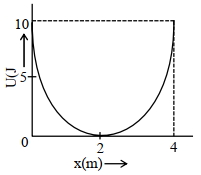
A mass of $5\, {kg}$ is connected to a spring. The potential energy curve of the simple harmonic motion executed by the system is shown in the figure. A simple pendulum of length $4\, {m}$ has the same period of oscillation as the spring system. What is the value of acceleration due to gravity on the planet where these experiments are performed? (In ${m} / {s}^{2}$)
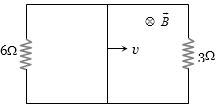
A rectangular loop with a sliding connector of length $l = 1.0 \,m$ is situated in a uniform magnetic field $B = 2\,T$ perpendicular to the plane of loop. Resistance of connector is $r = 2$ $\Omega$ Two resistance of $6$ $\Omega$ and $3$ $\Omega$ are connected as shown in figure. The external force required to keep the connector moving with a constant velocity $v = 2\,m/s$ is........$N$