MCQ
When a telescope is adjusted for parallel light, the distance of the objective from the eye piece is found to be $80 \mathrm{~cm}$. The magnifying power of the telescope is $19.$ The focal lengths of the lenses are
  • A
    $61 \mathrm{~cm}, 19 \mathrm{~cm}$
  • B
    $40 \mathrm{~cm}, 40 \mathrm{~cm}$
  • $76 \mathrm{~cm}, 4 \mathrm{~cm}$
  • D
    $50 \mathrm{~cm}, 30 \mathrm{~cm}$

Answer

Correct option: C.
$76 \mathrm{~cm}, 4 \mathrm{~cm}$
$f_o+f_e=80$ and $\frac{f_o}{f_e}=19 \Rightarrow f=76$ and $f=4 \mathrm{~cm}$.

Need a full question paper?

Generate a complete, print-ready paper with questions like this in minutes — across 16+ boards, with answer keys.

Start Generating Free

Similar questions

In a thermodynamics process, pressure of a fixed mass of a gas is changed in such a manner that the gas releases $20 \mathrm{~J}$ of heat and 8J of work is done on the gas. If the initial internal energy of the gas was $30 \%$. The final internal energy will be
The unit of angular acceleration in the SI system is
The maximum kinetic energy of photoelectrons emitted from a surface when photons of energy $6 \mathrm{eV}$ fall on it is $4 \mathrm{eV}$. The stopping potential in volts is
The kinetic energy $k$ of a particle moving along a circle of radius $R$ depends on the distance covered $s$ as $k=a s^2$ where $a$ is a constant. The force acting on the particle is
A wire when connected to $220 V$ mains supply has power dissipation $P_1$. Now the wire is cut into two equal pieces which are connected in parallel to the same supply. Power dissipation in this case is $P_2$. Then $P_2: P_1$ is
Two putty balls of equal mass moving with equal velocity in mutually perpendicular directions, stick together after collision. If the balls were initially moving with a velocity of $45 \sqrt{2} \mathrm{~ms}^{-1}$ each, the velocity of their combined mass after collision is
A force of $2 \hat{i}+3 \hat{j}+4 \hat{k}\ N$ acts on a body for 4 second, produces a displacement of $(3 \hat{i}+4 \hat{j}+5 \hat{k})\ m$. The power used is
The amount of work done in an adiabatic expansion from temperature $T$ to $T_1$ is
Light of wavelength is $7200 \mathring A$ in air. It has a wavelength in glass ( $\mu=1.5$ ) equal to
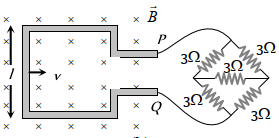
A square metallic wire loop of side $0.1 \mathrm{~m}$ and resistance of $1\  \Omega$ is moved with a constant velocity in a magnetic field of $2\  \mathrm{wb} / \mathrm{m}$ as shown in figure. The magnetic field is perpendicular to the plane of the loop, loop is connected to a network of resistances. What should be the velocity of loop so as to have a steady current of $1 \mathrm{~mA}$ in loop
Image