Question
When a transformer is known as an ideal transformer?

Answer

In an ideal transformer, there is no loss in energy on transferring the energy from primary coil to secondary coil and then the value of power is same in both the coils. Efficiency of such transformer should be $100 \%$.

Need a full question paper?

Generate a complete, print-ready paper with questions like this in minutes — across 16+ boards, with answer keys.
Start Generating Free

Similar questions

Applied voltage in any ac circuit is 220 V . If $R =8 \Omega, X _{ L }= X _{ C }=6 \Omega$, then find the value of the following :(a) root mean square value of the voltage,
(b) impedance of the circuit.
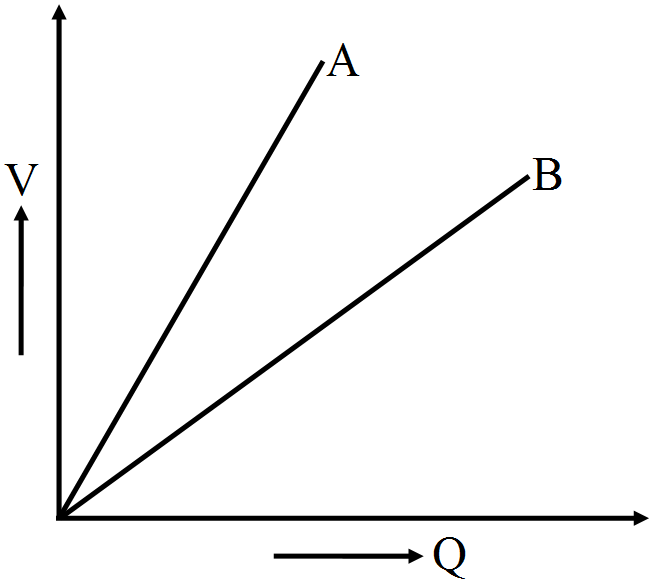
The graph shows the variation of voltage ‘V’ across the plates of two capacitors A and B versus increase of charge ‘Q’ stored on them. Which of the two capacitors has higher capacitance? Give reason for your answer.
An electron is moving a along +ve x-axis in the presence of uniform magnetic field along +ve y-axis. What is the direction of the force acting on it?
On a winter day the temperature of the tap water is $20^{\circ} \mathrm{C}$ whereas the room temperature is $5^{\circ} \mathrm{C}$. Water is stored in a tank of capacity $0.5 \mathrm{~m}^3$ for household use. If it were possible to use the heat liberated by the water to lift a 10 kg mass vertically, how high can it be lifted as the water comes to the room temperature? Take $\mathrm{g}=10 \mathrm{~m} \mathrm{~s}^{-2}$.
If in any electric circuit, phase of current lags the phase of potential difference by 90°, then what is the nature of reactance of the circuit?
A capacitor of capacity C is charged with a potential difference V. What will be the value of electric flux passing through the surface around the capacitor?
${ }^{32} \mathrm{P}$ beta-decays to ${ }^{32} \mathrm{S}$. Find the sum of the energy of the antineutrino and the kinetic energy of the $\beta$-particle. Neglect the recoil of the daughter nucleus. Atomic mass of ${ }^{32} \mathrm{P}=31.974 \mathrm{u}$ and that of ${ }^{32} \mathrm{~S}=31.972 \mathrm{u}$.
Can we have a single north pole? A single south pole?
Show that the minimum energy needed to separate a proton from a nucleus with Z protons and N neutrons is:
$\Delta\text{E}=(\text{M}_{\text{Z}-1,\text{N}}+\text{M}_{\text{H}}-\text{M}_{\text{Z,N}})\text{c}^2$
where $M_{\text{Z,N}}=$ mass of an atom with Z protons and N neutrons in the nucleus and $M_H=$ mass of a hydrogen atom. This energy is known as proton-separation energy.
An inductor and a resistor are joined in series with any ac source. What is the phase difference in the potential difference across their ends?