MCQ
When a tuning fork vibrates, the waves produced in the fork are
  • Longitudinal
  • B
    Transverse
  • C
    Progressive
  • D
    Stationary

Answer

Correct option: A.
Longitudinal
a
(a) when a tuning fork vibrates waves are produced in the stem are longitudnal.

Need a full question paper?

Generate a complete, print-ready paper with questions like this in minutes — across 16+ boards, with answer keys.

Start Generating Free

Similar questions

A wave pulse, travelling on a two -piece string, gets partially reflected and partially transmitted at the junction. The reflected wave is inverted in shape as compared to the incident one. If the incident wave has wavelengt $\lambda$ and the transmitted wave $\lambda'.$
Radiation from a black body at the thermodynamic temperature $T_1$ is measured by a small detector at distance $d_1$ from it. When the temperature is increased to $T_2$ and the distance to $d_2$ , the power received by the detector is unchanged . What is the ratio $d_2/d_1$ ?
When frequency of oscillations is high then motion is called:
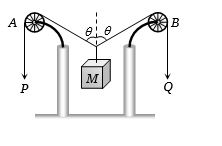
In the arrangement shown in figure the ends $P$ and $Q$ of an unstretchable string move downwards with uniform speed $ U$. Pulleys $A$ and $B$ are fixed. Mass $M$ moves upwards with a speed
A Young's double slit experiment is performed with white light:
Two bodies of masses $1 kg$  and $5 kg$  are dropped gently from the top of a tower. At a point $20 cm$  from the ground, both the bodies will have the same
The average distance a molecule can travel without colliding is called as:
Assume that a tunnel is dug along a chord of the earth, at a perpendicular distance $( R / 2)$ from the earth's centre, where $'R'$ is the radius of the Earth. The wall of the tunnel is frictionless. If a particle is released in this tunnel, it will execute a simple harmonic motion with a time period
In an experiment, brass and steel wires of length $1\,m$ each with areas of cross section $1\,mm^2$ are used. The wires are connected in series and one end of the combined wire is connected to a rigid support and other end is subjected to elongation. The stress requires to produced a new elongation of $0.2\,mm$ is [Given, the Young’s Modulus for steel and brass are respectively $120\times 10^9\,N/m^2$ and $60\times 10^9\,N/m^2$ ]
A particle moves in east direction with $15 \,m/sec$. for $2\, sec$ then moves northward with $5\, m/sec$. for  $8 \,sec$. then average velocity of the particle is