MCQ
When an alpha particle is emitted from a radioactive source:
  • A
    Its atomic number increases by $4$
  • Its atomic number decreases by $2$
  • C
    Its atomic number increases by $2$
  • D
    It atomic number decreases by $4$

Answer

Correct option: B.
Its atomic number decreases by $2$

When an alpha particle is emitted from a radioactive source or substance, its atomic number decreases by $2$ and its atomic mass decreases by $4$, which is same as that of helium ion.

Need a full question paper?

Generate a complete, print-ready paper with questions like this in minutes — across 16+ boards, with answer keys.
Start Generating Free

Similar questions

A body of mass $M$ and charge $q$ is connected to a spring of spring constant $k$. It is oscillating along $x-$ direction about its equilibrium position, taken to be at $x = 0$, with an amplitude $A$. An electric field $E$ is applied along the $x-$ direction. Which of the following statements is correct?
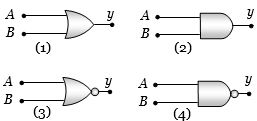
Given below are four logic gate symbol (figure). Those for $OR, NOR$ and $NAND $are respectively
In a common emitter transistor, the current gain is 80. What is the change in collector current, when the change in base current is 250 mA
The radius of a circular loop is $r$ and a current $i$ is flowing in it. The equivalent magnetic moment will be
Choose the incorrect statement from the following: When two identical capacitors are charged individually to different potentials and connected parallel to each other after disconnecting them from the source
Assertion : Circuit containing capacitors should be handled cautiously even when there is no current.
Reason : The capacitors are very delicate and so quickly break down..
Given below are two statements:

Statement $I$: An $AC$ circuit undergoes electrical resonance if it contains either a capacitor or an inductor.

Statement $II$: An $AC$ circuit containing a pure capacitor or a pure inductor consumes high power due to its non-zero power factor.

In the light of above statements, choose the correct answer from the options given below

The ratio of the intensity at the centre of a bright fringe to the intensity at a point one-quarter of the distance between two fringe from the centre is
In which of the following decay, the element does not change
A small conducting sphere of radius $r$ is lying concentrically inside a bigger hollow conducting sphere of radius $R.$ The bigger and smaller spheres are charged with $Q$ and $q (Q > q)$ and are insulated from each other. The potential difference between the spheres will be