MCQ
When an electron in a hydrogen atom makes a transition from $2^{nd}$ excited state to ground state, it emits a photon of frequency $f$ . The frequency of photon emitted when an electron of $Li^{++}$ makes a transition from $1^{st}$ excited state to ground state is
  • $\frac{{243}}{{32}}f$
  • B
    $\frac{{81}}{{32}}f$
  • C
    $\frac{{243}}{8}f$
  • D
    $\frac{{27}}{8}f$

Answer

Correct option: A.
$\frac{{243}}{{32}}f$
a
$\mathrm{f}=\mathrm{C} \times 1^{2}\left(\frac{1}{1^{2}}-\frac{1}{9}\right)=\frac{8}{9} \mathrm{C}$

$f=C \times 3^{2}\left(\frac{1}{1^{2}}-\frac{1}{2^{2}}\right)=\frac{27}{4} C=\frac{27}{4} \times \frac{9 f}{8}$

Need a full question paper?

Generate a complete, print-ready paper with questions like this in minutes — across 16+ boards, with answer keys.

Start Generating Free

Similar questions

To explain his theory, Bohr used
A hollow lens is made of thin glass and in the shape of a double concave lens. It can be filled with air, water of refractive index $1.33$ or $CS _2$ of refractive index $1.6$. It will act as a diverging lens, if it is
The conduction band and valency band of a good conductor are:
An electromagnetic wave going through vacuum is described by $\text{E}=\text{E}_0\sin(\text{kx}-\omega\text{t})$ which of the following is/are independent of the wavelength?
Two similar bar magnets $P $ and $Q$ , each of magnetic moment $M,$  are taken, If $P$ is cut along its axial line and $Q$ is cut along its equatorial line, all the four pieces obtained have
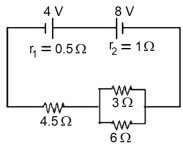
In the circuit diagram shown in figure given below, the current flowing through resistance $3\, \Omega$ is $\frac{ x }{3}\,A$. The value of $x$ is $...........$
Two parallel wires of length $9 m$ each are separated by a distance $0.15 m$. If they carry equal currents in the same direction and exerts a total force of $30 \times 10^{-7} N$ on each other, then the value of current must be
Zener diode acts as $a/an$ :
A potential difference of 42,000 volts is used in an X-ray tube to accelerate electrons. The maximum frequency of the X–radiations produced is (1 eV = $1.6 \times 10^{-19} \mathrm{~J}$ and h =$6.63 \times 10^{-34} \mathrm{~J}-\mathrm{sec}$)
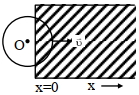
A constant magnetic field of $1 \,{T}$ is applied in the ${x}\,>\,0$ region. A metallic circular ring of radius $1 \,{m}$ is moving with a constant velocity of $1 \,{m} / {s}$ along the $x$-axis. At $t=0$ $s,$ the centre of $O$ of the ring is at ${x}=-1 \,{m}$. What will be the value of the induced $emf$ in the ring at $t=1\, s$ ? (Assume the velocity of the ring does not change.) (In ${V}$)