Question
When an ideal capacitor is charged by a dc battery, no current flows. However, when an ac source is used, the current flows continuously. How does one explain this, based on the concept of displacement current?

Answer

When an ideal capacitor is charged by dc battery, charge flows $($momentarily$)$ till the capacitor gets fully charged.
When an ac source is connected then conduction current $\text{i}_{c} =\frac{\text{dq}}{\text{dt}}$ keep on flowing in the connecting wires.
Due to changing current, charge deposited on the plates of the capacitor changes with time.
This causes change in electric field between the plates of the capacitor which causes the electric flux to change and gives rise to a displacement current in the region between the plates of the capacitor.
​​​​​​​Displacement current $i_d$ is given by $i_{d } = \in_{0}\frac{\text{dq}_{E}}{\text{dt}}$ and is equal to the conduction current at all instants.

Need a full question paper?

Generate a complete, print-ready paper with questions like this in minutes — across 16+ boards, with answer keys.
Start Generating Free

Similar questions

Light is incident from glass $(\mu=1.5)$ to air. Sketch the variation of the angle of deviation $\delta$ with the angle of incident i for 0 < i < 90°.
  1. Can two equipotential surfaces intersect each other? Give reasons.
  2. Two charges – q and +q are located at points A (0, 0, –a) and B (0, 0, +a) respectively. How much work is done in moving a test charge from point P (7, 0, 0) to Q (-3, 0, 0)?
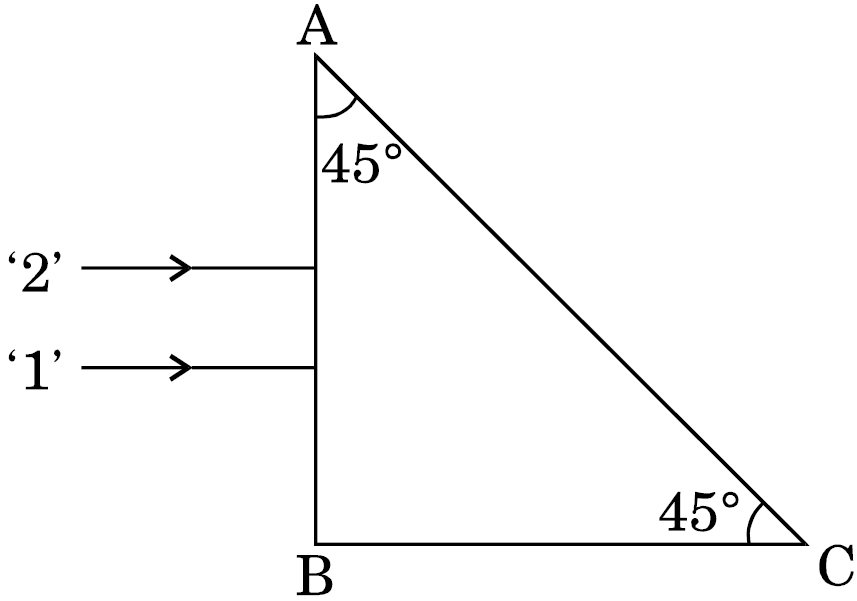
Two monochromatic rays of light are incident normally on the face AB of an isosceles right-angled prism ABC. The refractive indices of the glass prism for the two rays ‘1’ and ‘2’ are respectively 1.3 and 1.5 Trace the path of these rays after entering through the prism.
A light bulb is rated at $100 W$ for a $220 V$ supply. Find (a) the resistance of the bulb; (b) the peak voltage of the source; and (c) the rms current through the bulb.
Under what condition, force on moving charged particle in a magnetic field will be (i) maximum (ii) minimum?
Derive Einstein's Photoelectric equation.
A converging lens and a diverging lens of the same focal length are placed coaxially in contact with each other. Find the focal length and power of the combination.
Light from Balmer series of hydrogen is able to eject photoelectrons from a metal. What can be the maximum work function of the metal?
The contact angle between pure water and pure silver is $90^\circ .$ If a capillary tube made of silver is dipped at one end in pure water, will the water rise in the capillary?
Show that the interior of a conductor can have no excess charge in the static situation.