Question
When an ideal capacitor is charged by a dc battery, no current flows. However, when an ac source is used, the current flows continuously. How does one explain this, based on the concept of displacement current?

Answer

When an ideal capacitor is charged by dc battery, charge flows (momentarily) till the capacitor gets fully charged. When an ac source is connected then conduction current $\text{i}_{c} =\frac{\text{dq}}{\text{dt}}$ keep on flowing in the connecting wires.
Due to changing current, charge deposited on the plates of the capacitor changes with time.This causes change in electric field between the plates of the capacitor which causes the electric flux to change and gives rise to a displacement current in the region between the plates of the capacitor. Displacement current id is given by i$ = \in_{0}\frac{\text{dq}_{E}}{\text{dt}}$ and is equal to the conduction current at all instants.

Need a full question paper?

Generate a complete, print-ready paper with questions like this in minutes — across 16+ boards, with answer keys.
Start Generating Free

Similar questions

Metallic (nonferromagnetic) and nonmetallic particles in a solid waste may be separated as follows. The waste is allowed to slide down an incline over permanent magnets. The metallic particles slow down as compared to the norunetallic ones and hence are separated. Discuss the role of eddy currents in the process.
The refractive index of a material is. What is the angle of refraction if the unpolarised light is incident on it at the polarising angle of the medium?
Define equipotential surface. Write its characteristics.
Derive the equation of intensity of resultant wave generated due to super postion (or interference) of waves generated from two coherent sources.
In a Young's double slit experiment $\lambda=500\text{nm},$ d = 1.0mm and D = 1.0m. Find the minimum distance from the central maximum for which the intensity is half of the maximum intensity.
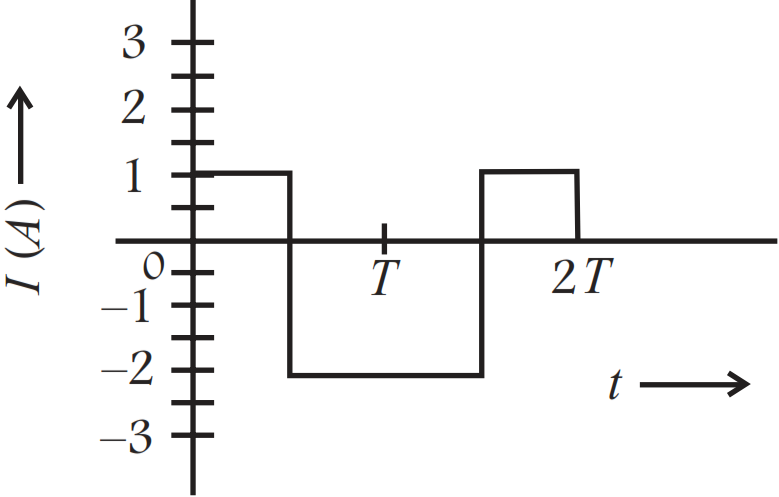
The alternating current in a circuit is described by the graph shown in Fig. Show rms current in this graph.

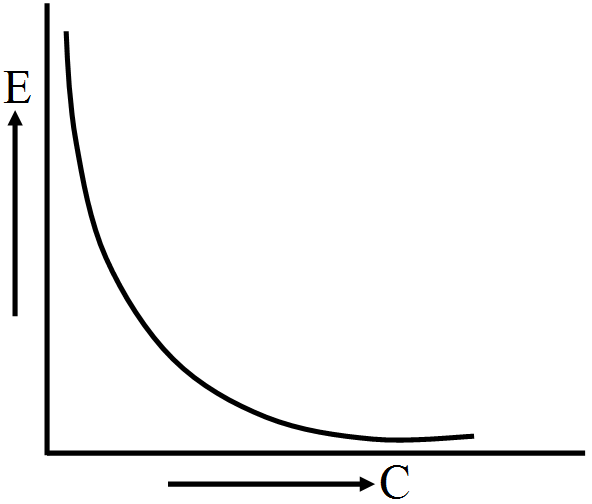
The graph shown here shows the variation of total energy (E) stored in a capacitor against the value of the capacitance (C) itself. Which of the two: the charge on capacitor or the potential used to charge it, is kept constant for this graph?

Answer the following questions:
A high tension (HT) supply of, say, 6 kV must have a very large internal resistance. Why?
The radius of a spherical conductor shell is $R$ and the charge on it is $Q$. Compare the potential at a distance 2 R from the centre of the sphere with the potential at a distance $R / 2$.
Define the SI unit of the magnetic field.