Question
When an insulator is placed in an external field, the dipoles become aligned. Induced surface charges on the insulator establish a polarization field $\vec{\text{E}}_\text{i}$ in its interior. The net field $\vec{\text{E}}$ in the insulator is the vector sum of $\vec{\text{E}}_0$ and $\vec{\text{E}}_\text{i}$ as shown in the figure.
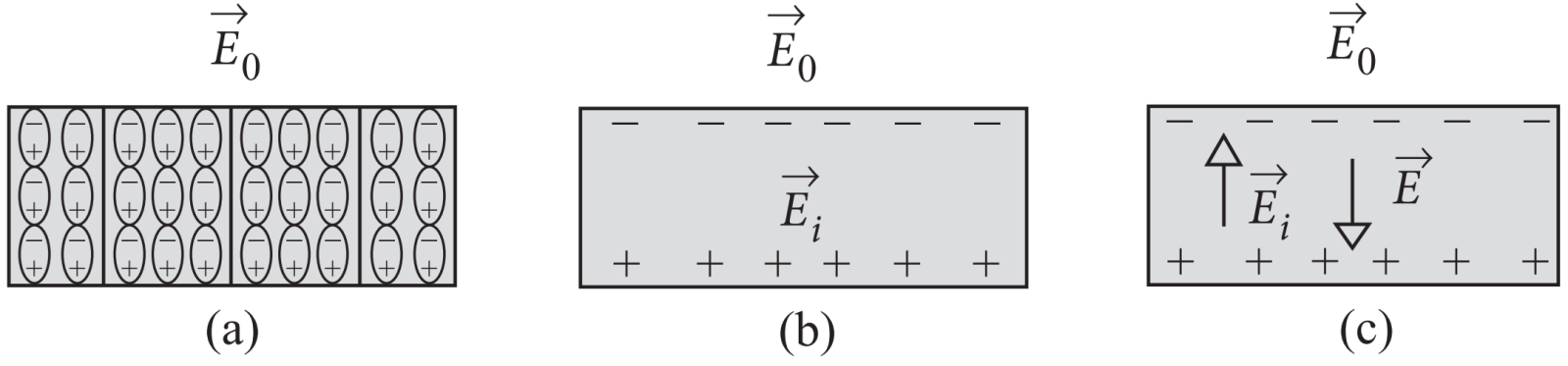
On the application of external electric field, the effect of aligning the electric dipoles in the insulator is called polarisation, and the field $\vec{\text{E}}_\text{i}$ is known as the polarisation field.

The dipole moment per unit volume of the dielectric is known as polarisation $(\vec{\text{P}}).$ For linear isotropic dielectrics, $\vec{\text{P}}=\chi\vec{\text{E}},$ where $\chi=$ electrical susceptibility of the dielectric medium.

  1. Which among the following is an example of polar molecule?
  1. O2
  2. H2
  3. N2
  4. HCI
  1. When air is replaced by a dielectric medium of constant K, the maximum force of attraction between two charges separated by a distance:
  1. Increases K times.
  2. Remains unchanged.
  3. Decreases K times.
  4. Increases 2K times.
  1. Which of the following is a dielectric?
  1. Copper.
  2. Glass.
  3. Antimony (Sb).
  4. None of these.
  1. For a polar molecule, which of the following statements is true?
  1. The centre of gravity of electrons and protons coincide.
  2. The centre of gravity of electrons and protons do not coincide.
  3. The charge distribution is always symmetrical.
  4. The dipole moment is always zero.
  1. When a comb rubbed with dry hair attracts pieces of paper. This is because the?
  1. Comb polarizes the piece of paper.
  2. Comb induces a net dipole moment opposite to the direction of field.
  3. Electric field due to the comb is uniform.
  4. Comb induces a net dipole moment perpendicular to the direction of field.

Answer

  1. (d) HCI

Explanation:

ln polar molecule the centres of positive and negative charges are separated even when there is no external field. Such molecule have a permanent dipole moment. Ionic molecule like HCI is an example of polar molecule.

  1. (c) Decreases K times.

Explanation:

As $\text{F}_\text{m}=\frac{\text{F}_0}{\text{K}}$

$\therefore$ The maximum force decreases by Klimes.

  1. (b) Glass.
  2. (b) The centre of gravity of electrons and protons do not coincide.

​​​​​​​​​​​​​​​​​​​​​Explanation:

A polar molecule is one in which the centre of gravity for positive and negative charges are separated.

  1. (a) Comb polarizes the piece of paper.

Need a full question paper?

Generate a complete, print-ready paper with questions like this in minutes — across 16+ boards, with answer keys.

Start Generating Free

Similar questions

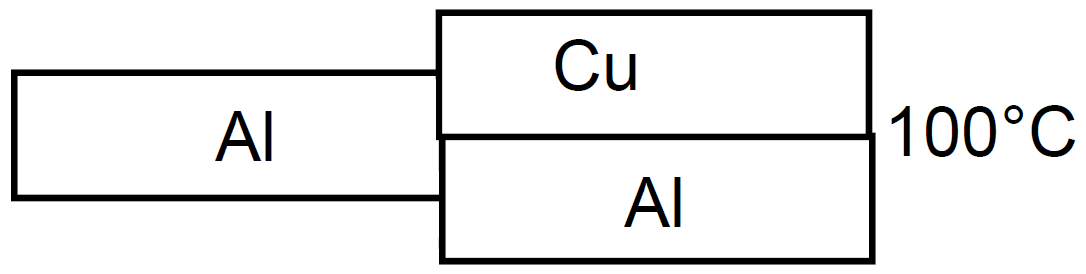
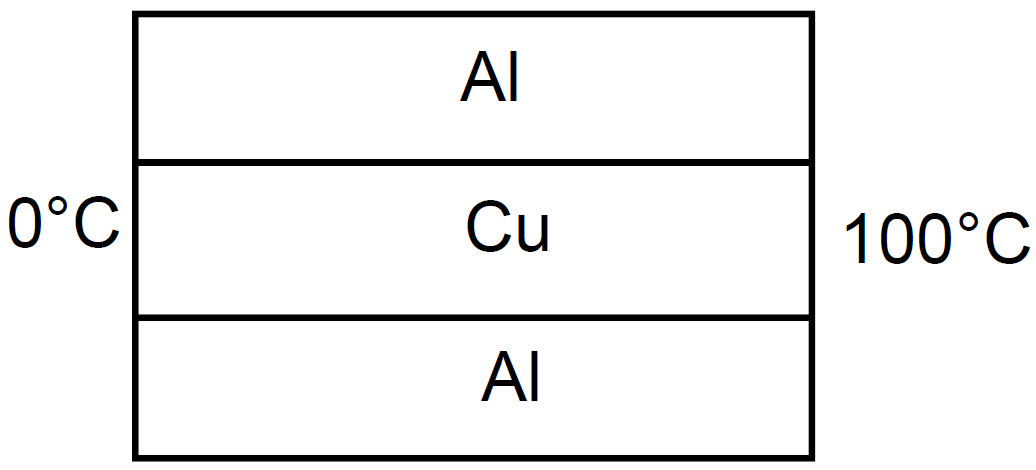
The three rods shown in figure, have identical geometrical dimensions. Heat flows from the hot end at a rate of 40 Win the arrangement (a) Find the rates of heat flow when the rods are joined as in arrangement (b) and in (c) Thermal conductivities of aluminium and copper are 200Wm-1°C-1 and 400Wm-1°C-1 respectively.

  1.  

  1.  

  1.  

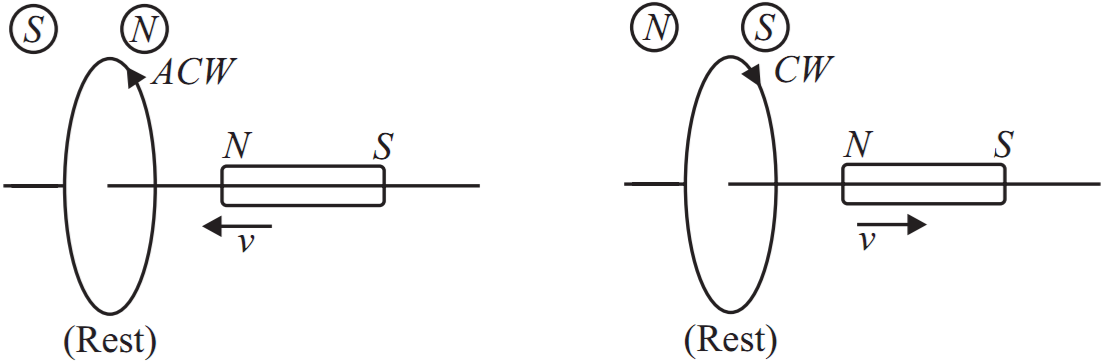
Lenz's law states that the direction of induced current in a circuit is such that it opposes the change which produces it. Tims, if the magnetic flux linked with a closed circuit increases, the induced current flows in such a direction that a magnetic flux is created in the opposite direction of the original magnetic flux. If the magnetic flux linked with the closed circuit decreases, the induced current flows in such a direction so as to create a magnetic flux in the direction of the original flux.

  1. Which of the following statements is correct?
  1. The induced e.m.f is not in the direction opposing the change in magnetic flux so as to oppose the cause which produces it.
  2. The relative motion between the coil and magnet produces change in magnetic flux.
  3. Emf is induced only if the magnet is moved towards coil.
  4. Emf is induced only if the coil is moved towards magnet.
  1. The polarity of induced emf is given by:
  1. Ampere's circuital law.
  2. Biot-Savart law.
  3. Lenz's law.
  4. Fleming's right hand rule.
  1. Lenz's law is a consequence of the law of conservation of:
  1. Charge.
  2. Mass.
  3. Momentum.
  4. Energy.
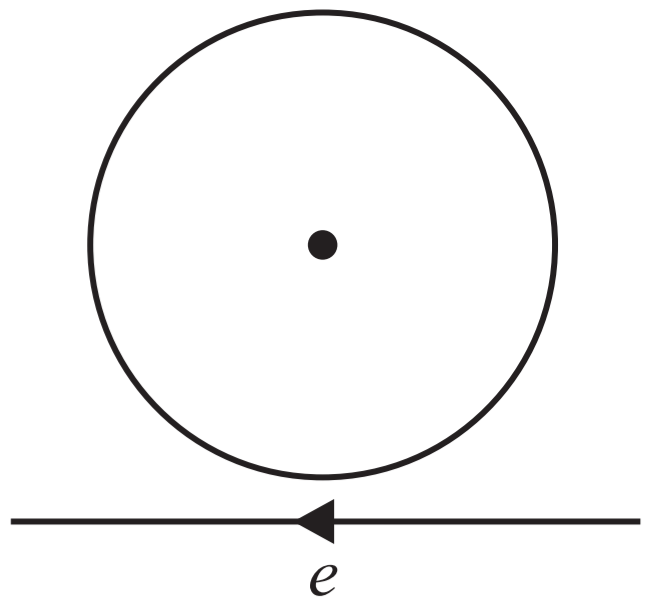
  1. Near a circular loop of conducting wire as shown in the figure, an electron moves along a straight line. The direction of the induced current if any in the loop is:

  1. Variable.
  2. Clockwise.
  3. Anticlockwise.
  4. Zero.
  1. Two identical circular coils A and Bare kept in a horizontal tube side by side without touching each other. If the current in the coil A increases with time, in response, the coil B:
  1. Is attracted by A.
  2. Remains stationary.
  3. Is repelled.
  4. Rotates.
A car starts from rest on a half kilometer long bridge. The coefficient of friction between the tyre and the road is 1.0. Show that one cannot drive through the bridge in less than 10s.
Show that the magnetic field at a point due to a magnetic dipole is perpendicular to the magnetic axis if the line joining the point with the centre of the dipole makes an angle of $\tan^{-1}(\sqrt{2})$ with the magnetic axis.
A lady cannot see objects closer than 40cm from the left eye and closer than 100cm from the right eye. While on a mountaineering trip, she is lost from her team. She tries to make an astronomical telscope from her reading glasses to look for her teammates.
  1. Which glass should she use as the eyepiece?
  2. What magnification can she get with relaxed eye?
A small coin is placed on a record rotating at $33\frac{1}{3}$ rev/ minute. The coin does not slip on the record. Where does it get the required centripetal force from?
A police jeep is chasing a culprit going on a motorbike. The motorbike crosses a turning at a speed of 72km/h. The jeep follows it at a speed of 90km/h, crossing the turning ten seconds later than the bike. Assuming that they travel at constant speeds, how far from the turning will the jeep catch up with the bike?
Out of the two magnetic materials, 'A' has relative permeability slightly greater than unity while 'B' has less than unity. Identify the nature of the materials 'A' and 'B'. Will their susceptibilities be positive or negative?
When a ferromagnetic material goes through a hysteresis loop, its thermal energy is increased. Where does this energy come from?
A bar magnet makes 40 oscillations per minute in an oscillation magnetometer. An identical magnet is demagnetized completely and is placed over the magnet in the magnetometer. Find the time taken for 40 oscillations by this combination. Neglect any induced magnetism.