Question
When an object cools down, heat is withdrawn from it. Does the entropy of the object decrease in this process? If yes, is it a violation of the second law of thermodynamics stated in terms of increase in entropy?

Answer

When an object cools down, heat is withdrawn from it. Hence, the entropy of the object decreases. But the decrease in entropy leads to the transfer of energy to the surrounding. The second law is not violated here, which states that entropy of the universe always increases as the net entropy increases.
Here,
Net entropy = Entropy of object + Entropy of surrounding

Need a full question paper?

Generate a complete, print-ready paper with questions like this in minutes — across 16+ boards, with answer keys.
Start Generating Free

Similar questions

An average emf of 20V is induced in an inductor when the current in it is changed from 2.5A in one direction to the same value in the opposite direction in 0.1s. Find the self-inductance of the inductor.
At what distance should two charges, each equal to 1C, be placed so that the force between them equals your weight?
A battery of emf 10 V and internal resistance 3 Ω is connected to a resistor. If the current in the circuit is 0.5 A, what is the resistance of the resistor? What is the terminal voltage of the battery when the circuit is closed?
A concrete slab has a length of 10m on a winter night when the temperature is 0°C. Find the length of the slab on a summer day when the temperature is 35­°C. The coefficient of linear expansion of concrete is 1.0 × 10⁻⁵­°C-1.
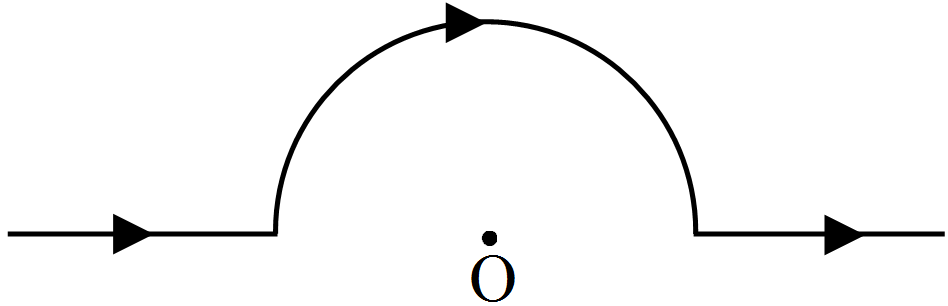
A straight wire carrying a current of 12A is bent into a semi-circular arc of radius 2.0cm as shown. What is the magnetic field at O due to:

  1. Straight segments.
  2. The semi-circular arc?

The drift current in a reverse-biased p-n junction increases in magnitude if the temperatu,re of the junction is increased. Explain this on the basis of creation of hole-electron pairs.
A compound microscope uses an objective lens of focal length 4 cm and eyepiece lens of focal length 10 cm. An object is placed at 6 cm from the objective lens. Calculate the magnifying power of the compound microscope. Also calculate the length of the microscope.
State briefly the underlying principle of a transistor oscillator. Draw a circuit diagram showing how the feedback is accomplished by inductive coupling. Explain the oscillator action.
Half life of $^{238}\text{U}_{92}$against$\alpha$ decay is $4.5 \times 10^{9}$years. Calculate the activity of Ig sample of$^{238}\text{U}_{92}$? Given Avogadro's number $= 6 \times 10^{26}$atoms/kmol.
A straight wire of length l can slide on two parallel plastic rails kept in a horizontal plane with a separation d. The coefficient of friction between the wire and the rails is $\mu.$ If the wire carries a current i, what minimum magnetic field should exist in the space in order to slide the wire on the rails?