MCQ
When an object gets negatively charged by the process of friction then:
  • A
    The object loses some electrons.
  • B
    The object loses some protons.
  • The object gains some electrons.
  • D
    The object gains some protons.

Answer

Correct option: C.
The object gains some electrons.
During a charging by rubbing $($or by friction$)$ process, the material that becomes negatively charged does so because it simply likes or gain electrons more than the material with which it is rubbed. The conductive abilities of the two materials has nothing to do with the subsequent result of the rubbing process.

Need a full question paper?

Generate a complete, print-ready paper with questions like this in minutes — across 16+ boards, with answer keys.
Start Generating Free

Similar questions

Which hormone is secreted by adrenal glands?
Which of the following statement is or are incorrect?
The frictional force exerted by fluids is also known as
Fill in the blanks with the most appropriate option.
$i.\ 'W'$ is very reactive metal, reacts vigorously with oxygen and water therefore, stored in $.......(1).......$.
$ii.\ 'X'$ is non-metal, soft and dull and forms $.......(2).......$. oxides with oxygen.
$iii.\ 'Y'$ is very reactive $.......(3).......$. catches fire if exposed to air, therefore, stored in water.
$iv.\ 'Z'$ does not react with dilute hydrochloric acid even on heating but it reacts with sulphuric acid. When it is exposed to moist air for long, it acquires a dull $.......(4).......$. coating.
The functional unit of life is called.
Which of the following statements is/ are correct$?$
$I.$ Most synthetic fibres are obtained from coal, petroleum and natural gas.
$II.$ Acrylic fibres closely resemble wool.
$III.$ Most synthetic fibres have very high moisture absorbing capacity.
$IV.$ Polyester is prepared from cellulose.
Which of the following tables correctly matches the given zones of a candle flame with their respective characteristics?
Which of the following is used for making terylene fibres?
The material similar to silk in appearance is:
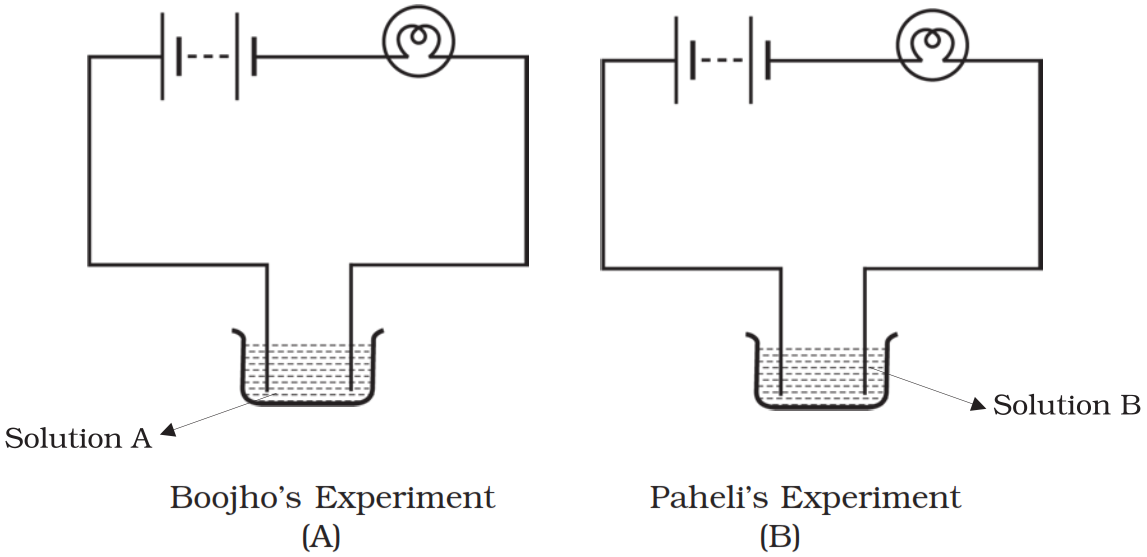
Boojho and Paheli performed experiments taking similar bulbs and cells but two different solutions $A$ and $B$ as shown in Figure.

They found that the bulb in the setup $A$ glows more brightly as compared to that of the setup $B.$ You would conclude that: