MCQ
When an object is in equilibrium state, then
  • A
    It must be at rest
  • B
    No force is acting on it
  • Its net acceleration must be zero
  • D
    All of these

Answer

Correct option: C.
Its net acceleration must be zero
c
(c)

Equilibrium $\Rightarrow \vec{F}_{\text {net }}=0$

Using Newton's second law, $\vec{a}=0$

Need a full question paper?

Generate a complete, print-ready paper with questions like this in minutes — across 16+ boards, with answer keys.

Start Generating Free

Similar questions

A body of mass $‘m’$ is dropped from a height of $‘h’$. Simultaneously another body of mass $2m$ is thrown up vertically with such a velocity $v$ that they collide at the height $h/2$. If the collision is perfectly inelastic, the velocity at the time of collision with the ground will be :
An aeroplane is to go along straight line from $A$ to $B$, and back again. The relative speed with respect to wind is $V$. The wind blows perpendicular to line $AB$ with speed $v$. The distance between $A$ and $B$ is $\ell $. The total time for the round trip is
First law of thermnodynamics is given by
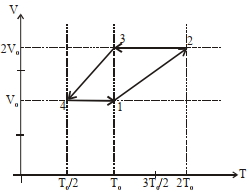
One mole of a monoatomic ideal gas goes through a thermodynamic cycle, as shown in the volume versus temperature ($V-T$) diagram. The correct statement($s$) is/are :

[ $R$ is the gas constant]

$(1)$ Work done in this thermodynamic cycle $(1 \rightarrow 2 \rightarrow 3 \rightarrow 4 \rightarrow 1)$ is $| W |=\frac{1}{2} RT _0$

$(2)$ The ratio of heat transfer during processes $1 \rightarrow 2$ and $2 \rightarrow 3$ is $\left|\frac{ Q _{1 \rightarrow 2}}{ Q _{2 \rightarrow 3}}\right|=\frac{5}{3}$

$(3)$ The above thermodynamic cycle exhibits only isochoric and adiabatic processes.

$(4)$ The ratio of heat transfer during processes $1 \rightarrow 2$ and $3 \rightarrow 4$ is $\left|\frac{Q_{U \rightarrow 2}}{Q_{3 \rightarrow 4}}\right|=\frac{1}{2}$
Air is pumped into a balloon, of initial volume $V$ , until its diameter has doubled. If the atmospheric pressure is $p$ , what is the work done against the atmosphere ? 
A hollow sphere of mass $1 \,kg$ and radius $10 \,cm$ is free to rotate about its diameter. If a force of $30 \,N$ is applied tangentially to it, its angular acceleration is (in $rad / s ^2$ )
The dimensions of $C{V^2}$ matches with the dimensions of
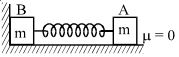
The block $A$ is pushed towards the wall by a distance and released. The normal reaction by vertical wall on the block $B$ $v/s$ compression in spring is given by :
The displacement $x$ of a particle depend on time $t$ as $x = \alpha {t^{^2}} - \beta {t^3}$ 
A particle is executing $S.H.M.$ If its amplitude is $2 \,m$ and periodic time $2$ seconds, then the maximum velocity of the particle will be