Question
When and how does placenta develop in human female?

Answer

Placenta develops after implantation of embryo in human female in the uterus. After implantation, finger-like projections called chorionic villi are surrounded by the uterine tissue and maternal blood. The chorionic villi and uterine tissue become interdigitated with each other and together form a structural and functional unit between developing embryo and maternal body called placenta.

Need a full question paper?

Generate a complete, print-ready paper with questions like this in minutes — across 16+ boards, with answer keys.
Start Generating Free

Similar questions

Explain the steps involved in the elongation of polypeptide chain during its synthesis.
Unless the vector and source DNAs are cut, fragments separated and joined, the desired recombinant vector molecules cannot be created.
  1. How are the desired DNA sequences cut?
  2. Explain the technique used to separate the cut fragments.
  3. How are the resultant fragments joined to the vector molecule?
Do you think that friends can influence one to take alcohol/ drugs? If yes, how may one protect himself/ herself from such an influence?
Answer the following questions:
Differentiate between gametogenesis in human males and females on the basis of:
  1. Time of initiation of the process.
  2. Products formed at the end of the process.
  1. State the law of independent assortment.
  2. Using Punnett Square demonstrate the law of independent assortment in a dihybrid cross involving two heterozygous parents.
Answer the following questions:
Draw a sectional view of human ovary and label the different follicular stages, ovum and corpus luteum.
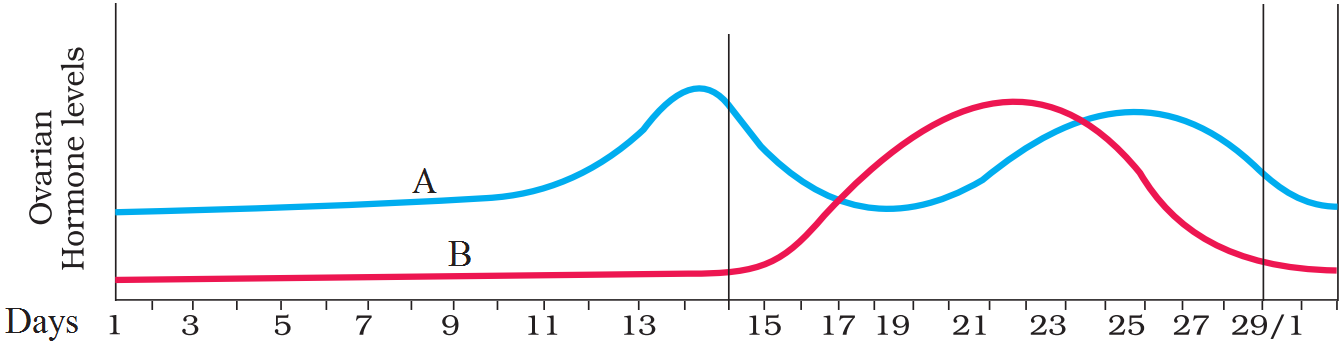
The graph given below shows the variation in the levels of ovarian hormones during various phases of menstrual cycle:

Identify ‘A’ and ‘B’.

With a neat, labelled diagram, describe the parts of a typical angiosperm ovule.
  1. Differentiate between repetitive and satellite DNA.
  2. How can satellite DNA be isolated? Explain.
  3. List two forensic application of this technology.
Answer the following questions:
Draw a diagrammatic sectional view of a human seminiferous tubule, and label Sertoli cells, primary spermatocyte, spermatogonium and spermatozoa in it.