MCQ
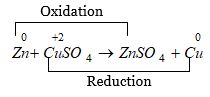
When $Cu$ or $Zn$ added to $CuSO_4$ we get $Cu$ .It is due to
  • A
    Oxidation of $C{u^{ + 2}}$
  • Reduction of $C{u^{ + 2}}$
  • C
    Hydrolysis of $CuS{O_4}$
  • D
    Ionization of $CuS{O_4}$

Answer

Correct option: B.
Reduction of $C{u^{ + 2}}$
(b)In this reaction $C{u^{2 + }}$ change in $C{u^o}$, hence it is called as reduction reaction.

Need a full question paper?

Generate a complete, print-ready paper with questions like this in minutes — across 16+ boards, with answer keys.

Start Generating Free

Similar questions

The colour of light absorbed by an aqueous solution of $CuSO _4$ is :
Chloropicrin is manufactured by the reaction between $C{l_2},\,\,NaOH$ and
The structure of diborane $({B_2}{H_6})$ contains
(image) $\xrightarrow{{Cr{O_3}}}A\xrightarrow[{{H^ \oplus }/{H_2}O}]{{C{H_3}MgBr}}B\xrightarrow[\Delta ]{{{H_2}S{O_4}}}C\xrightarrow[{{H_2}{O_2},O{H^\Theta }}]{{{B_2}{H_6}}}D$
Among the statements $(I - IV),$ the correct ones are:

$(I)$ $Be$ has smaller atomic radius compared to $Mg$

$(II)$ $Be$ has higher ionization enthalpy than $Al.$

$(III)$ Charge/radius ratio of $Be$ is greater than that of $Al$.

$(IV)$ Both Be and $Al$ form mainly covalent compounds.

Solution $A, B$ and $C$ of the same strong electrolyte offered resistances of $50\ \Omega $ , $100\ \Omega $ and $150\ \Omega $ in given conductivity cell. The resistance observed if they are mixed in a volume proportion which is reciprocal of their resistances and tested in the same conductivity cell would be ............. $\Omega $
Which of the following spin para magnetic complex show geometrical and optical isomerism
For the reaction, $PC{l_{3(g)}}$ $+$ $C{l_{2(g)}}$ $\rightleftharpoons$ $PC{l_{5(g)}}$, the value of ${K_c}$ at $250\,^oC$ is $ 26$. The value of ${K_p}$ at this temperature will be
Two oxides of nitrogen, $NO$ and $NO_2$ are allowed to react together at $243\,^o K$ and form a coloured compound of nitrogen $(X)$ . When compound $(X)$ reacts with water to yield another compound of nitrogen $(Y)$. The shape of the anion of $(Y)$ molecule is
Consider the given reaction

$RCOOAg \xrightarrow{{B{r_2}/\Delta }} R-Br$

which one of the following acid will give maximum yield of $R-Br$ in the above reaction?