When equal current is passed through two coils, equal magnetic field is produced at their centres. If the ratio of number of turns in the coils is $8: 15$, then the ratio of their radii will be
Easy


Download our appand get started for free
Experience the future of education. Simply download our apps or reach out to us for more information. Let's shape the future of learning together!No signup needed.*
Similar Questions
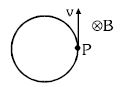
- 1A particle having charge of $10\,\mu C$ and $1\,\mu g$ mass moves along circular path of $10\, cm$ radius in the effect of uniform magnetic field of $0.1\, T$. When charge is at point $'P'$, a uniform electric field applied in the region so charge moves tangentially with constant speed. The value of electric field is......$V/m$View Solution
- 2A uniform magnetic field $B$ is acting from south to north and is of magnitude $1.5$ $Wb/{m^2}$. If a proton having mass $ = 1.7 \times {10^{ - 27}}\,kg$ and charge $ = 1.6 \times {10^{ - 19}}\,C$ moves in this field vertically downwards with energy $5\, MeV$, then the force acting on it will beView Solution
- 3An electron moving in a circular orbit of radius $r$ makes $n$ rotations per second. The magnetic field produced at the centre has magnitudeView Solution
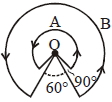
- 4A wire $A$, bent in the shape of an arc of a circle, carrying a current of $2\, A$ and having radius $2\, cm$ and another wire $B ,$ also bent in the shape of arc of a circle, carrying a current of $3\, A$ and having radius of $4\, cm ,$ are placed as shown in the figure. The ratio of the magnetic fields due to the wires $A$ and $B$ at the common centre $O$ isView Solution
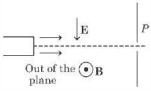
- 5A collimated beam of charged and uncharged particles is directed towards a hole marked $P$ on a screen as shown below. If the electric and magnetic fields as indicated below are turned $ON$View Solution
- 6View SolutionTwo parallel wires are carrying electric currents of equal magnitude and in the same direction. They exert
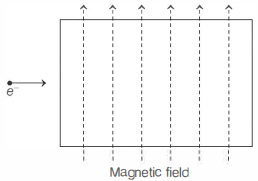
- 7View SolutionAn electron enters a chamber in which a uniform magnetic field is present as shown below. An electric field of appropriate magnitude is also applied, so that the electron travels undeviated without any change in its speed through the chamber. We are ignoring gravity. Then, the direction of the electric field is
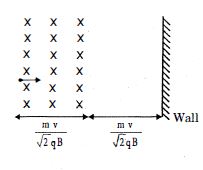
- 8A particle of mass $m$ and charge $q$ enters a region of magnetic field (as shown) with speed $v$. There is a region in which the magnetic field is absent, as shown. The particle after entering the region collides elas tically with a rigid wall. Time after which the velocity of particle becomes anti parallel to its initial velocity isView Solution
- 9When a current of $5\ mA$ is passed through a galvanometer having a coil of resistance $15\ \Omega$, it shows full scale deflection. The value of the resistance to be put in series with the galvanometer to convert it into to voltmeter of range $0 - 10\ V$ isView Solution
- 10An $\alpha -$ particle of $1\,MeV$ energy moves on circular path in uniform magnetic field. Then kinetic energy of proton in same magnetic field for circular path of double radius is......$MeV$View Solution