MCQ
When formic acid reacts with $PC{l_5}$ it forms
  • Formyl chloride
  • B
    Acetyl chloride
  • C
    Methyl chloride
  • D
    Propionyl chloride

Answer

Correct option: A.
Formyl chloride
a
(a)$\mathop {HCOOH}\limits_{{\rm{Formic\, acid}}} + PC{l_5} \to \mathop {HCOCl}\limits_{{\rm{Formyl \,chloride}}} + POC{l_3} + HCl$

Need a full question paper?

Generate a complete, print-ready paper with questions like this in minutes — across 16+ boards, with answer keys.

Start Generating Free

Similar questions

Complexes $\left(\mathrm{ML}_{5}\right)$ of metals $\mathrm{Ni}$ and $Fe$ have ideal square pyramidal and trigonal bipyramidal grometries, respectively. The sum of the $90^{\circ}, 120^{\circ}$ and $180^{\circ}\;\; \mathrm{L}-\mathrm{M}- \mathrm{L}$ angles in the two complexes is
$\underset{{{S}^{o}}(298\,K)\,{{K}^{-1}}\,mo{{l}^{-1}}}{\mathop{{{H}^{+}}(aq)}}\,+\underset{-10.7}{\mathop{O{{H}^{-}}(aq)}}\,\xrightarrow{{}}\underset{+70}{\mathop{{{H}_{2}}O(l)}}\,$

Standard entropy change for the above reaction is .....$J\,{K^{ - 1}}\,mo{l^{ - 1}}$

An element with electronic configuration $[Rn]\, 7s^2\,5f^3\,6d^1$ will fall in
Which of the following is not a fat soluble vitamin?
Which occurs in nature in free state
In compound $A$, $1.00 \,g$ nitrogen unites with $0.57 \,g$ oxygen. In compound $B$, $2.00 \,g$ nitrogen combines with $2.24\, g$ oxygen. In compound $C$,  $3.00 \,g$ nitrogen combines with $5.11\, g$ oxygen. These results obey the following law
The correct order of increasing $s$ -character (in percentage) in the hybrid orbitals of following molecules ions is :-
$(I)$ $CO_3^{2-}$                  $(II)$ $XeF_4$
$(III)$ $I_3^-$                       $(IV)$ $NCl_3$
$(V)$ $BeCl_2$
A mixture of $H_2$ and sufficient quantity of air at $25\,^oC$ aild $1\ atm$ pressure undergoes complete combustion in a closed rigid adiabatic container leaving behind $H_2O(g)$ and $N_2(g)$. If air is a mixture of $80\% N_2$ and $20\%O_2$ by volume and $C_{P(N_2 )}$ and $C_{P(H_2O)g}$ are $7.0$ and $8.0\  cal-deg^{- 1}\  mol^{-1}$ respectively. What will be max imum temperature attained ?

( Given that : ${\left( {\Delta {H^o}_f} \right)_{{H_2}O(g)}} =  - 56.0\,\,kcal/mol$ and it is independnet of temperature).......$ K$ 

$2.1 \,g $ of $ Fe$  combines with $S$  evolving $ 3.77 \,kJ$. The heat of formation of $FeS$ in $kJ/mol $ is
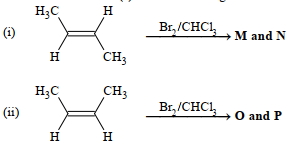
The correct statement(s) for the following addition reactions is(are)

(IMAGE)

$[A]$ ( $M$ and $O)$ and ( $N$ and $P$ ) are two pairs of diastereomers

$[B]$ Bromination proceeds through trans-addition in both the reactions

$[C]$ $O$ and $P$ are identical molecules

$[D]$ (M and $O)$ and ( $N$ and $P)$ are two pairs of enantiomers