MCQ
When glycerol is heated with $KHS{O_4}$ it gives
  • A
    $C{H_2} = CH - C{H_3}$
  • B
    $C{H_2} = CH - C{H_2}OH$
  • $C{H_2} = CH - CHO$
  • D
    $C{H_2} = C = C{H_2}$

Answer

Correct option: C.
$C{H_2} = CH - CHO$
c
$\underset{Glycerol}{\mathop{\begin{matrix}
   \begin{matrix}
   \begin{matrix}
   H  \\
   |  \\
   \,\,\,\,H-C-OH  \\
\end{matrix}  \\
   |  \\
   HO-C-H\,\,\,\,  \\
   |  \\
\end{matrix}  \\
   H-C-H  \\
   |  \\
   \,\,\,\,\,OH  \\
\end{matrix}}}$  $\xrightarrow{KHS{{O}_{4}}}$  $\underset{Unstable}{\mathop{\begin{matrix}
   \begin{matrix}
   \begin{matrix}
   \,\,\,H\,\,\,\,\,\,\,  \\
   \,\,\,|\,\,\,\,\,\,\,  \\
   H-C\,\,\,\,\,\,\,\,\,\,\,\,\,\,\,\,\,  \\
\end{matrix}  \\
  \,\, \,||\,\,\,\,\,\,\,\,\,  \\
   \,\,C\,\,\,\,\,\,\,\,\,  \\
   |\,\,\,\,\,\,\,\,\,  \\
\end{matrix}  \\
   \,\,\,\,C-H  \\
   |\,\,\,\,\,\,\,\,\,\,  \\
   OH\,\,\,\,  \\ 
\end{matrix}}}\,$  $\to $ $\underset{Unstable}{\mathop{\begin{matrix}
   \begin{matrix}
   \begin{matrix}
   \,\,\,H\,\,\,\,\,\,\,  \\
   \,\,\,|\,\,\,\,\,\,\,  \\
   H-C\,\,\,\,\,\,\,\,\,\,\,\,\,\,\,\,\,  \\
\end{matrix}  \\
   \,\,\,||\,\,\,\,\,\,\,\,\,  \\
   \,\,\,\,\,\,\,\,\,\,\,\,\,\,\,C-H\,\,\,\,\,\,\,\,\,  \\
  \,\,\,||\,\,\,\,\,\,\,\,\,  \\
\end{matrix}  \\
   \,\,\,\,\,C-H  \\
   \,\,\,||\,\,\,\,\,\,\,\,\,\,  \\
   \,\,O\,\,\,\,\,\,\,\,\,\,  \\
\end{matrix}}}\,$  Or  $\underset{Acrolein}{\mathop{\begin{matrix}
   \begin{matrix}
   C{{H}_{2}}\,\,  \\
   ||\,\,\,\,\,\,\,\,\,  \\
\end{matrix}  \\
   CH\,\,\,\,  \\
   |\,\,\,\,\,\,\,\,\,  \\
   CHO  \\
\end{matrix}}}\,$

Need a full question paper?

Generate a complete, print-ready paper with questions like this in minutes — across 16+ boards, with answer keys.

Start Generating Free

Similar questions

Total stereo isomers of the complex 

${{\text{[Fe(F)(Cl)(Br)(I)(N}}{{\text{H}}_3}{\text{)(}}{{\text{H}}_2}{\text{O)]}}^\Theta }$
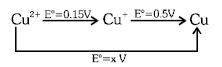
The value of $x$ from the given data is
The number of complexes from the following with no electrons in the $t_2$ orbital is. . . . . . . $\mathrm{TiCl}_4,\left[\mathrm{MnO}_4\right]^{-},\left[\mathrm{FeO}_4\right]^{2-},\left[\mathrm{FeCl}_4\right]^{-},\left[\mathrm{CoCl}_4\right]^{2-}$
For the first order reaction $A \rightarrow B$ Br the half life is $30\,mm$. The time taken for $75 \%$ completion of the reaction is $.....mm$. (Nearest mteger)

Given : $\log 2=0.3010$

$\log 3=0.4771$

$\log 5=0.6989$

Find the solubility product of a saturated solution of $Ag_2CrO_4$ in water at $298\, K$ , if the emf of the cell $Ag | Ag^+ (satd. Ag_2CrO_4$ solution) $|| Ag^+(0.1\,M) | Ag$ is $0.591\,V$ , at $298\, K$.
Prussian blue is due to the formation of
Which of the following is not correct reason for the substantially lower rate of reaction than the collision frequency?
For a first order reaction, the half-life period is independent of
Which acid can be oxidised be Fehling solution:
The given reaction

$\begin{array}{*{20}{c}}
  \,\,\,{{C_2}{H_5}} \\ 
  {|\,\,\,\,\,\,\,} \\ 
  {C{H_3} - C - COOH} \\ 
  {|\,\,\,\,\,\,} \\ 
  \,\,\,{{C_3}{H_7}} 
\end{array}\xrightarrow{{{N_3}H/Conc.\,{H_2}S{O_4}}}\begin{array}{*{20}{c}}
 \,\,\,\,\,\,\,\,\,{{C_2}{H_5}} \\ 
  | \\ 
  {C{H_3} - C - N{H_2}} \\ 
  | \\ 
  \,\,\,\,\,\,\,\,\,{{C_3}{H_7}} 
\end{array}$

is called :