MCQ
When heat in given to a gas in an isobaric process, then
  • A
    The work is done by the gas
  • B
    Internal energy of the gas increases
  • Both $ (a)$ and $(b)$
  • D
    None from $(a)$ and $(b)$

Answer

Correct option: C.
Both $ (a)$ and $(b)$
c
(c)When heat is supplied at constant pressure, a part of it goes in the expansion of gas and remaining part is used to increase the temperature of the gas which in turn increases the internal energy.

Need a full question paper?

Generate a complete, print-ready paper with questions like this in minutes — across 16+ boards, with answer keys.
Start Generating Free

Similar questions

The colour of the second line of Balmer series is
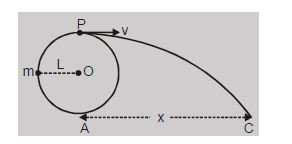
A body tied to a string of length  $L$  is revolved in a vertical circle with minimum velocity, when the body reaches the upper most point the string breaks and the body moves under the influence of the gravitational field of earth along a parabolic path. The horizontal range  $AC$  of the body will be
If the nuclear force between two protons, two neutrons and between proton and neutron is denoted by $F _{p p}, F _{n n}$ and $F _{p n}$ respectively, then
Boiling water is changing into steam. Under this condition, the specific heat of water is
A concrete sphere of radius $R$  has a cavity of radius $ r$  which is packed with sawdust. The specific gravities of concrete and sawdust are respectively $2.4$  and $0.3$  for this sphere to float with its entire volume submerged under water. Ratio of mass of concrete to mass of sawdust will be
Four point charges, each of $+ q$, are rigidly fixed at the four corners of a square planar soap film of side ' $a$ ' The surface tension of the soap film is $\gamma$. The system of charges and planar film are in equilibrium, and $a=k\left[\frac{q^2}{\gamma}\right]^{1 / N}$, where ' $k$ ' is a constant. Then $N$ is
Escape velocity on a planet is ${v_e}$. If radius of the planet remains same and mass becomes 4 times, the escape velocity becomes
An infinite number of electric charges each equal to $5\, nC$ (magnitude) are placed along $X$-axis at $x = 1$ $cm$, $x = 2$ $cm$ , $x = 4$ $cm$ $x = 8$ $cm$ ………. and so on. In the setup if the consecutive charges have opposite sign, then the electric field in Newton/Coulomb at $x = 0$ is $\left( {\frac{1}{{4\pi {\varepsilon _0}}} = 9 \times {{10}^9}\,N - {m^2}/{c^2}} \right)$
In a circuit $L,\,C{\rm{ and }}R$are connected in series with an alternating voltage source of frequency $f$. The current leads the voltage by $45^o$. The value of $C$ is
A particle moves in the $xy$ plane with a constant acceleration $'g'$ in the negative $y$-direction. Its equation of motion is $y = ax-bx^2$, where $a$ and $b$ are constants. Which of the following are correct?