MCQ
When light falls on matter, it can produce:
  • A
    Mechanical effect
  • B
    Chemical effect
  • C
    Heating effect
  • All the above

Answer

Correct option: D.
All the above

since photons have momentum and energy, they can produce all the three stated effects.

Need a full question paper?

Generate a complete, print-ready paper with questions like this in minutes — across 16+ boards, with answer keys.
Start Generating Free

Similar questions

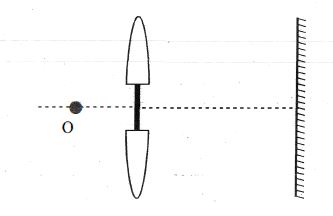
Consider the figure (not drawn on scale) in which a converging lens of $R = 1\ cm$ and focal length $f = 20\ cm$ is cut in the middle. The Upper part is lifted up by $d = 1\ mm$ and lower part is pulled down by same distance. The gap between them is blocked by an opaque sheet. A point light source with wavelength $\lambda = 500\ nm$ is placed on the optical axis at $2f$ distance from the split lens. A large screen is placed at $L = 1\ m$ from right focus of Find the approximate number interference fringes on screen
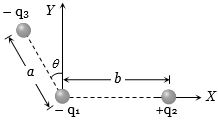
Three charges $ - {q_1},\,\, + {q_2}$ and $ - {q_3}$ are placed as shown in the figure. The $x$-component of the force on $ - {q_1}$ is proportional to
A radioactive sample is undergoing $\alpha$ decay. At any time $t_{1}$, its activity is $A$ and another time $t _{2}$, the activity is $\frac{ A }{5}$. What is the average life time for the sample?
Assertion : The stars twinkle while the planets do not.

Reason : The stars are much bigger in size than the planets.
In hydrogen spectrum the wavelength of $H _\alpha$ line is 656 nm whereas in the spectrum of a distant galaxy, $H _\alpha$ line wavelength is 706 nm . Estimated speed of the galaxy with respect to earth is
A ray of light is incident on one face of a transparent slab of thickness $15 \,cm$. The angle of incidence is $60^o$. If the lateral displacement of the ray on emerging from the parallel plane is $5$ index of the material of the slab is
If $m$ is mass of electron, $v$ its velocity, $r$ the radius of stationary circular orbit around a nucleus with charge $Ze$, then from Bohr's first postulate, the kinetic energy $K = \frac{1}{2}m{v^2}$of the electron in $C.G.S.$ system is equal to
A wire length $2\,m$ carrying a current of $1\,A$ is bent to form a circle. The magnetic moment of the coil is
A nucleus $_Z{X^A}$ emits $3 \alpha$ - particles and $5 \beta$ particle. The ratio of total neutrons and protons in the final nucleus is
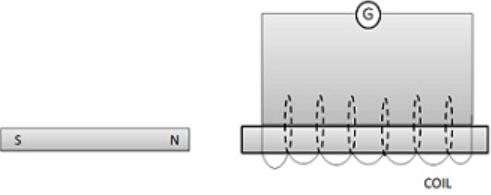
Refer to the figure. When does the the galvanometer $(G)$ deflect?
Image