Question
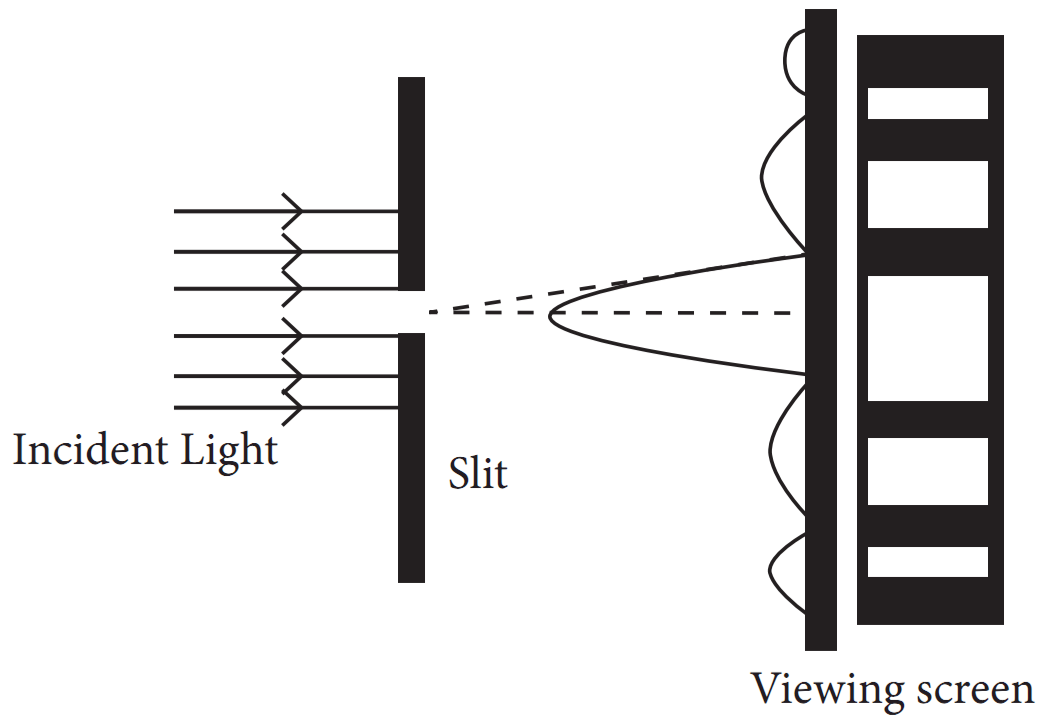
When light from a monochromatic source is incident on a single narrow slit, it gets diffracted and a pattern of ahem ate bright and dark fringes is obtained on screen, called "Diffraction Pattern" of single slit. ln diffraction pattern of single slit, it is found that.

  1. Central bright fringe is of maximum intensity and the intensity of any secondary bright fringe decreases with increase in its order.
  2. Central bright fringe is twice as wide as any other secondary bright or dark fringe.
  1. A single slit of width 0.1mm is illuminated by a parallel beam oftight of wavelength $6000\mathring{\text{A}}$ and diffraction bands are observed on a screen 0.5m from the slit. The distance of the third dark band from the central bright band is:

  1. 3mm
  2. 1.5mm
  3. 9mm
  4. 4.5mm
  1. ln Fraunhofer diffraction pattern, slit width is 0.2mm and screen is at 2m away from the lens. If wavelength of tight used is $5000\mathring{\text{A}}$ then the distance between the first minimum on either side the central maximum is:
  1. 10-1m
  2. 10-2m
  3. 2 × 10⁻²m
  4. 2 × 10⁻¹m
  1. Light of wavelength 600nm is incident normally on a slit of width 0.2mm. The angular width of central maxima in the diffraction pattern is (measured from minimum to minimum).
  1. 6 × 10⁻³rad
  2. 4 × 10⁻³rad
  3. 2.4 × 10⁻³rad
  4. 4.5 × 10⁻³rad
  1. A diffraction pattem is obtained by using a beam of red light. What will happen, if the red light is replaced by the blue light?
  1. Bands disappear
  2. Bands become broader and farther apart
  3. No change will take place
  4. Diffraction bands become narrower and crowded together.
  1. To observe diffraction, the size of the obstacle.
  1. Should be $\frac{\lambda}{2}$, where $\lambda$, is the wavelength.

  2. Should be of the order of wavelength.
  3. Has no relation to wavelength.
  4. Should be much larger than the wavelength.
Answer

  1. (c) 9mm

Explanation:

Here, $\text{d} = 0.1 \text{mm},\lambda= 6000 \mathring{\text{A}}, \text{D}=0.5\text{m}$

For third dark band, $\text{d}\sin\theta=3\lambda\ ;\ \sin\theta=\frac{3\lambda}{\text{d}}=\frac{\text{y}}{\text{D}}$

$\text{y}=\frac{3\text{D}\lambda}{\text{d}}=\frac{3\times0.5\times6\times10^{-7}}{0.1\times10^{-3}}$

$=9\times10^{-3}\text{m}=9\text{mm}$

  1. (b) 10-2m

Explanation:

Given d = 0.2mm = 0.2 × 10⁻³m, D = 2m

$\lambda=5000\mathring{\text{A}}=5\times10^{-7}\text{m}$

The distance between the first minimum on other side of the central maximum

$\text{x}=\frac{2\lambda\text{D}}{\text{d}}=\frac{2\times5\times10^{-7}\times2}{0.2\times10^{-3}}$

$\Rightarrow\text{x}=10^{-2}\text{m}$

  1. (a) 6 × 10⁻³rad

Explanation:

Here, $\lambda=600\text{nm}=6\times10^{-7}\text{m}$

$\text{a}=0.2\text{mm}=2\times10^{-4}\text{m},\theta=?$

Angular width of central maxima,

$\theta=\frac{2\lambda}{\text{a}}=\frac{2\times6\times10^{-7}}{2\times10^{-4}}=6\times10^{-3}\text{rad}$

  1. (d) Diffraction bands become narrower and crowded together.

Explanation:

When red light is replaced by blue light $(\lambda_\text{B}<\lambda_\text{R})$ the diffraction pattern bands becomes narrow and crowded together.

  1. (b) Should be of the order of wavelength.

Explanation:

To observe diffraction, the size of the obstacle should be of the order of wavelength.

Need a full question paper?

Generate a complete, print-ready paper with questions like this in minutes — across 16+ boards, with answer keys.

Start Generating Free

Similar questions

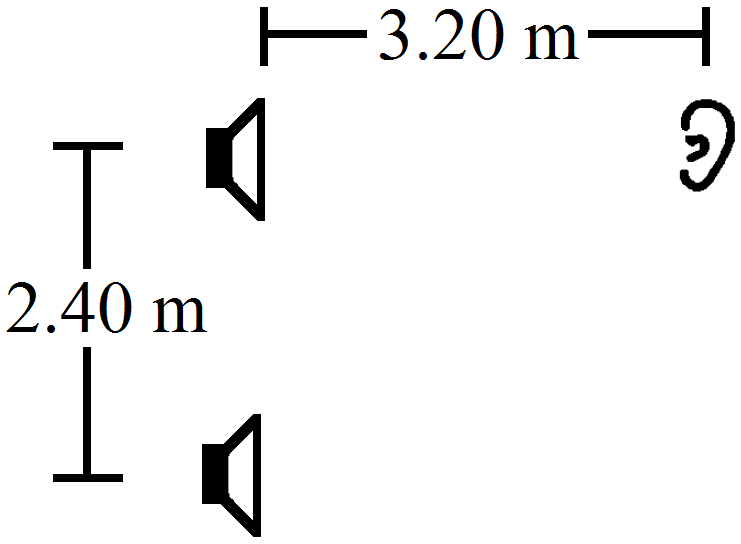
Two stereo speakers are separated by a distance of 2.40m. A person stands at a distance of 3.20m directly in front of one of the speakers as shown in figure, Find the frequencies in the audible range (20-2000Hz) for which the listener will hear a minimum sound intensity. Speed of sound in air = 320m/s.

Derive the formula for the magnetic field produced at a point on the axis of a current carrying circular loop.
If double slit apparatus is immersed in a liquid of refractive index, $\mu$ the wavelength of light reduces to $\lambda$ and fringe width also reduces to $\beta=\frac{\beta}{\mu}$.
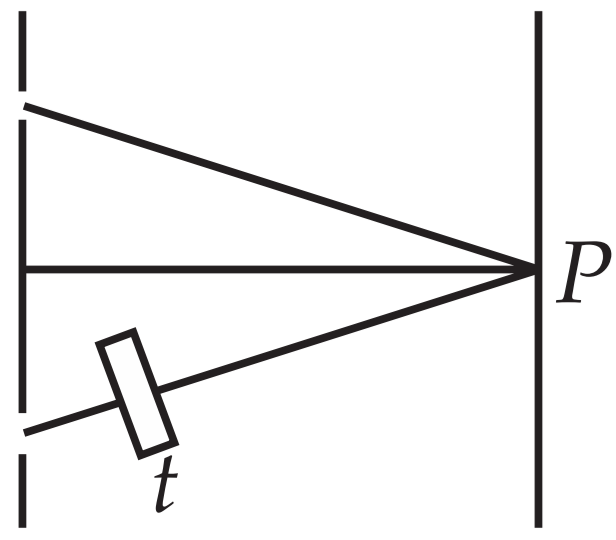
The given figure shows a double-slit experiment in which coherent monochromatic light of wavelength $\lambda$ from a distant source is incident upon the two slits, each of width $\text{w}(\text{w}>>\lambda)$ and the interference pattern is viewed on a distant screen. A thin piece of glass of thickness t and refractive index n is placed between one of the slit and the screen, perpendicular to the light path.

  1. ln Young's double slit interference pattern, the fringe width.
  1. Can be changed only by changing the wavelength of incident light.
  2. Can be changed only by changing the separation between the two slits.
  3. Can be changed either bychangingthe wavelength or by changing the separation between two sources.
  4. Is a universal constant and hence cannot be changed.
  1. If the width w ofone of the slits is increased to 2w, the become the amplitude due to slit.
  1. $1.5\text{a}$
  2. $\frac{\text{a}}{2}$
  3. $2\text{a}$
  4. No change.
  1. ln YDSE, let A and B be two slits. Films of thicknesses tA and tB and refractive indices mA and mB are placed in front of A and B, respectively. If $\mu_\text{A}\text{t}_\text{A}=\mu_\text{B}\text{t}_\text{B}$ then the central maxima will:
  1. Not shift.
  2. Shift towards A.
  3. Shift towards B.
  4. Shift towards A if tB = tA and shift towards B if tB < tA
  1. ln Young's double slit experiment, a third slit is made in between the double slits. Then:
  1. Fringes of unequal width are formed.
  2. Contrast between bright and dark fringes is reduced.
  3. Intensity of fringes totally disappears.
  4. Only bright tight is observed on the screen.
  1. ln Young's double slit experiment, if one of the slits is covered with a microscope cover slip, then:
  1. Fringe pattern disappears.
  2. The screen just gets illuminated.
  3. In the fringe pattern, the brightness of the bright fringes will decreases and the dark fringes will become more dark.
  4. Bright fringes will be more bright and dark fringes will become more dark.
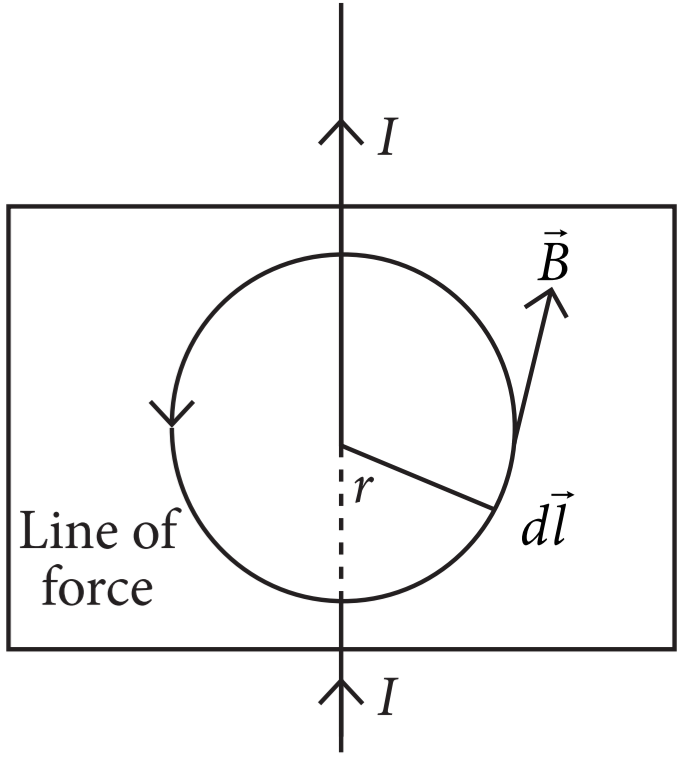
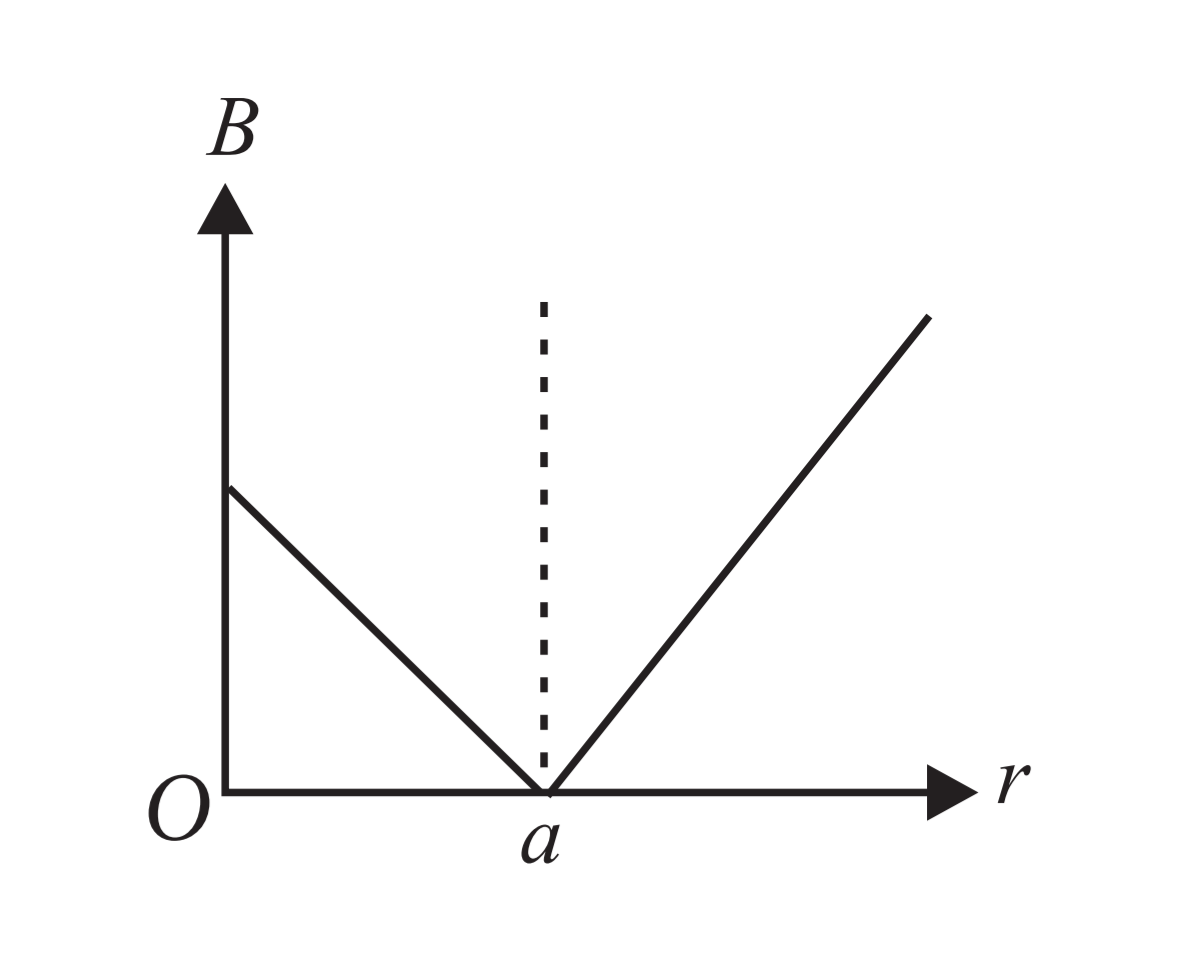
Ampere's law gives a method to calculate the magnetic field due to given current distribution. According to it, the circulation $\oint\vec{\text{B}}.\text{d}\vec{\text{l}}$ di of the resultant magnetic field along a closed plane curve is equal to $\mu_0$ times the total current crossing the area bounded by the closed curve provided the electric field inside the loop remains constant. Ampere's law is more useful under certain synunetrical conditions. Consider one such case of a long Straight wire with circular cross-section (radius R) carrying current f uniformly distributed across this cross-section.

  1. The magnetic field at a radial distance r from the centre of the wire in the region r > R, is:
  1. $\frac{\mu_0\text{I}}{2\pi\text{r}}$

  2. $\frac{\mu_0\text{I}}{2\pi\text{R}}$

  3. $\frac{\mu_0\text{IR}^2}{2\pi\text{r}}$

  4. $\frac{\mu_0\text{Ir}^2}{2\pi\text{R}}$

  1. The magnetic field at a distance r in the region r < R is:
  1. $\frac{\mu_0\text{I}}{2\text{r}}$

  2. $\frac{\mu_0\text{Ir}^2}{2\pi\text{R}^2}$

  3. $\frac{\mu_0\text{I}}{2\pi\text{r}}$

  4. $\frac{\mu_0\text{Ir}}{2\pi\text{R}^2}$

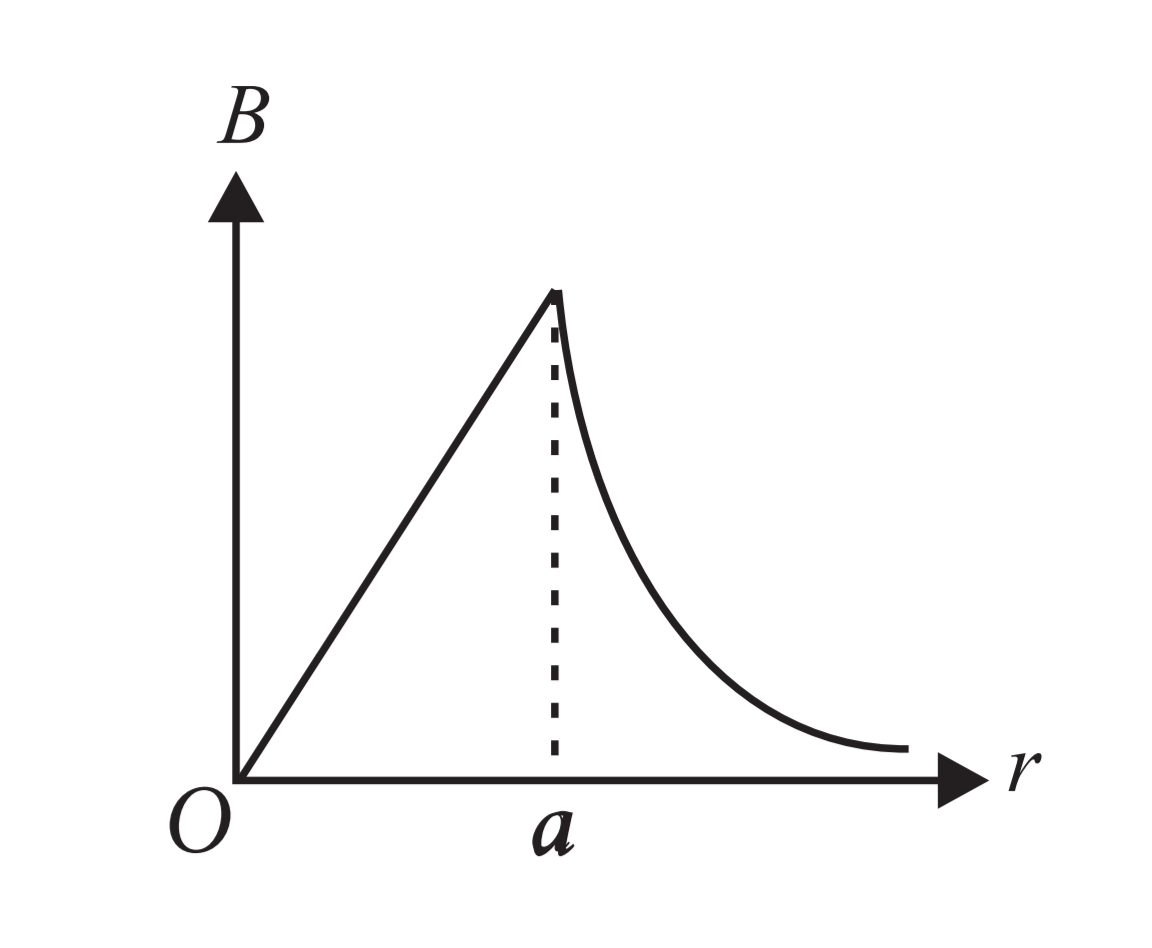
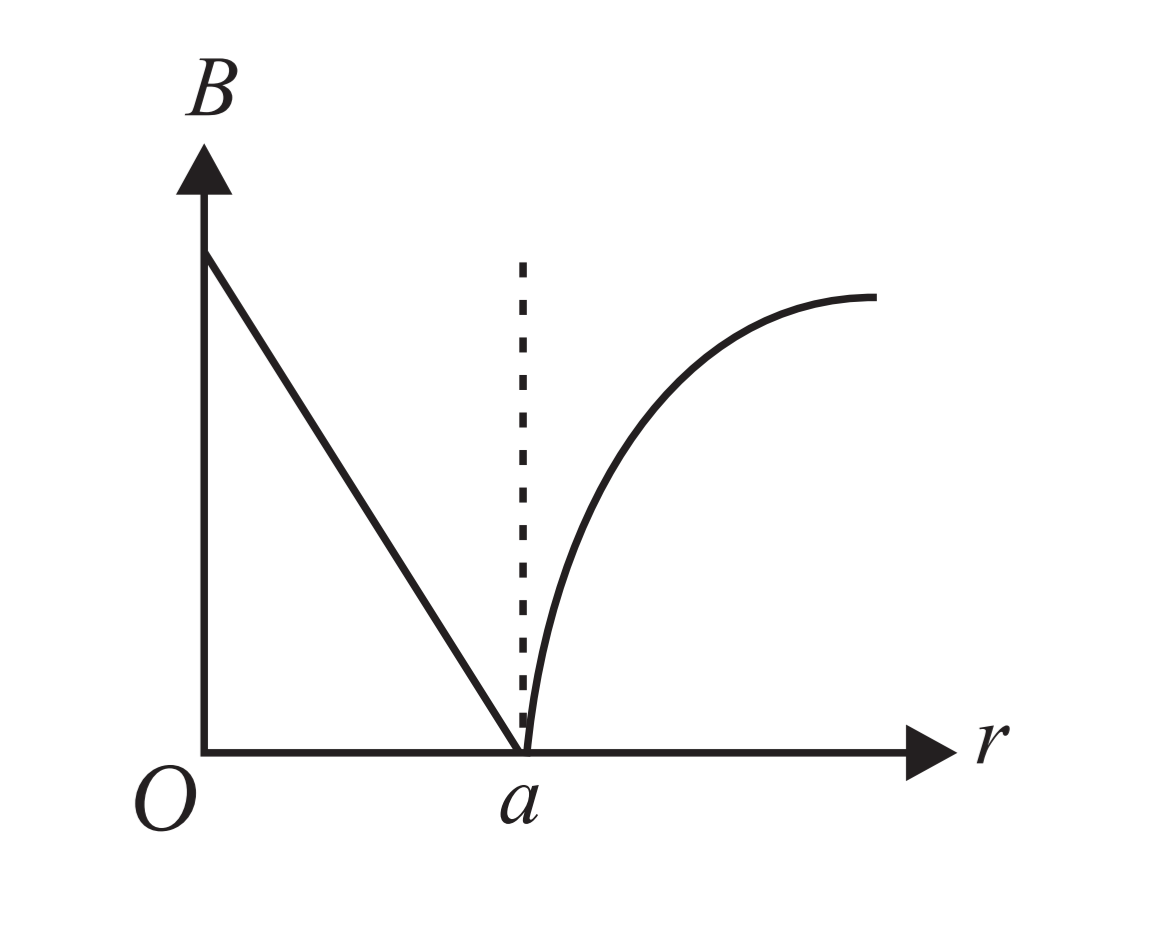
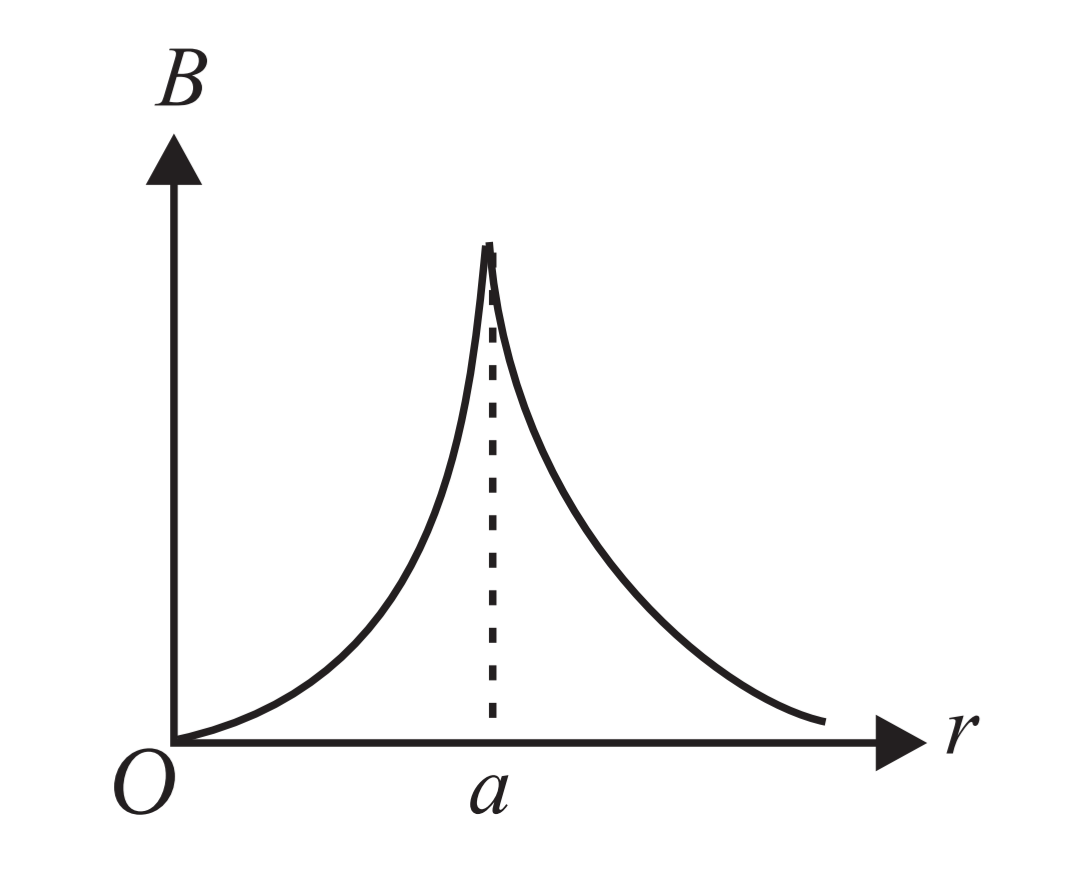
  1. A long straight wire of a circular cross section (radius a) carries a steady current I and the current I is uniformly distributed across this cross-section. Which of the following plots represents the variation of magnitude of magnetic field B with distance r from the centre of the wire?
  1.  

  1.  

  1.  

  1.  

  1. A long straight wire of radius R carries a steady current I. The current is uniformly distributed across its cross-section. The ratio of magnetic field at $\frac{\text{R}}{2}$ and 2R is:
  1. $\frac{\text{1}}{\text{2}}$

  2. $2$

  3. $\frac{\text{1}}{\text{4}}$

  4. $1$ 

  1. A direct current I flows along the length of an infinitely long straight thin walled pipe, then the magnetic field is:
  1. Uniform throughout the pipe but not zero.
  2. Zero only along the axis of the pipe.
  3. Zero at any point inside the pipe.
  4. Maximum at the centre and minimum at the edges. 
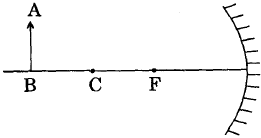
An object AB is kept in front of a concave mirror as shown in the figure.

  1. Complete the ray diagram showing the image formation of the object.
  2. How will the position and intensity of the image be affected if the lower half of the mirror's reflecting surface is painted black?
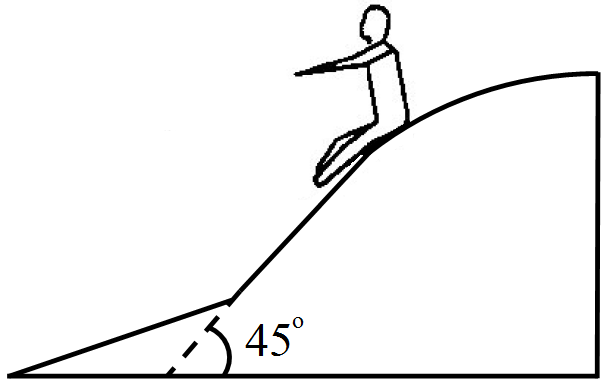
In a children-park an inclined plane is constructed with an angle of incline 45° in the middle part. Find the acceleration of a boy sliding on it if the friction coefficient between the cloth of the boy and the incline is 0.6 and g = 10m/s2.

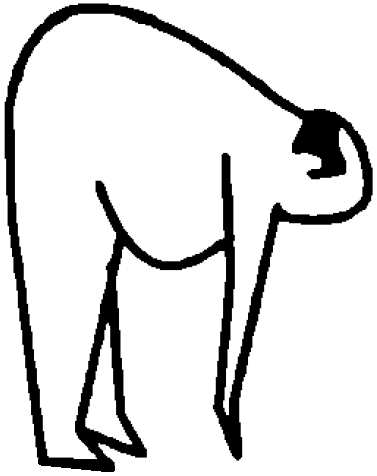
When a fat person tries to touch his toes, keeping the legs straight, he generally falls. Explain with reference to figure.

There are materials which absorb photons of shorter wavelength and emit photons of longer wavelength. Can there be stable substances which absorb photons of larger wavelength and emit light of shorter wavelength.
On a winter day, the outside temperature is 0°C and relative humidity 40%. The air from outside comes into a room and is heated to 20°C. What is the relative humidity in the room? The saturation vapour pressure at 0°C is 4.6mm of mercury and at 20°C it is 18mm of mercury.
Mr. Verma (50kg) and Mr. Mathur (60kg) are sitting at the two extremes of a 4m long boat (40kg) standing still in water. To discuss a mechanics problem, they come to the middle of the boat. Neglecting friction with water, how far does the boat move on the water during the process?