MCQ
When light is incident on a diffraction grating the zero order principal maximum will be
 
  • A
    One of the component colours
  • B
     Absent
  • C
    Spectrum of the colours
  •  White

Answer

Correct option: D.
 White
 White

Need a full question paper?

Generate a complete, print-ready paper with questions like this in minutes — across 16+ boards, with answer keys.
Start Generating Free

Similar questions

Assertion : The number of electrons in a P-type silicon semiconductor is less than the number of electrons in a pure silicon semiconductor at room temperature.
Reason : It is due to law of mass action.
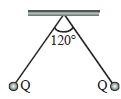
Two small spherical balls each carrying a charge $Q = 10\,\mu C$ ($10\, micro-coulomb$) are suspended by two insulating threads of equal lengths $3\, m$ each, from a point fixed in the ceiling. It is found that in equilibrium threads are separated by an angle $120^o$ between them, as shown in the figure. What is the tension in the threads (Given : $\frac{1}{{\left( {4\pi {\varepsilon _0}} \right)}} = 9 \times {10^9}\,Nm/{C^2}$)
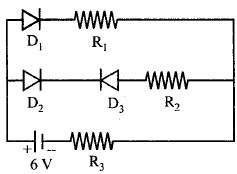
Figure shows a circuit in which three identical diodes are used . Each diode has forward resistance of $20\,\Omega $ and infinite backward resistance. Resistors $R_1 = R_2 = R_3 = 50\,\Omega.$ Battery voltage is $6\,V.$ The current through $R_3$ is.....$mA$
An electric dipole is placed at an angle of $30^\circ$ to a non-uniform electric field. The dipole will experience:
Doppler's effect in sound in addition to relative velocity between source and observer, also depends while source and observer or both are moving. Doppler effect in light depend only on the relative velocity of source and observer. The reason of this is
The true statement is, on increasing the distance between the plates of a parallel plate condenser
During negative $\beta$-decay
Light of wavelength 589.3 nm is incident normally on the slit of width 0.1 mm. What will be the angular width of the central diffraction maximum at a distance of 1 m from the slit
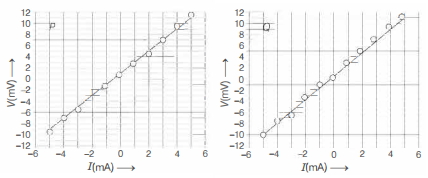
Two students $P$ and $Q$ perform an experiment to verify Ohm's law for a conductor with resistance $R$. They use a current source and a voltmeter with least counts of $0.1 mA$ and $0.1 \,mV$, respectively. The plots of the variation of voltage drop $V$ across $R$ with current $I$ for both are shown below. The statement which is most likely to be correct?
When two deuterium nuclei fuse together to form a tritium nucleus, we get a: